


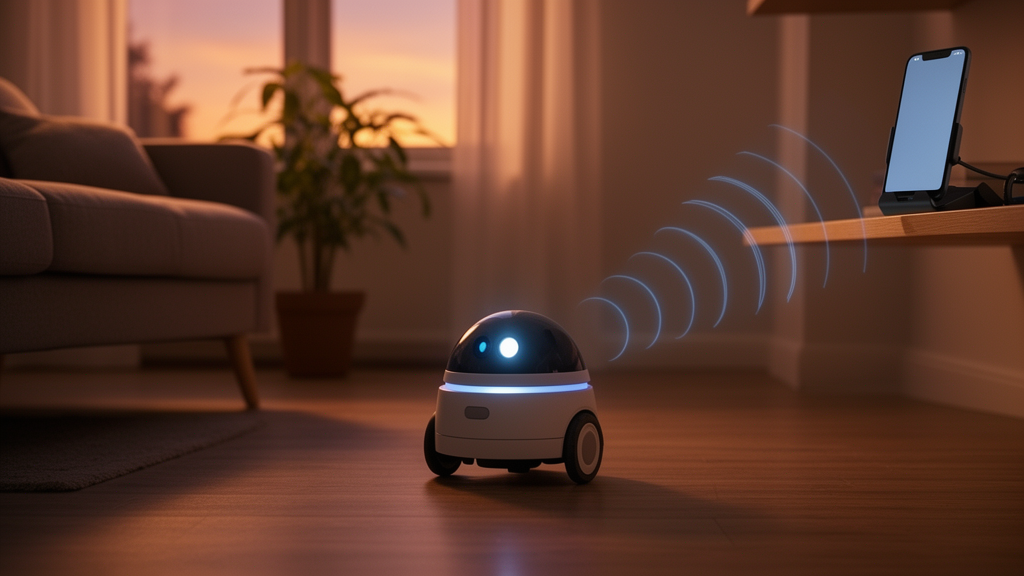
Autonomous robots that can find their way through hospitals, offices and warehouses usually depend on expensive hardware. LiDAR-based simultaneous localization and mapping, or SLAM, delivers accurate positioning indoors where GPS fails, but the specialized scanning sensors and high-performance processors it demands put it beyond the reach of low-cost embedded platforms. A team of researchers has now demonstrated a strikingly cheaper alternative: a small four-wheeled robot that homes in on a Bluetooth Low Energy beacon by reading the trend of its radio signal, recovering from obstacles and ambiguous readings along the way, and finishing the job with a camera-guided precision maneuver.
The system, described in a paper published in Discover Robotics, combines three complementary navigation modes on a single distributed embedded platform. The core contribution is a BLE RSSI-based probabilistic directional homing scheme in which raw, volatile signal-strength measurements are tamed by median filtering and exponential moving average smoothing, while a finite state machine makes navigation decisions based on how the signal is trending rather than on its instantaneous magnitude. A supporting module uses an overhead camera to detect an ArUco marker mounted on the robot and steers it along a drawn path for fine positioning near the target.
The problem the researchers set out to solve is well known to anyone who has worked with indoor radio positioning. Raw BLE received signal strength indicator values inside buildings fluctuate wildly, swinging by 5 to 8 dBm even when the robot stands still, thanks to multipath propagation from walls, scattering from furniture, wall attenuation, absorption by human bodies and vibration from the robot’s own motors. Reacting directly to each instantaneous reading produces unstable behavior: rapid turning corrections, oscillatory motion and frequent false directional decisions. Reflected BLE paths can even produce transient signal peaks in the wrong direction, causing a naive controller to steer toward a reflection rather than the beacon itself.
The team’s answer is a multi-stage signal-processing pipeline. Rather than reacting to individual BLE packets, the robot collects a window of RSSI samples during a fixed scan interval of roughly 1.5 seconds. A median filter is computed across each window, suppressing transient reflection spikes before they can trigger a state change; the researchers found that single reflected packets could shift an arithmetic mean by 4 to 6 dBm while leaving the median steady. The sequence of median estimates is then smoothed with an exponential moving average using a coefficient of 0.4, a value chosen empirically to balance stability against responsiveness to genuine signal improvement.
Crucially, the system does not attempt centimeter-level coordinate localization. Instead of estimating physical distance from RSSI magnitude, which proved unreliable because the log-distance path loss model breaks down under heavy indoor multipath, the navigation controller classifies the change in smoothed RSSI between cycles against a 2.0 dBm threshold. Improving trends allow forward motion to continue, worsening trends trigger a directional correction, plateaus prompt a slow probe and rescan, and excessive variance flags the environment as ambiguous. A four-state finite state machine, comprising Idle, Navigating, Ambiguous and Reached states, governs the robot’s behavior, with obstacle-triggered recovery, timeout-based recovery and a multi-confirmation arrival criterion built in.
When the machine enters the Ambiguous state, the robot suspends forward motion and performs a four-direction RSSI scan at the cardinal orientations of 0, 90, 180 and 270 degrees. The team initially considered an eight-direction scan at 45-degree intervals, but experimental evaluation revealed two problems: the total scan duration reached roughly 36 seconds, by which time measurements from the first orientations reflected a different environmental state, and the intermediate angles frequently coincided with multipath-induced artificial peaks that caused the controller to pick incorrect headings. The four-direction design cuts scan time to approximately 12 seconds, and a 0.6-second settling delay after each rotation lets chassis vibration die down before signal acquisition.
Accurate rotation itself depends on closed-loop control. Time-based motor turning proved unreliable because heading error varied with battery voltage, floor friction and motor imbalance, accumulating across repeated cycles. The robot’s real-time controller, a Raspberry Pi Pico, therefore integrates angular velocity measurements from an MPU6050 gyroscope during each rotation and stops only when the accumulated angle reaches the commanded target. The Pico also polls an HC-SR04 ultrasonic sensor every 50 milliseconds during forward motion, halting the robot whenever an obstacle comes within 25 centimeters and signaling the Raspberry Pi 4B navigation stack to initiate recovery. A five-second UART watchdog halts all motors if no command arrives, providing a fail-safe during communication interruptions.
The experimental validation consisted of thirteen independent indoor BLE navigation trials in a furnished corridor with plastered walls and standard office furniture, representative of an intended hospital ward deployment. In each trial the robot was placed 8 to 10 meters from a stationary ESP32 beacon broadcasting advertisements that mimic a wearable device such as a patient wristband, and tasked with homing toward it using RSSI-based navigation alone. Every trial produced a complete, timestamped JSONL event log recorded directly on the Raspberry Pi, and all thirteen runs were generated by the same firmware build, removing ambiguity about which algorithm version produced each result. All thirteen trials reached the target state.
The logs reveal a nuanced picture of how the system behaves under stress. Twenty-three obstacle events were logged across eight of the thirteen trials, and the obstacle-escape maneuver resolved twenty-two of them directly, with a median recovery duration of 6.9 seconds. Twelve full-sweep recovery events were triggered by sustained plateaus or last-resort obstacle handling, each taking a measured average of 24.5 seconds, and in every one of those twelve instances the sweep selected a heading with stronger signal than the reading that triggered it. One trial, the longest at 444.1 seconds of navigation time, escalated through a fallback recovery path after an obstacle escape failed to clear, then re-acquired the beacon signal and resumed normal navigation, demonstrating that the layered recovery design degrades gracefully rather than stalling. Notably, navigation time varied far more than the underlying homing behavior: the four trials with no obstacle events converged within a narrow time range, while the dispersion in the full dataset primarily reflects time spent recovering from obstacles rather than instability in the homing algorithm itself.
The researchers are careful about the limits of their evidence. With a 100 percent observed success rate over thirteen trials, a Wilson score interval places the true success probability at roughly 77 to 100 percent at the 95 percent confidence level, so the sample size supports a favorable point estimate but not a tight bound. All trials took place in a single environment with one beacon, and none tested a second room, a more reflective space or multiple concurrent beacons. The minus 55 dBm arrival threshold, confirmed on three consecutive cycles before the Reached state is declared, was calibrated empirically for this specific environment and hardware and would need recalibration elsewhere. No ground-truth stopping distance was recorded during the main campaign, though four preliminary verification runs afterward measured separations of 29, 30, 45 and 120 centimeters from the beacon. The ArUco vision module, evaluated separately in seven freehand trials under consistent artificial lighting, stopped within its 12-centimeter acceptance radius in four trials and marginally beyond it in three, with arrival distances ranging from 8.3 to 22.6 centimeters, and it depends on an external laptop for OpenCV processing, a constraint the authors flag as a practical limit rather than a fundamental flaw. Gyroscope drift also accumulates without continuous correction, and the ultrasonic sensor’s narrow forward cone leaves off-axis obstacles undetected. Even with those caveats, the work makes a concrete case that cheap, complementary sensing, disciplined signal processing and a well-guarded state machine can deliver dependable beacon-directed homing in real indoor conditions, without LiDAR, SLAM or pre-built maps.
Subject of Research: A low-cost hybrid indoor robot navigation system combining BLE RSSI probabilistic homing, gyroscope-assisted control and ArUco vision guidance.
Article Title: Hybrid indoor navigation with BLE RSSI probabilistic homing and vision-assisted guidance
Article References: Ray, A., Seal, P., Bucha, K., & Laskar, M. J. (2026). Hybrid indoor navigation with BLE RSSI probabilistic homing and vision-assisted guidance. Discover Robotics, 2(1), Article 27. https://doi.org/10.1007/s44430-026-00041-5
Image Credits: AI Generated
DOI: 10.1007/s44430-026-00041-5
Keywords: indoor navigation, robotics, BLE, RSSI, finite state machine, ArUco, Raspberry Pi, SLAM, obstacle recovery, embedded systems, beacon homing, gyroscope
News Source: Denise Maddox. (October 29, 2026). Low-Cost Robot Finds Its Way Indoors Using Bluetooth Signals Instead of LiDAR. Scienmag.



