Winglets, the upturned surfaces at the tips of aircraft wings, have delivered measurable aerodynamic gains in a new computational study that directly compares how the same winglet performs on two fundamentally different wing sections. Researchers Irfan Nazir Wani, Manoj Kumar and Pushpendra Kumar Shukla modeled wings built from the cambered NACA 2412 aerofoil and the symmetric NACA 0012 aerofoil, each tested with and without a winglet, and report that winglet integration increased the lift-to-drag ratio by 13.5 to 16.8 percent for the cambered wing and 12.9 to 16.2 percent for the symmetric wing at moderate angles of attack between 4 and 8 degrees. The work, published as an open access article in Discover Vehicles, is a computational study rather than a wind tunnel or flight campaign, and its conclusions are explicitly bounded by the specific geometry and flow conditions examined.
The study’s framework chained three tools together. CATIA was used to build precise geometric models of the aerofoil profiles and the winglet, MATLAB (version R2023a) performed preliminary aerodynamic analysis using thin airfoil theory, a vortex panel method with 200 panels per surface, and infinite swept wing theory, and ANSYS Fluent carried out the detailed computational fluid dynamics simulations. The simulations were run at a Reynolds number of 1.5 million, corresponding to low subsonic conditions with a Mach number of 0.088, across angles of attack from 0 to 16 degrees. The solver was pressure-based and steady-state with the SIMPLE algorithm, second-order upwind discretization, and the k-omega SST turbulence model with enhanced wall treatment. Convergence was declared when residuals for continuity, momentum and turbulence equations fell below 10 to the minus sixth.
Before trusting any performance numbers, the team verified that their results did not depend on the computational mesh. Four meshes were tested at a representative condition of 6 degrees angle of attack, with element counts rising from 1.2 million through 2.0 million and 2.8 million to 4.5 million. Differences between the fine and very fine meshes were below 1.0 percent for both lift and drag coefficients, so the 2.8 million element mesh was adopted for all subsequent runs. The average y-plus value on that mesh was 0.85, satisfying the requirement of y-plus below 1 for the turbulence model with enhanced wall treatment, meaning the near-wall boundary layer was resolved rather than bridged by wall functions alone.
The computational model was then validated against published experimental data for the clean aerofoils. The NACA 0012 predictions were checked against experiments reported by Ladson in 1988, and the NACA 2412 predictions against the classic Abbott and von Doenhoff data from 1959. Across the tested range, the maximum deviation between the simulations and the published measurements was 3.1 percent for the lift coefficient and 2.9 percent for the drag coefficient. The MATLAB implementation was separately validated against XFOIL predictions for both aerofoils, with deviations under 2.5 percent. This layered cross-checking, the authors argue, is what distinguishes their integrated approach from single-tool studies, though they note that no experimental validation of the winglet-integrated configurations themselves was performed.
The headline result concerns aerodynamic efficiency. The lift-to-drag ratio, which measures how much lift a wing generates per unit of drag it suffers, improved by roughly 15 percent when winglets were added, with the 95 percent confidence intervals placing the true improvement between 13.5 and 16.8 percent for NACA 2412 and 12.9 and 16.2 percent for NACA 0012. The improvement was most evident at higher angles of attack, where wingtip vortices contribute substantially to induced drag. Winglet integration also marginally increased the lift coefficient for both wings, with the cambered section benefiting slightly more, and the drag reduction was more pronounced in the winglet-equipped configurations for both aerofoils.
The comparison between the two aerofoils confirmed expected aerodynamic behavior. The cambered NACA 2412 consistently generated approximately 13 to 15 percent higher lift coefficient than the symmetric NACA 0012 across the angle-of-attack range, a difference the authors attribute to the camber line providing an effective zero-lift angle shift of minus 2 degrees compared with zero degrees for the symmetric section. However, adding winglets narrowed the performance gap between the two wings, because the symmetric wing’s drag, being more dominated by the induced component at the tested conditions, gained a slightly larger percentage reduction in total drag. The best performing configuration overall was the winglet-integrated NACA 2412 wing at 6 degrees angle of attack, which achieved a maximum lift-to-drag ratio of 16.6, an absolute improvement of 4.1 over the basic wing, equivalent to a 15.2 percent gain.
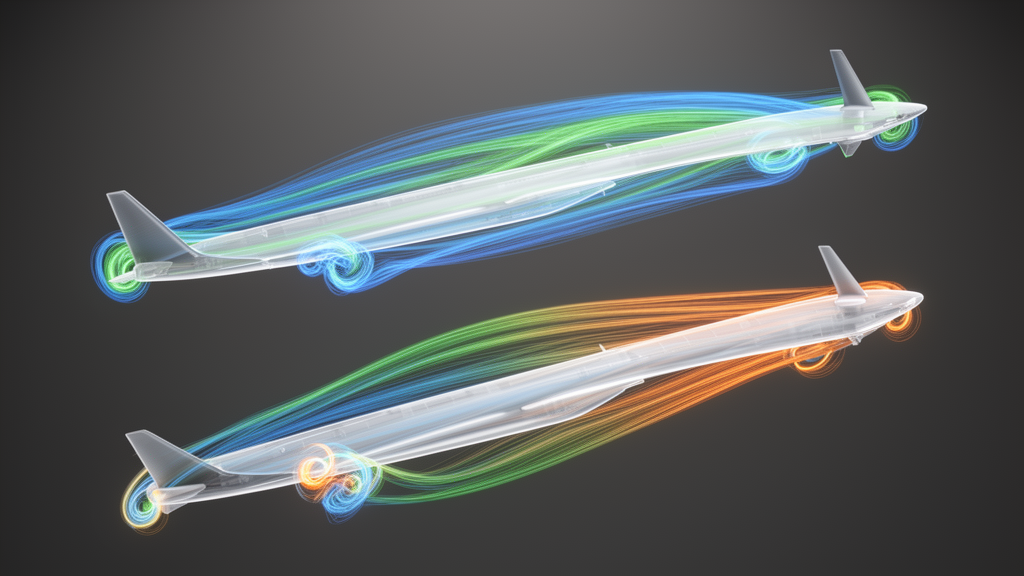
One of the study’s more distinctive contributions is its quantitative vortex analysis, which goes beyond simply reporting performance percentages. Using the Q-criterion and the lambda-2 method of Jeong and Hussain implemented in ANSYS CFD-Post, the team characterized the wingtip vortices directly. They found that winglets reduce vortex intensity primarily by enlarging the vortex core radius, by 15.6 percent for NACA 2412 and 14.3 percent for NACA 0012, rather than by simply lowering the vorticity magnitude. Vorticity at the wingtip nonetheless decreased by 16.7 percent for the cambered wing and 17.0 percent for the symmetric wing, and circulation fell by roughly 18.1 and 17.7 percent respectively. The authors explain the mechanism through three effects: the winglet acts as a pressure barrier preventing high-pressure air from rolling around the tip, it redirects spanwise flow into a more streamwise direction, and it induces a counter-rotating vortex system that interacts destructively with the main tip vortex.
The study also found that winglet effectiveness is aerofoil-dependent in a subtle way. The optimal angle of attack for maximum lift-to-drag improvement differed between the two sections, occurring at 6 degrees for NACA 2412 and 5 degrees for NACA 0012. The authors suggest this means winglet design should account for the specific lift characteristics of the aerofoil it is paired with, rather than treating winglets as generic bolt-on devices. This finding addresses a gap the authors identified in the literature, where most prior work examined winglets or aerofoils in isolation, and few studies had systematically compared symmetric and cambered sections with identical winglet geometry under identical flow conditions.
The authors situate their results against earlier research. Whitcomb’s original work in the 1970s reported 15 to 20 percent drag reduction from blended winglets, which is consistent with the roughly 15 percent lift-to-drag improvement observed here. They also cite a 2023 comparison of winglet geometries on a cambered NACA 6321 aerofoil that found 95-degree blended winglets most efficient, supporting their own choice of blended geometry, and a 2022 study of variable cant and sweep angles on the ONERA M6 wing at Mach 0.84 that reported a 5.33 percent improvement, smaller than the present result, a difference the authors attribute to the transonic versus subsonic regime and different aerofoil characteristics. Beyond aircraft, the authors suggest the findings could inform wind energy and drone technology, where drag minimization is equally important.
The limitations are stated plainly. Only two aerofoils were tested, a single winglet geometry was evaluated, and the flow conditions were confined to low subsonic speeds at one Reynolds number, so the results may not generalize to other aerofoil families, winglet shapes or flight regimes. Structural weight, manufacturing complexity and aeroelastic effects were not considered, unsteady phenomena such as dynamic stall and vortex shedding were not examined, and, critically, no experimental validation of the winglet configurations was carried out. The authors frame the validated computational framework and its quantified uncertainty bounds as a baseline for future work, recommending multi-objective winglet optimization, wind tunnel testing of the winglet-integrated wings, extension to transonic conditions and higher Reynolds numbers, and exploration of morphing winglets that adapt geometry across the flight envelope.
Subject of Research: Computational comparison of winglet effects on the aerodynamic performance of NACA 2412 and NACA 0012 wings
Article Title: Comparative aerodynamic performance assessment of NACA 2412 and NACA 0012 aerofoils with winglet integration: a computational study using MATLAB-CATIA-CFD framework
Article References: Wani, I. N., Kumar, M., & Shukla, P. K. (2026). Comparative aerodynamic performance assessment of NACA 2412 and NACA 0012 aerofoils with winglet integration: a computational study using MATLAB-CATIA-CFD framework. Discover Vehicles, 2(1), Article 41. https://doi.org/10.1007/s44465-026-00031-2
Image Credits: AI Generated
DOI: 10.1007/s44465-026-00031-2
Keywords: aerodynamics, winglets, NACA 2412, NACA 0012, CFD, lift-to-drag ratio, wingtip vortices, ANSYS Fluent, induced drag, MATLAB, CATIA, aircraft design
News Source: Audrey Campbell. (October 29, 2026). Winglets Boost Lift-to-Drag Ratio by Up to 16.8% in Comparative CFD Study of Cambered and Symmetric Wings. Scienmag.