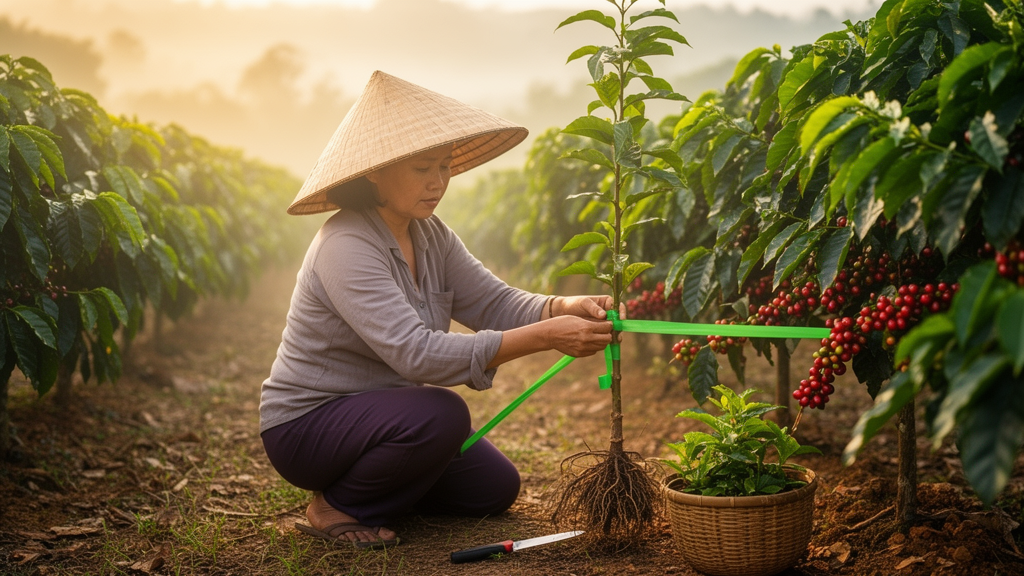
Grafting coffee trees can raise yields on smallholder farms in Vietnam by 61 percent, according to a new study that for the first time measures the technique’s performance outside of experimental plots. The research, published in Agriculture & Food Security, analyzed plot-level data from 1,321 coffee plots managed by 802 farmers across four provinces in Vietnam’s Central Highlands, the region that produces the overwhelming majority of the country’s Robusta coffee.
The study, conducted by Thuyen Thi Pham, Goytom Abraha Kahsay and Aske Skovmand Bosselmann, focused on Robusta coffee (Coffea canephora), a species that accounts for roughly 43 percent of global coffee production and dominates Vietnam’s output. Vietnam is the world’s second-largest coffee producer after Brazil, supplying 18 percent of global coffee output and about 40 percent of the worldwide Robusta supply. In the 2023/2024 season, the country produced 27.50 million 60-kilogram bags, around 96 percent of it Robusta, and coffee contributes about 12 percent of Vietnam’s agricultural GDP. Yet the Central Highlands, where most of this coffee grows, faces mounting climate pressure: droughts in 2015 and 2016 left roughly 10,000 hectares of coffee unirrigated and caused direct economic losses of US$243.58 million, and climatic suitability for growing coffee in the region is anticipated to drop by up to 80 percent by 2050.
Grafting involves joining the rootstock of one plant with the scion, or shoot, of another, combining desirable traits from both in a single tree. In coffee, the technique typically pairs hardy root systems with high-yielding, disease-resistant cultivars. While previous experimental studies had shown that grafting can boost yields in Arabica coffee, the authors note that empirical evidence from real farm conditions, where farmers face imperfect access to inputs, variable management practices and heterogeneous agroecological conditions, was entirely absent for Robusta. Their survey, conducted between February and March 2024 after a month-long pilot in July 2023, covered 11 of the most coffee-producing districts in Gia Lai, Dak Lak, Dak Nong and Lam Dong provinces, with farmers randomly selected from lists supplied by coffee buying companies including Nestle, Ecom and LDC.
The raw numbers from the survey tell a striking story. Of the 1,321 plots surveyed, 384 were fully grafted, 670 were non-grafted, and 267 contained a mix of both. The average yield of green beans across all plots was 3.25 tons per hectare, but grafted plots yielded significantly more, at 3.75 tons per hectare, compared with 2.99 tons per hectare for non-grafted plots. Grafted trees were also younger, averaging about 10 years old versus 16 years for non-grafted trees, reflecting the role of replanting programs in driving adoption. Most grafted plots in the sample used TRS1 and unknown Robusta rootstocks, which yielded 3.87 tons per hectare, while those grafted onto Liberica rootstocks yielded 3.18 tons per hectare, a difference the researchers attribute to renovation grafting onto mature root systems versus replanting with young trees.
To move beyond simple averages, the researchers estimated a log-linearized Cobb-Douglas production function, a standard tool in agricultural economics that allows coefficients to be interpreted as output elasticities of inputs. Because farmers who choose to graft may differ systematically from those who do not, in skill, resources or land quality, the team applied an instrumental variable approach to address potential selection bias. They instrumented plot-level grafting adoption with the share of grafted farms at the commune level, calculated using a leave-one-out method that excludes the current observation. The instrument proved strong: the first-stage F-statistic was 171.57, well above the conventional threshold of 10, and a minimum eigenvalue statistic confirmed the instrument was not weak. Under this instrumental variable model, grafting adoption increased coffee yield by 61 percent, and a specification that included intercropping raised the estimate to 63 percent. A simpler ordinary least squares model, which does not correct for selection bias, put the gain at 41 percent.
The results were robust to a battery of alternative specifications. A translog production function produced the same conclusions, as did propensity score matching and inverse probability weighted regression adjustment. Kernel density estimation and stochastic dominance analysis showed that the cumulative distribution of yields for grafted plots dominated that of non-grafted plots at the 1 percent significance level under a Kolmogorov-Smirnov test. Roughly 40 percent of non-grafting adopters obtained yields below about 2.5 tons per hectare, compared with only 20 percent of grafting adopters, while more than 35 percent of grafting adopters exceeded 4.5 tons per hectare versus around 12 percent of non-grafting adopters. When mixed plots were reclassified using different thresholds of grafted tree shares, the positive association held. A probit-based alternative estimation strategy also confirmed the finding.
Several control variables shaped the results in ways that illuminate the broader production system. A 10 percent increase in labour days was associated with a 16 percent increase in coffee yield, and plots with higher soil fertility, as rated by farmers on a five-point scale, were more productive. Rainfall was positively associated with yield, while mean maximum and mean minimum temperatures and the variability of minimum temperature were negatively associated with it, underscoring the vulnerability of Robusta coffee to heat. A roughly 10 percent increase in pesticide use was associated with a small reduction in yield of about 0.2 percent. Plots intercropped with pepper, durian and avocado yielded 16 percent less than mono-cropped coffee, likely due to competition for space and light. Location mattered too: plots in Dak Lak and Dak Nong provinces yielded less than those in Gia Lai, where conditions are comparatively more uniform.
Looking forward, the team used climate projections from the World Bank Climate Change Knowledge Portal and the CMIP6 ensemble, based on IPCC AR6 pathways, to simulate yields under three warming scenarios through 2080–2099: a low-warming SSP1-2.6 scenario, an intermediate SSP2-4.5 scenario, and a high-warming SSP5-8.5 scenario. Projected temperature increases led to substantial yield declines in all scenarios, but grafted coffee systems consistently outperformed non-grafted systems under every future climate condition tested. The authors caution that their study does not reveal the biophysical mechanisms behind the yield advantage, though they point to known physiological benefits of grafting, including stronger root systems, improved water uptake, maintained carbon balance and improved drought tolerance, as plausible explanations.
Despite the demonstrated benefits, adoption remains modest. Among the 802 farmers surveyed, 52.74 percent did not adopt grafted coffee, 29.43 percent adopted it exclusively, and 17.83 percent cultivated a mix. Farmers’ perceptions reveal why: most recognize that grafting improves resistance to bad weather, drought and diseases, and enhances quality and yield, but the high cost of seedlings, increased fertilizer requirements and higher labour demand present significant barriers. Among the 423 farmers with only non-grafted coffee, 80.85 percent knew about grafted coffee, and 220 of those who knew about it intended to adopt it in the future. The most common reason for postponing adoption, cited by 55.91 percent, was that their existing trees remained healthy and productive, suggesting deliberate delay rather than rejection of the technology.
The study’s findings carry direct policy weight in Vietnam, where the Ministry of Agriculture and Environment has run a coffee replanting, renovation and grafting program for Central Highlands provinces since 2014, which has already renovated 105,769 hectares with replanted and grafted coffee. The authors recommend targeted subsidies for certified grafted seedlings, support for decentralized nurseries in remote regions, quality control mechanisms to reduce farmer uncertainty, and extension efforts focused on renovation grafting that can be implemented on existing trees. They also emphasize that adoption is strongly linked to location and proximity to nurseries, so region-specific strategies matching rootstock-scion combinations to local conditions are likely to outperform uniform national programs. With 12.5 to 25 million farmers, mostly smallholders, producing coffee across more than 80 countries, and with the IPCC predicting that climate change will reduce coffee yield and suitable land in many producing countries by 2050, the researchers argue that grafting offers a practical and scalable pathway toward climate-resilient livelihoods, provided that the economic and institutional barriers that currently keep adoption low are addressed.
Subject of Research: The yield impact of grafting on Robusta coffee production among smallholder farms in Vietnam's Central Highlands
Article Title: Sustainable intensification: how grafting boosts coffee production in Vietnam
Article References: Pham, T. T., Kahsay, G. A., & Bosselmann, A. S. (2026). Sustainable intensification: how grafting boosts coffee production in Vietnam. Agriculture & Food Security, 15(1), Article 50. https://doi.org/10.1186/s40066-026-00633-9
Image Credits: AI Generated
DOI: 10.1186/s40066-026-00633-9
Keywords: coffee, grafting, Robusta, Vietnam, Central Highlands, smallholder farmers, yield, climate resilience, sustainable intensification, instrumental variable, agricultural technology, replanting
News Source: Alan Morgan. (October 29, 2026). Grafting lifts Robusta coffee yields by 61 percent on Vietnamese smallholder farms. Scienmag.