


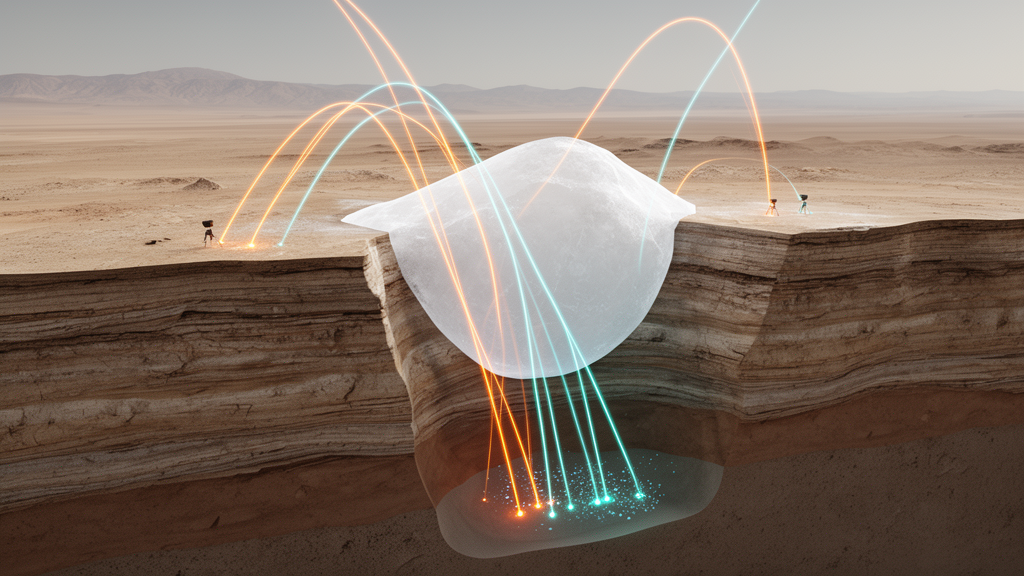
Imaging geological targets buried beneath salt bodies remains one of the hardest problems in seismic exploration, and a new open-access study published on 11 October 2026 in Geomechanics and Geophysics for Geo-Energy and Geo-Resources tackles it head-on. Hadi Mahdavi Basir, Abdolrahim Javaherian, Sadegh Saffarzadeh Hosseini and Hakim Esmaeili Oghaz present a ray-tracing-based seismic illumination analysis for a salt diapir in central Iran, in a setting relevant to underground gas storage (UGS) exploration. Their goal was to assess whether high-fidelity imaging of reflectors beneath and adjacent to the salt is even feasible before committing to expensive field acquisition.
The method rests on a dual ray-tracing framework. First, a survey-independent analysis maps where seismic energy can physically reach the potential target reflectors, given only the salt geometry. This intrinsic assessment revealed regions of poor coverage caused by ray-path turning and masking effects inherent to the salt body itself. Second, a survey-dependent analysis quantified the illumination quality achievable with the proposed 3D land acquisition geometry, mapping the spatial distribution and angular content of seismic energy at the targets.
The survey-dependent results exposed critical gaps in both spatial and azimuthal coverage, particularly near steep salt boundaries where wide-angle reflections are essential for imaging. According to the authors, the salt flanks—the very zones that could supply turning or wide-angle rays—show severe illumination deficits regardless of which migration algorithm is applied. In contrast, areas with sufficient illumination coverage, including both steep and wide-angle rays, correlate strongly with the potential for high-fidelity subsurface imaging.
The study’s central conclusion is that the fundamental limitation in imaging complex salt bodies is the geometric accessibility of targets by seismic energy, not the shortcomings of imaging algorithms alone. In other words, if rays cannot physically travel from source to target and back to the receivers, no amount of computational sophistication in migration will recover the missing signal. The framework therefore provides constraints for assessing the inherent resolvability of subsalt targets based on wave-propagation physics within given survey constraints.
For practitioners, the authors position ray-based illumination modeling as an indispensable, cost-effective feasibility tool for survey design and risk assessment in UGS development. By isolating intrinsic geological masking caused by steep salt flanks from acquisition-geometry limitations, the dual analysis also offers a decision-making framework for judging when advanced, computationally expensive migration algorithms are genuinely necessary in subsalt projects—and when the geometry itself must change. As an early-access, peer-reviewed article, the work is citable with a permanent DOI, though the version of record may still be edited.
Subject of Research: Seismic illumination analysis using ray tracing to evaluate subsalt imaging feasibility beneath a salt diapir in central Iran for underground gas storage exploration.
Article Title: Ray‑tracing-based seismic illumination analysis for subsalt imaging in gas storage exploration: a case study of a salt diapir in central Iran
Article References: Mahdavi Basir, H., Javaherian, A., Saffarzadeh Hosseini, S., & Esmaeili Oghaz, H. (2026). Ray‑tracing-based seismic illumination analysis for subsalt imaging in gas storage exploration: a case study of a salt diapir in central Iran. Geomechanics and Geophysics for Geo-Energy and Geo-Resources. https://doi.org/10.1007/s40948-026-01244-1
Image Credits: AI Generated
DOI: 10.1007/s40948-026-01244-1
Keywords: seismic illumination, ray tracing, subsalt imaging, salt diapir, underground gas storage, central Iran, survey design, migration algorithms, wide-angle reflections, 3D seismic acquisition, tracing-based, seismic
News Source: Violet Maxwell. (October 29, 2026). Ray-Tracing Illumination Study Reveals Limits of Subsalt Imaging at a Central Iran Gas Storage Site. Scienmag.



