


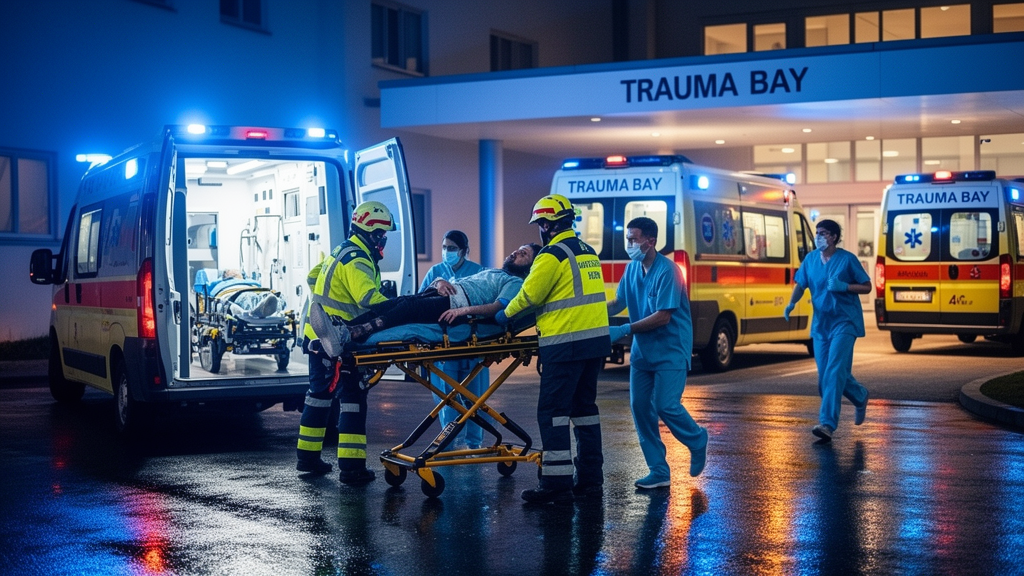
When German emergency medical services declare a mass casualty incident, the clock starts running differently. Severely injured patients treated during such events waited markedly longer before reaching hospital than comparable patients cared for under routine conditions, yet their chances of dying in hospital were not significantly different, according to a large matched analysis of the TraumaRegister DGU, the trauma registry of the German Trauma Society. The study, published in BMC Emergency Medicine, offers one of the first nationwide registry-based pictures of how everyday civilian mass casualty incidents, rather than dramatic terrorist attacks or simulated disaster exercises, affect the care of the most seriously injured patients.
From a total of 65,152 severely injured patients treated at 614 participating hospitals, 430 cases, or 0.7 percent, were flagged as occurring during a mass casualty incident. All patients had a Maximum Abbreviated Injury Scale score of at least 3, meaning their injuries were severe, and only patients treated within Germany were included to ensure comparability of response strategies.
To make the comparison as fair as possible, the team constructed a matched cohort in which each mass casualty patient was paired with four routine-care controls. Matching was based on age decade, injury pattern, defined as whether injuries of Abbreviated Injury Scale severity 3 or higher were present in the head, thorax, abdomen, and extremities, and whether the incident involved traffic. Seven of the 430 mass casualty patients could not be matched to suitable controls and were excluded, leaving 423 patients in the incident group and 1,692 controls. The primary endpoint was in-hospital mortality; secondary endpoints included prehospital time intervals, interventions performed at the scene, transport strategies, lengths of stay, and transfusion requirements.
The baseline characteristics revealed important differences even before care began. The mean age of mass casualty patients was 39.2 years, compared with 56.1 years among controls, and the proportion of male patients was lower in the incident group, at 62.6 percent versus 69.6 percent. Injury severity was slightly higher among mass casualty patients, with a mean Injury Severity Score of 24.8 against 20.3 in the control group, and an Injury Severity Score of 16 or more was more frequent in the incident group, at 76.3 percent versus 62.9 percent. The overwhelming majority of mass casualty cases, 84.1 percent, stemmed from traffic accidents, with passenger car occupants forming the largest subgroup, and 92.8 percent of injuries were due to blunt trauma. Ten percent of the incident patients were children under 16 years of age.
The most striking finding concerned time. The median on-scene time during mass casualty responses was 40 minutes, compared with 29 minutes in routine care, and the median total prehospital time reached 85 minutes in the incident group against 67 minutes among controls, an increase of roughly 18 minutes. In the full cohort, the difference in total prehospital time was highly statistically significant, with median times of 85 minutes (interquartile range 67 to 100) for incident patients and 67 minutes (interquartile range 53 to 83) for controls. The authors attribute this prolongation to the additional organizational and logistical demands inherent to mass casualty responses, including triage processes, structured scene management, and the coordination of limited personnel and material resources. Notably, the delays of more than two hours that have been reported in parts of the earlier literature did not appear in this dataset.
Prehospital interventions also differed between the groups. Prehospital intubation was performed in 33.6 percent of mass casualty patients compared with 20.9 percent of controls, and tranexamic acid, a drug used to limit bleeding, was administered in 32.1 percent versus 15.0 percent. However, other interventions, including catecholamine administration, chest tube placement, cardiopulmonary resuscitation, and fluid administration, did not differ significantly. The authors caution that the mass casualty cohort was more severely injured overall, so the higher rates of invasive procedures and tranexamic acid use may reflect differences in patient and injury characteristics rather than an independent effect of the mass casualty setting itself. Because these analyses were not adjusted for injury severity and physiological status, no causal relationship between the incident setting and individual treatment decisions can be inferred.
Transport strategies shifted noticeably during mass casualty responses. Helicopter emergency medical services were used in 34.5 percent of incident cases versus 20.7 percent of controls, while ground transport accompanied by an emergency physician was less common, at 53.5 percent versus 63.5 percent. At the same time, the overall presence of an emergency physician at the scene was slightly higher during mass casualty responses, at 98.9 percent versus 94.0 percent. The researchers interpret this pattern as a context-dependent redistribution of limited resources that highlights the adaptability of emergency medical services. They stress, however, that the observational design cannot show whether greater helicopter use improves clinical outcomes or whether it should be adopted as an operational strategy, and that evidence-based recommendations on optimal transport in mass casualty settings remain scarce.
On the central question of survival, the matched analysis found no statistically significant difference. In-hospital mortality was 13.5 percent in the mass casualty group versus 11.7 percent among matched controls, a difference that did not reach statistical significance. When patients requiring early interhospital transfer, whose final outcomes were unavailable in the registry, were excluded, mortality was 14.4 percent versus 12.7 percent, and RISC III-predicted mortality was 13.9 percent and 13.3 percent respectively, with observed figures lying close to predicted values in both groups, although the comparison was purely descriptive. In an additional multivariable logistic regression sensitivity analysis adjusting for the RISC III score, hospital level of care, and helicopter transport, mass casualty status was not significantly associated with in-hospital mortality, with an adjusted odds ratio of 1.19 and a 95 percent confidence interval of 0.77 to 1.85. The authors emphasize that the study was not designed to demonstrate equivalence and that the wide confidence interval does not exclude a clinically meaningful difference in mortality.
The study also carries important caveats that shape how the findings should be read. Because the registry records mass casualty involvement at the individual patient level without incident identifiers, the number of distinct events, the number of casualties per incident, and the distribution of triage categories could not be determined, and multiple patients may have shared the same scene, resources, and transport conditions, meaning the observations are not statistically independent. Regional variation in how mass casualty incidents are declared, which depends on local emergency medical service capacity rather than a fixed casualty threshold, adds further uncertainty, and factors such as crew experience, time of day, and transport distances could not be assessed. The registry captures only severely injured patients who reached a participating hospital, so patients with minor injuries, those not transported, and those who died at the scene are invisible to the analysis, and prehospital mortality could not be evaluated. Intentional mass violence events could not be reliably distinguished from unintentional civilian incidents, although traffic mechanisms dominated the cohort. Roughly 95 percent of declared German mass casualty incidents involve five or ten casualties at most, underscoring that these are everyday operational events rather than large disasters. Within those limits, the study suggests that German emergency systems absorb routine mass casualty pressures with longer scene times and altered transport patterns, but without a detectable penalty in hospital survival for the severely injured.
Subject of Research: Prehospital management and hospital outcomes of severely injured patients treated during routine civilian mass casualty incidents in Germany
Article Title: Prehospital management and hospital outcomes of severely injured patients during routine civilian mass casualty incidents: a 1:4 matched cohort analysis of the TraumaRegister DGU®
Article References: Breuer, F., Beckers, S. K., Brune, B., Dudda, M., Franke, T., Lefering, R., & Nohl, A. (2026). Prehospital management and hospital outcomes of severely injured patients during routine civilian mass casualty incidents: a 1:4 matched cohort analysis of the TraumaRegister DGU®. BMC Emergency Medicine, 26(1), Article 282. https://doi.org/10.1186/s12873-026-01818-y
Image Credits: AI Generated
DOI: 10.1186/s12873-026-01818-y
Keywords: mass casualty incidents, trauma, prehospital care, TraumaRegister DGU, emergency medical services, in-hospital mortality, triage, helicopter emergency medical services, tranexamic acid, prehospital intubation, matched cohort study, Germany
News Source: Ophelia Keating. (October 29, 2026). Research report: Prehospital management and hospital outcomes of severely injured patients during routine civilian mass casualty incidents: a 1:4 matched cohort analysis of the TraumaRegister DGU®. Scienmag.



