


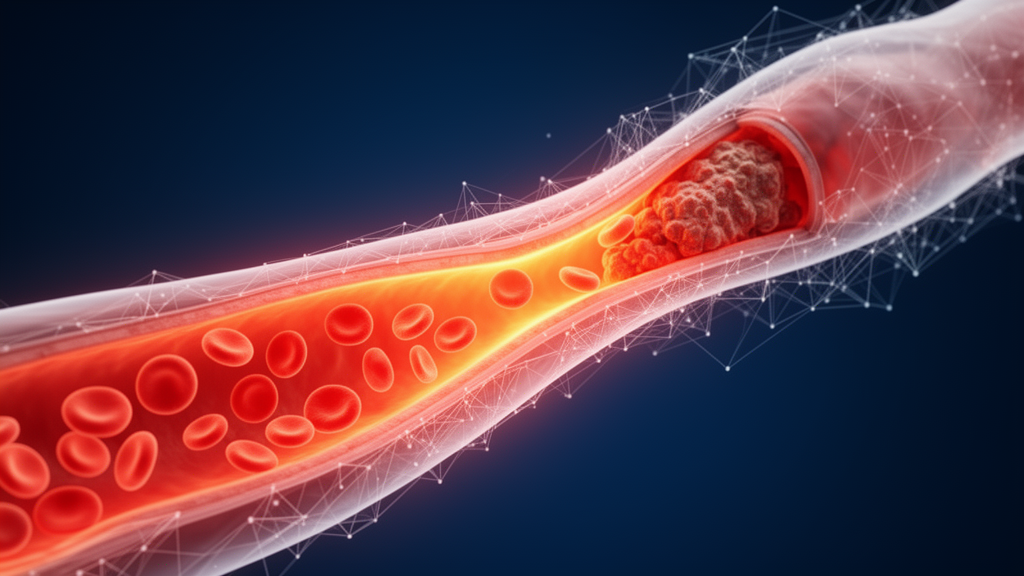
The new study addresses blood flow through a stenotic artery, a constriction that the authors connect to cardiovascular disease treatment. A new theoretical study published in the journal Discover Nano tackles this problem not with patient data or laboratory experiments, but with mathematics: a system of partial differential equations describing a blood-based trihybrid nanofluid flowing through a stenotic artery, solved numerically and then approximated by an artificial neural network trained with Bayesian regularization. The authors, Brahim Mrabet, Joffin J Ponnore, Rumla Jawo and Yakup Yildirim, present the work as a computational framework that could eventually support thermal therapy planning, targeted drug delivery and the design of biomedical devices such as stents and artificial organs.
The fluid at the center of the model is not ordinary blood but a trihybrid nanofluid, a relatively new class of engineered fluid in which three different types of nanoparticles are suspended in a base liquid. In this case the base fluid is blood, and the suspended nanoparticles alter its thermal conductivity, viscosity, density and electrical conductivity according to established mixture formulas. Trihybrid nanofluids, formed by suspending three different classes of nanoparticles in a single base fluid, have attracted attention as researchers seek to enhance nanofluids for applications requiring high temperature capabilities; the authors connect such fluids to industrial uses as well as to biomedical scenarios in which heat must be delivered to or removed from tissue with precision. The study is explicitly labeled as not a clinical trial, and its results concern model equations rather than measurements in patients.
The mathematical formulation treats the stenosed artery as a tube whose radius varies along its axis, with a cosine-shaped constriction centered at the midpoint of a characteristic length. The governing equations conserve mass, momentum, energy and species concentration in cylindrical coordinates. Three physical effects are built into the energy and concentration equations: thermal radiation, represented through the Rosseland approximation in which a radiative term proportional to the cube of the ambient temperature augments thermal conduction; a temperature-dependent heat source, which adds or removes energy in proportion to the local temperature difference; and a chemical reaction, which depletes the concentration field at a rate set by a reaction-rate parameter. A magnetic field also acts on the flow through the electrical conductivity of the nanofluid, introducing a Lorentz-force term that retards motion in the momentum equation.
The boundary conditions reflect a convective exchange at the arterial wall rather than a fixed wall temperature or concentration. Heat passes between the wall and the fluid at a rate governed by the thermal Biot number, while mass transfer at the wall is controlled by a concentration Biot number. Far from the wall, the model requires velocity, temperature and concentration to decay to their ambient values. Using dimensionless similarity transformations, the authors reduce the full set of partial differential equations to three coupled ordinary differential equations for the dimensionless velocity, temperature and concentration profiles, which they then solve with the Bvp4c boundary-value solver. The authors highlight Bvp4c’s ability to handle stiff, nonlinear systems with adaptive mesh refinement and built-in error estimates, qualities that matter when the solution changes rapidly near the constriction.
The artificial-intelligence component of the study is an artificial neural network developed using back propagation, with training and testing datasets supplied as inputs; the authors state that the Bayesian-regularization algorithm was modified to speed up training. The network uses twelve neurons in a single hidden layer with a tangent-sigmoid activation function, while the output layer applies a linear activation. The dataset generated by the numerical solver was divided so that seventy percent of the examples trained the network and the remaining thirty percent were reserved for validation and testing. Three separate scenarios were analyzed, each corresponding to a different input parameter mapping, and the network’s task was to reproduce the numerical solutions quickly enough to support rapid, patient-specific predictions without solving the governing equations from scratch each time.
The performance statistics reported for the trained networks are striking, with the usual caveat that they describe agreement between the network and the underlying model, not agreement with physical measurements. Across the three scenarios, the mean squared errors during training, testing and validation reached values of 9.34×10⁻¹³, 7.19×10⁻¹² and 1.82×10⁻¹¹ at 288, 446 and 229 epochs respectively. Regression plots for the three scenarios show correlation coefficients of essentially unity, and the authors report that error histograms, absolute-error analyses and comparison plots between the network outputs and the numerical targets all support the goodness of fit. In practical terms, once trained, the network can stand in for the expensive numerical solver and return a full profile prediction almost instantly, which is the core advantage the authors claim for the hybrid ANN-BRA approach.
Beyond validating the network, the study maps how individual dimensionless parameters reshape the flow, thermal and concentration fields. Increasing the thermal Biot number raises the temperature profile: because the Biot number measures how readily heat passes from the interior of the body to its exterior, a larger value means less heat escapes the system, so the total energy within it grows and the thermal boundary layer thickens. The same pattern holds for the concentration field, which rises as the concentration Biot number increases. The solutal and thermal fields both strengthen with increasing values of the thermal and concentration Biot numbers, and correspondingly the Sherwood and Nusselt numbers, which quantify the rates of mass and heat transfer at the wall, also rise with these parameters.
The magnetic parameter works in the opposite direction on the flow. As its value increases, the flow field decays, a consequence of the Lorentz force that the applied magnetic field exerts on the electrically conducting nanofluid. Interestingly, the conclusions report that an enhanced magnetic parameter led to a decline in the temperature profile of the trihybrid nanofluid, tying the thermal response to the slowing of the flow. The authors also examined the influence of nanoparticle volume fraction, reporting that with increasing volume fraction the flow dispersion decreased while the temperature profile increased, and they suggest that nanoparticle properties may be tuned to improve blood-flow efficiency within the model.
To check the reliability of their numerical scheme, the authors compared their computed skin-friction results against previously published values with the additional effects switched off. For three values of the relevant parameter, their results of 0.939989, 0.924771 and 0.911323 sit extremely close to the published figures of 0.939968, 0.924794 and 0.911311, a comparison the authors offer as evidence of the correctness and dependability of the current implementation. They also report that the mean squared error between the reference solution and the network’s proposed data falls in the typical range of ten to the power of minus six for the Bayesian-regularized network, indicating close agreement between the two computational representations of the same physics.
The authors are careful, in their framing, to position the work as a step toward diagnostic and therapeutic tools rather than a finished clinical technology. They argue that models of this kind could promote the development of instruments that track the temperature of stenosed arteries, improving the management and treatment of cardiac illness, and they point to therapy scenarios such as targeting hyperthermic tumors or using heat to break up clots as contexts where accurate prediction of thermal fields matters. They also note that replicating the interactions of multiple nanoparticles with blood could aid the design and optimization of biomedical devices like stents and artificial organs. What the study actually delivers is a validated computational pipeline: governing equations, a numerical solver, and a fast neural surrogate whose errors against that solver are quantified. Translating such a pipeline into bedside value would require experimental validation against real hemodynamic and thermal measurements, patient-specific geometry and properties, and regulatory-grade verification, none of which this theoretical study provides. Its contribution lies in demonstrating that a Bayesian-regularized neural network can learn the behavior of a demanding nonlinear boundary-layer model of stenotic nanofluid flow with near-perfect fidelity to the numerical reference, opening a path toward the quick, precise, patient-specific predictions the authors envision for cardiovascular procedure planning.
Subject of Research: Mathematical and neural-network modeling of heat transfer and flow in blood-based trihybrid nanofluid within a stenotic artery
Article Title: Thermal convective and flow dynamics of blood trihybrid nanofluid inside a stenosis artery for cardiovascular disease treatment using artificial intelligence approach
Article References: Mrabet, B., Ponnore, J. J., Jawo, R., & Yildirim, Y. (2026). Thermal convective and flow dynamics of blood trihybrid nanofluid inside a stenosis artery for cardiovascular disease treatment using artificial intelligence approach. Discover Nano, 21(1), Article 556. https://doi.org/10.1186/s11671-026-05019-1
Image Credits: AI Generated
DOI: 10.1186/s11671-026-05019-1
Keywords: trihybrid nanofluid, stenosed artery, blood flow, heat transfer, artificial neural network, Bayesian regularization, thermal radiation, chemical reaction, Bvp4c, cardiovascular modeling, magnetic field, nanoparticles
News Source: Cassandra Pierce. (October 29, 2026). Neural Network Model Tracks Heat and Blood Flow in Narrowed Arteries. Scienmag.



