


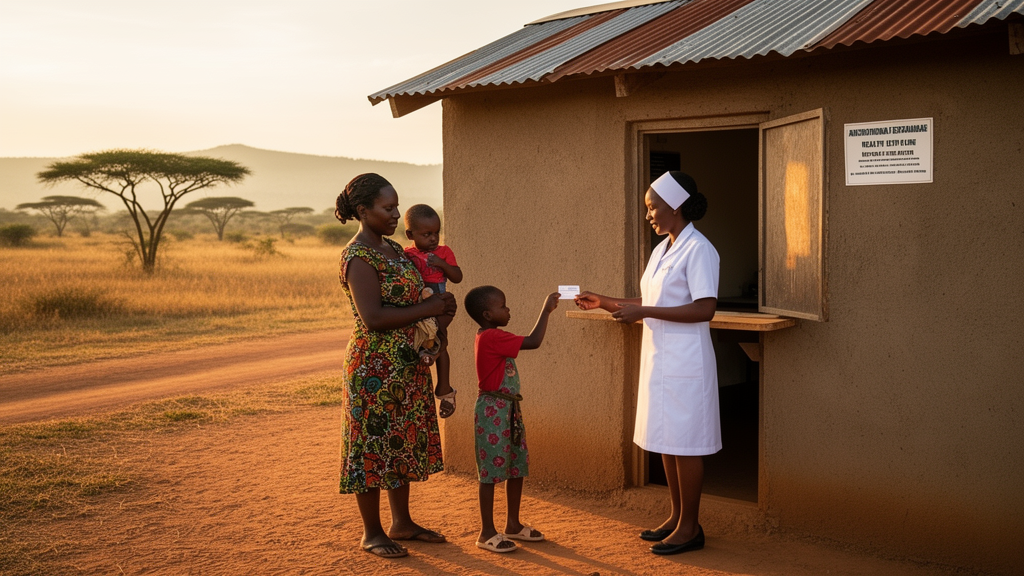
In a rural district at the foot of Mount Kilimanjaro, fewer than three in ten residents had used any healthcare service in the past year, yet those holding health insurance were more than twice as likely to have sought care as their uninsured neighbours. That is the central finding of a cross-sectional survey of 494 households in Hai District, Northern Tanzania, published in Discover Health Systems. The study, led by Timon S. Emaely of Muhimbili University of Health and Allied Sciences with colleagues Malale Tungu and Amani Anaeli, set out to quantify how insurance status relates to healthcare use in a predominantly rural population, and to compare voluntary schemes with compulsory ones.
The numbers behind the headline are stark. Overall, 26.9 percent of participants reported using healthcare services in the previous twelve months. Outpatient care accounted for most of that activity, with 19.2 percent of respondents reporting an outpatient visit, while only 7.7 percent reported an inpatient admission. Insurance coverage itself was thin: just 18.2 percent of the sampled households had any form of health insurance. Among the insured, 43.3 percent had used healthcare services in the past year, compared with 23.3 percent of the uninsured, a difference the authors report as statistically significant at p < 0.001.
After adjusting for a battery of potential confounders, the association held. In a multivariable logistic regression, health insurance coverage carried an adjusted odds ratio of 2.24 for healthcare utilization, with a 95 percent confidence interval of 1.22 to 4.11 and a p-value of 0.010. In plain terms, insured individuals in this sample had roughly double the odds of having used healthcare services in the past year compared with uninsured individuals of similar age, sex, marital status, education, income, employment, illness history and distance to the nearest facility. The authors are careful, however, to note that because enrollment into insurance schemes may itself be shaped by socioeconomic and health-related factors, the association should be interpreted with caution and not necessarily as a causal effect.
Insurance was not the only variable that mattered. Married participants had nearly three times the odds of using services compared with single participants (adjusted odds ratio 2.74; 95 percent CI 1.41 to 5.30). Household income showed the strongest gradient: those reporting more than 500,000 Tanzanian shillings per month had an adjusted odds ratio of 4.27 (95 percent CI 2.03 to 8.99) relative to lower-income households. Need factors also loomed large. Respondents who had fallen ill in the preceding two weeks had an adjusted odds ratio of 2.91 (95 percent CI 1.80 to 4.73), and those taking chronic medication for three months or longer had an adjusted odds ratio of 3.38 (95 percent CI 1.77 to 6.48). By contrast, female participants initially showed higher odds of utilization in crude analysis (crude odds ratio 1.68), but that association faded after adjustment (adjusted odds ratio 1.48; p = 0.100). Age, education, family size, religion, employment type and distance to a health facility were not significantly associated with utilization once other factors were accounted for.
The study’s design reflects a deliberate attempt to capture variation within a rural setting. Hai District, in the Kilimanjaro region, was purposively selected because it is predominantly rural yet has a relatively dense health infrastructure: two hospitals at district level, nine health centres and fifty-one dispensaries. Within the district, the researchers chose two wards, Masama Rundugai and KIA, and selected six villages from them, three within roughly five kilometres of a health facility and three farther away. Household lists from village registers served as sampling frames, and every second household was selected after a random starting point. The minimum sample size of 377 households, calculated with the Cochran formula assuming a 95 percent confidence level, a 5 percent margin of error and an expected utilization prevalence of 35.5 percent drawn from prior work, was expanded to 494 to improve statistical power and buffer against non-response. Fieldwork ran between June and July 2025, with eight trained research assistants conducting face-to-face interviews.
The questionnaire drew on instruments from the World Bank’s Living Standards Measurement Study and the Demographic and Health Surveys, and was pre-tested on ten percent of the estimated sample. Respondents were defined as household heads, whether father, mother or another available adult able to provide the required information. The outcome variable, healthcare services utilization, was defined as at least one visit to a healthcare facility for outpatient care, inpatient care or other interventions in the previous year. Analysis was performed in Stata version 18 using survey commands to account for the complex sampling design. The analytical framework was Andersen’s Behavioral Model of Health Services Use, which organizes determinants into predisposing factors such as age and education, enabling factors such as insurance and income, and need factors such as recent illness and chronic medication.
One of the study’s stated aims was to compare voluntary and compulsory insurance, and here the results were more muted. Among the insured, utilization did not differ significantly by enrollment type: 42.9 percent of voluntary enrollees used services versus 45.0 percent of those in compulsory schemes, a difference the authors report as not statistically significant (p = 0.865). Differences across specific schemes also fell short of significance (p = 0.090), although the raw pattern was notable: 66.7 percent of National Social Security Fund members reported utilization, compared with 41.8 percent of National Health Insurance Fund members and 30.0 percent of Community Health Fund members. The authors observe that voluntary enrollment showed higher odds of care-seeking than mandatory coverage, though not significantly so, and they suggest possible self-selection effects, whereby people who voluntarily enroll may be more health-conscious, more aware of their benefits, or carry higher healthcare needs.
The pattern of service use itself is telling. Among outpatient users, 58.9 percent visited a facility fewer than two times, 24.2 percent visited three to four times, and 16.9 percent had five or more visits. Inpatient admissions were rarer still, with 76.3 percent of those hospitalized admitted fewer than twice. Public facilities absorbed the bulk of encounters, at 58.6 percent, followed by pharmacies at 30.8 percent, private clinics at 8.3 percent and traditional healers at 2.3 percent. The authors situate these figures against broader context: the World Health Organization estimates that roughly half the global population cannot access basic health services, coverage in Sub-Saharan Africa is estimated below 42.56 percent, and access in Tanzania has been put at less than 36 percent. Within Tanzania, the National Health Insurance Fund covers roughly 9 percent of the population, largely public-sector employees, while the improved Community Health Fund, a voluntary scheme for informal and rural populations, covers roughly 24 percent.
The authors interpret their findings as underscoring the role of financial protection in rural healthcare access, while cautioning that insurance alone may not guarantee effective access. They point to implementation challenges in the Tanzanian system, including low coverage among informal-sector workers, limited awareness of benefits, premium affordability concerns, and health system constraints such as workforce shortages, medicine stockouts and long waiting times. They also cite contrasting evidence from Ghana suggesting that once socioeconomic factors are controlled, insurance status alone may not independently predict utilization, implying that insurance expansion should be paired with improvements in infrastructure, service quality and community education.
The study’s limitations are acknowledged plainly. The cross-sectional design precludes causal inference; self-reported utilization over a full year invites recall bias; the study did not assess the quality or perceived effectiveness of the services used; and the small number of insured participants limited sub-group analysis by scheme. Villages were selected on the basis of facility access rather than fully at random, which the authors note may have introduced selection bias and limits generalizability beyond similar rural contexts. Still, within those bounds, the message is consistent: in this rural Tanzanian district, insurance coverage, marital support, higher income and active health needs each traced a measurable path to care, and the single largest gap remains the roughly four in five residents who carry no insurance at all.
Subject of Research: The association between health insurance status and healthcare services utilization in a rural Tanzanian district
Article Title: Association between health insurance status and healthcare services utilization among rural population in Hai District Northern Tanzania
Article References: Emaely, T. S., Tungu, M., & Anaeli, A. (2026). Association between health insurance status and healthcare services utilization among rural population in Hai District Northern Tanzania. Discover Health Systems, 5(1), Article 76. https://doi.org/10.1007/s44250-026-00418-8
Image Credits: AI Generated
DOI: 10.1007/s44250-026-00418-8
Keywords: health insurance, healthcare utilization, Tanzania, rural health, universal health coverage, cross-sectional study, Kilimanjaro, outpatient care, inpatient care, household income, logistic regression, Sub-Saharan Africa
News Source: Ophelia Keating. (October 29, 2026). Health insurance doubles odds of care in rural Tanzania study. Scienmag.



