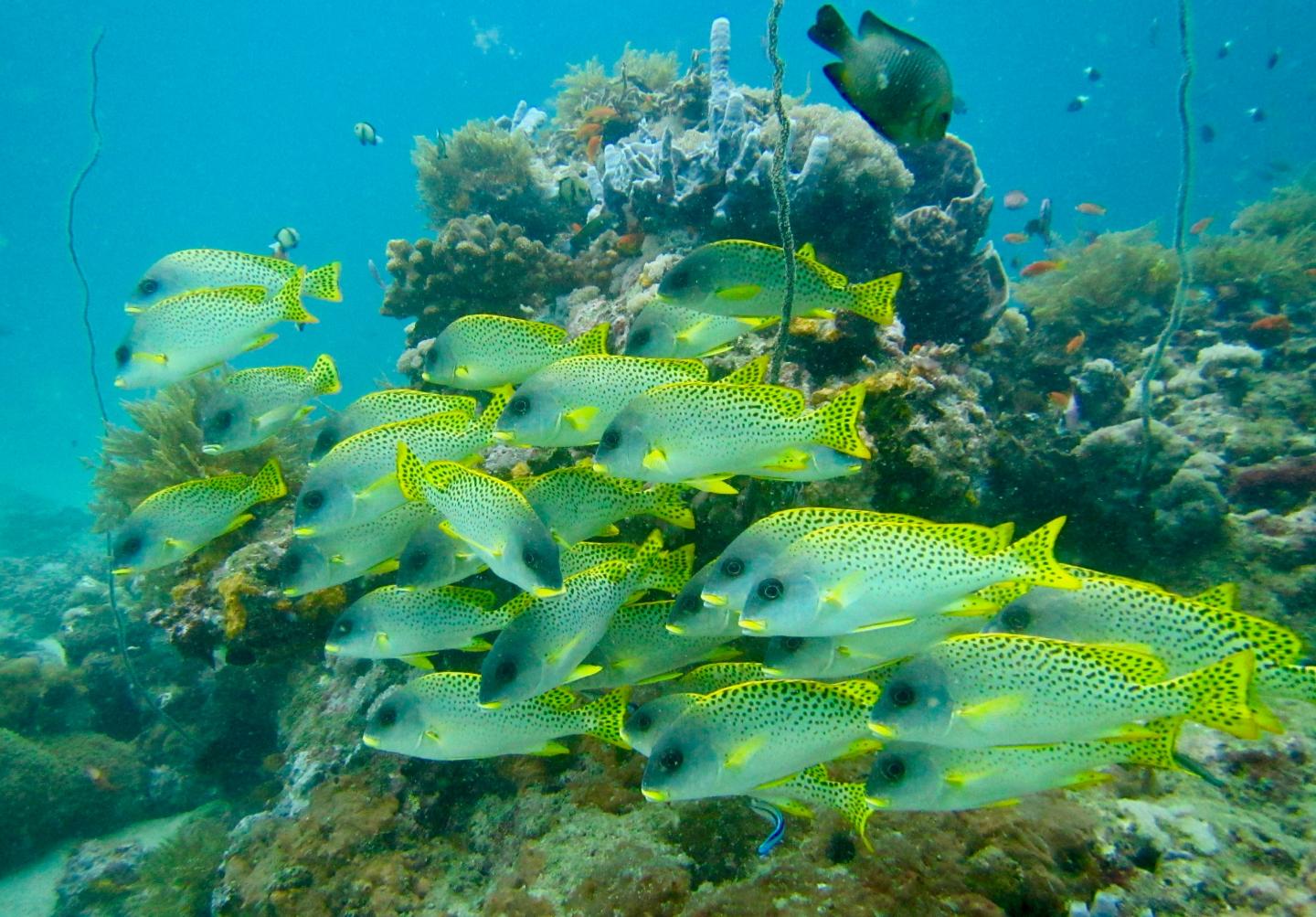
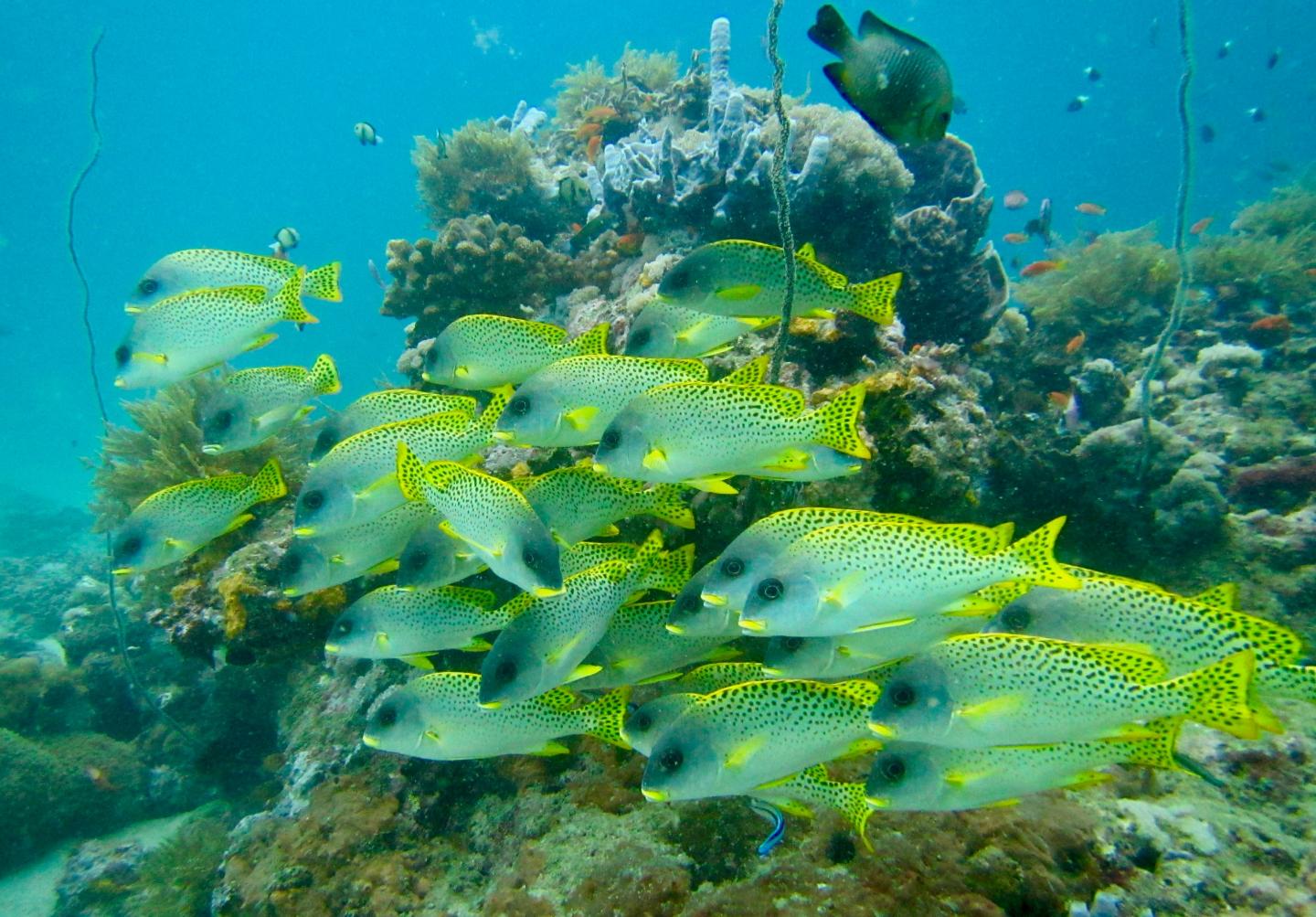
Credit: T. McClanahan/WCS
NEW YORK (October 18, 2017) — A new study appearing in the journal Marine Ecology Progress Series has found that conserving fish diversity in Madagascar's coral reef systems may depend on maintaining fish biomass above critical levels, according to scientists from WCS (Wildlife Conservation Society) and ES Caribbean.
Based on the findings, the authors recommend that fisheries managers work to ensure that fish biomass does not fall below these critical levels. The authors of the paper titled "Managing coral reef fish community biomass is a priority for biodiversity conservation in Madagascar" are Tim R. McClanahan of WCS and Catherine Jadot of ES Caribbean.
"Our research found that the most effective way to maintain species and their ecological roles is to prevent fish biomass from falling below a critical level," said McClanahan, WCS Senior Conservationist and the lead author of the study. "This also leads to widespread benefits provided by these species rather than restricting benefits to a few special places. In a poor country where food and hunger are constant issues, managers would not want to lose the contributions of each species to food."
The researchers analyzed data on fish communities in coral reef systems in four regions around Madagascar and three islands in the Mozambique Channel. The data were collected between 2006 and 2015 in 152 reefs, and 23 families of fish, including surgeonfishes, triggerfish, jacks, wrasses, and other species were evaluated. Estimations on the size of fish encountered along transect lines allowed researchers to calculate biomass or the wet weight of fish in each transect.
Looking for correlations with factors such as water depth, sea surface temperature, productivity, algae and coral cover, the researchers found only weak connections between fish biomass and both human influence and environmental characteristics. Rather, the strongest correlation was between fish diversity and total biomass. Fortunately, about 65 percent of the reefs had biomass levels of more than 600 kilograms per hectare that was suggested as a critical cutoff point. Values lower than this point were often associated with low rainfall urban centers that may lack other sources of food beside fish and where the authors suggest good fisheries management is most critical to avoiding starvation.
"The study reveals how important it is to have a benchmark for evaluating the health of fisheries and the consequences of going below a benchmark," added McClanahan. "In poor countries such as Madagascar that lack resources for management, the 35 percent of reefs below this threshold are locations where management efforts should be focused."
###
This work has been supported by the John D. and Catherine T. MacArthur Foundation, The Tiffany & Co. Foundation, and the Western Indian Ocean Marine Science Association's Marine Science for Management Program.
WCS (Wildlife Conservation Society)
MISSION: WCS saves wildlife and wild places worldwide through science, conservation action, education, and inspiring people to value nature. To achieve our mission, WCS, based at the Bronx Zoo, harnesses the power of its Global Conservation Program in nearly 60 nations and in all the world's oceans and its five wildlife parks in New York City, visited by 4 million people annually. WCS combines its expertise in the field, zoos, and aquarium to achieve its conservation mission. Visit: newsroom.wcs.org Follow: @WCSNewsroom. For more information: 347-840-1242.
Wildlife Conservation Society's New York Aquarium is open every day of the year. Summer hours are 10 a.m. to 6 p.m. daily. Fall/winter/spring hours are 10 a.m. to 4:30 p.m., daily. Tickets are $11.95 per person (ages 3 & up), and include Aquarium admission plus one admission to the new 4-D Theater; children age 2 and under are admitted free. Fridays after 4 p.m. in the summer and after 3 p.m. in the fall, Aquarium admission is by pay-what-you-wish donation. The aquarium is located on Surf Avenue at West 8th Street in Coney Island. The New York Aquarium is located on property owned by the City of New York, and its operation is made possible in part by public funds provided through the New York City Department of Cultural Affairs. For directions, information on public events and programs, and other aquarium information, call 718-265-FISH or visit our web site at http://www.nyaquarium.com. Now is the perfect time to visit and show support for the WCS New York Aquarium, a beloved part of Brooklyn and all of the City of New York. Due to Hurricane Sandy we are partially opened. Check our website for more information. http://www.nyaquarium.com.
The John D. and Catherine T. MacArthur Foundation supports creative people, effective institutions, and influential networks building a more just, verdant, and peaceful world. MacArthur is placing a few big bets that truly significant progress is possible on some of the world's most pressing social challenges, including over-incarceration, global climate change, nuclear risk, and significantly increasing capital for the social sector. In addition to the MacArthur Fellows Program, the Foundation continues its historic commitments to the role of journalism in a responsible and responsive democracy; the strength and vitality of our headquarters city, Chicago; and generating new knowledge about critical issues.
Media Contact
John Delaney
[email protected]
718-220-3275
@TheWCS
http://www.wcs.org
Related Journal Article
http://dx.doi.org/10.3354/meps12267