• HOME
  • NEWS
  • EXPLORE
    • CAREER
      • Companies
      • Jobs
    • EVENTS
    • iGEM
      • News
      • Team
    • PHOTOS
    • VIDEO
    • WIKI
  • BLOG
  • COMMUNITY
    • FACEBOOK
    • INSTAGRAM
    • TWITTER
Monday, August 31, 2026
BIOENGINEER.ORG
No Result
View All Result
  • Login
  • HOME
  • NEWS
  • EXPLORE
    • CAREER
      • Companies
      • Jobs
        • Lecturer
        • PhD Studentship
        • Postdoc
        • Research Assistant
    • EVENTS
    • iGEM
      • News
      • Team
    • PHOTOS
    • VIDEO
    • WIKI
  • BLOG
  • COMMUNITY
    • FACEBOOK
    • INSTAGRAM
    • TWITTER
  • HOME
  • NEWS
  • EXPLORE
    • CAREER
      • Companies
      • Jobs
        • Lecturer
        • PhD Studentship
        • Postdoc
        • Research Assistant
    • EVENTS
    • iGEM
      • News
      • Team
    • PHOTOS
    • VIDEO
    • WIKI
  • BLOG
  • COMMUNITY
    • FACEBOOK
    • INSTAGRAM
    • TWITTER
No Result
View All Result
Bioengineer.org
No Result
View All Result
Home NEWS Science News

New findings explain how UV rays trigger skin cancer

Bioengineer by Bioengineer
October 18, 2017
in Science News
Reading Time: 2 mins read
0
Share on FacebookShare on TwitterShare on LinkedinShare on RedditShare on Telegram
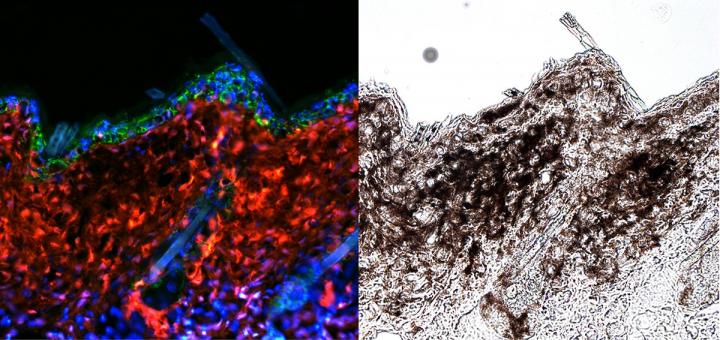
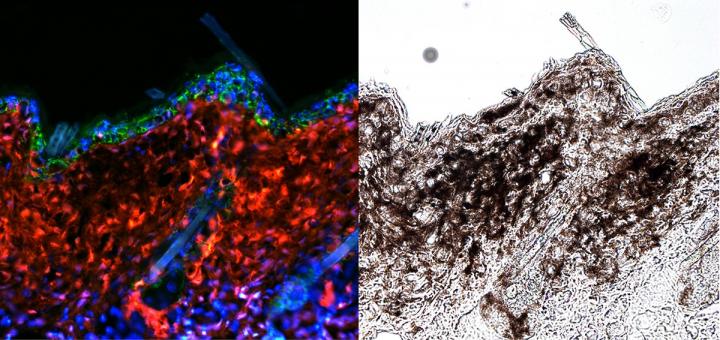
IMAGE

Credit: Hyeongsun Moon and Andrew White, Cornell University

ITHACA, N.Y. – Melanoma, a cancer of skin pigment cells called melanocytes, will strike an estimated 87,110 people in the U.S. in 2017, according to the Centers for Disease Control and Prevention. A fraction of those melanomas come from pre-existing moles, but the majority of them come from sources unknown – until now.

Cornell researchers have discovered that when melanocyte stem cells accumulate a sufficient number of genetic mutations, they can become the cells where these cancers originate. Under normal conditions, ultraviolet (UV) radiation from the sun activates melanocytes to release melanin, a pigment that protects the skin from the sun's rays. But if melanocyte stem cells have surpassed a threshold of genetic mutations, a tumor can start to grow when those skin stem cells are activated by sun exposure.

"If you had mutations that were sufficient for melanoma, everything would be fine until you went out and got a sunburn," said Andrew White, assistant professor of biomedical sciences at Cornell's College of Veterinary Medicine, and senior author of a study published this month in the journal Cell Stem Cell. Hyeongsun Moon, a postdoctoral researcher in White's lab, is the paper's lead author. "The stimuli that would normally just give you a tanning response could in fact start a melanoma instead," White said.

The researchers also may have discovered a way to prevent melanomas caused by mutated stem cells. A gene called Hgma2 was suspected to become expressed in the skin under UV radiation. When expressed, Hgma2 facilitates melanocyte stem cells to move from the base of skin hair follicles to the skin's surface (the epidermis), where the cells release melanin. Moon, White and colleagues used mice engineered with melanocyte stem cell mutations. One set of mice had the mutations, while another set with the mutations had the Hgma2 gene deleted. They then gave the mice a very low dose of UV radiation, just enough to trigger a tanning response. Mice with tumor-causing mutations and the Hgma2 gene intact developed melanomas, but the mice with mutations and the deleted gene remained healthy.

More study is needed to better understand the Hgma2 gene's function.

"We have an actual mechanism, with Hgma2, that can be explored in the future and could be a way we can prevent melanomas from happening," White said.

###

The study was supported by the Office of the Assistant Secretary of Defense for Health Affairs through the Peer Reviewed Cancer Research Program, the Cornell Center for Vertebrate Genomics, the Cornell Stem Cell Program and the National Institutes of Health.

Media Contact

Daryl Ann Lovell
[email protected]
607-592-3925
@cornell

http://pressoffice.cornell.edu

Original Source

http://news.cornell.edu/stories/2017/10/new-findings-explain-how-uv-rays-trigger-skin-cancer

Share12Tweet8Share2ShareShareShare2

Related Posts

β-Sitosterol from Ipomoea carnea Jacq. As a promising anti-inflammatory agent: Evidence from in silico modeling and in vitro validation

β-Sitosterol from Ipomoea carnea Jacq. As a promising anti-inflammatory agent: Evidence from in silico modeling and in vitro validation

August 31, 2026
Design, fabrication and characterization of a wearable Fiber Bragg grating sensor for cardiorespiratory monitoring using finger plethysmography

Design, fabrication and characterization of a wearable Fiber Bragg grating sensor for cardiorespiratory monitoring using finger plethysmography

August 31, 2026

KAIST opens the era of industrial-scale microbial foods, proposing growth strategies for the next-generation protein market

August 31, 2026

Virologist awarded $2 million NIH grant to investigate how virus-infected cells live and die

August 31, 2026
Please login to join discussion

POPULAR NEWS

  • β-Sitosterol from Ipomoea carnea Jacq. As a promising anti-inflammatory agent: Evidence from in silico modeling and in vitro validation

    29 shares
    Share 12 Tweet 7
  • Design, fabrication and characterization of a wearable Fiber Bragg grating sensor for cardiorespiratory monitoring using finger plethysmography

    29 shares
    Share 12 Tweet 7
  • KAIST opens the era of industrial-scale microbial foods, proposing growth strategies for the next-generation protein market

    29 shares
    Share 12 Tweet 7
  • Virologist awarded $2 million NIH grant to investigate how virus-infected cells live and die

    29 shares
    Share 12 Tweet 7

About

We bring you the latest biotechnology news from best research centers and universities around the world. Check our website.

Follow us

Recent News

β-Sitosterol from Ipomoea carnea Jacq. As a promising anti-inflammatory agent: Evidence from in silico modeling and in vitro validation

Design, fabrication and characterization of a wearable Fiber Bragg grating sensor for cardiorespiratory monitoring using finger plethysmography

KAIST opens the era of industrial-scale microbial foods, proposing growth strategies for the next-generation protein market

Subscribe to Blog via Email

Enter your email address to subscribe to this blog and receive notifications of new posts by email.

Join 85 other subscribers
  • Contact Us

Bioengineer.org © Copyright 2023 All Rights Reserved.

Welcome Back!

Login to your account below

Forgotten Password?

Retrieve your password

Please enter your username or email address to reset your password.

Log In
No Result
View All Result
  • Homepages
    • Home Page 1
    • Home Page 2
  • News
  • National
  • Business
  • Health
  • Lifestyle
  • Science

Bioengineer.org © Copyright 2023 All Rights Reserved.