


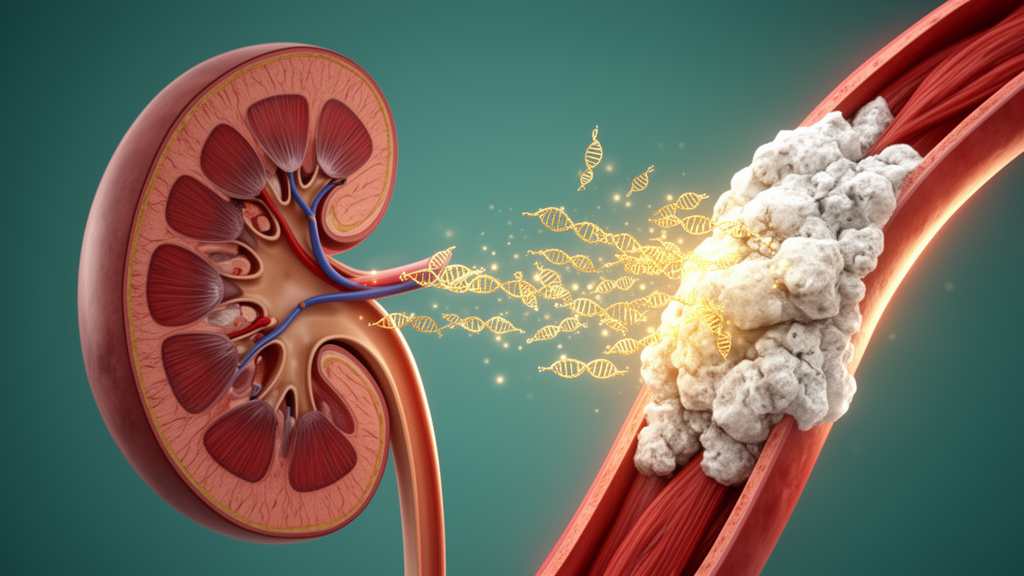
Researchers have identified a small regulatory RNA molecule, miR-3663-3p, that is elevated in patients with chronic kidney disease and appears to play an active role in driving vascular calcification, a common and serious complication of the condition. The study, published in BMC Medical Genomics, reports both diagnostic potential for the microRNA and a mechanistic explanation for how it may accelerate the calcification process.
Vascular calcification, the deposition of calcium in blood vessel walls, is a frequent complication in people with chronic kidney disease. MicroRNAs are known to regulate gene expression and influence this process, and identifying abnormally expressed microRNAs may offer new strategies for clinical intervention, according to the study’s background.
The research team, led by Guangfei Xu, Cunyou Xiong and Ming-En He, set out to investigate the clinical value of miR-3663-3p in chronic kidney disease and its associated vascular calcification, as well as the molecule’s regulatory role in the calcification process itself.
The study included 102 healthy controls and 118 patients with chronic kidney disease. The researchers used RT-qPCR, a laboratory technique for measuring RNA expression, to detect levels of miR-3663-3p in the participants. Receiver operating characteristic analysis and logistic regression were then employed to evaluate the diagnostic value of the microRNA and its capacity for risk prediction in calcification related to chronic kidney disease.
The results showed that, compared with healthy controls, the expression of miR-3663-3p was upregulated in patients with chronic kidney disease, and particularly in those who also had vascular calcification. The microRNA demonstrated high diagnostic value for both chronic kidney disease and its calcification complication, according to the authors’ analysis.
To probe the functional role of the molecule, the team built a laboratory model of calcium deposition using human aortic smooth muscle cells, inducing calcification with high inorganic phosphate. In this model, the level of miR-3663-3p rose, the amount of calcium increased, and osteogenic differentiation markers — Runx2, BMP-2 and ALP — all increased, while the transcriptional levels of smooth muscle cell markers α-SMA and SM22α decreased. This pattern indicates a shift of vascular smooth muscle cells toward a bone-like, calcification-prone state.
Manipulating the microRNA in the cell model strengthened the mechanistic picture. Inhibiting miR-3663-3p effectively reversed the osteogenic differentiation of the phosphate-induced human aortic smooth muscle cells, while overexpressing the molecule promoted that process. These cell-culture findings suggest the microRNA is not merely a passive marker but an active participant in the calcification pathway, although results from induced cell models do not by themselves establish effects in patients.
The researchers also identified the downstream target of the microRNA. A dual-luciferase assay verified that miR-3663-3p directly targets cAMP responsive element modulator, known as CREM. When the team knocked down CREM, this reversed the anti-calcification effect produced by inhibiting miR-3663-3p, placing CREM downstream of the microRNA in the regulatory pathway.
Taken together, the authors conclude that miR-3663-3p demonstrates diagnostic potential for chronic kidney disease and its complication of vascular calcification, likely by targeting CREM to promote the osteogenic differentiation of human aortic smooth muscle cells and thereby advancing the calcification process. The study was published on 8 October 2026 as an open-access research article, and the version shared early is subject to further edits before the final version of record appears.
Because the clinical component was cross-sectional and the mechanistic work was conducted in a cell model, further research would be needed to confirm whether targeting miR-3663-3p or CREM could become a therapeutic strategy for patients. Nevertheless, the findings add a specific molecular candidate to the growing list of microRNAs implicated in vascular calcification associated with chronic kidney disease, and they suggest a measurable biomarker that could support diagnostic evaluation in this patient population.
Subject of Research: The diagnostic value and regulatory role of miR-3663-3p in vascular calcification associated with chronic kidney disease
Article Title: Clinical significance and functional role of miR-3663-3p in vascular calcification associated with chronic kidney disease
Article References: Xu, G., Xiong, C., & He, M.-E. (2026). Clinical significance and functional role of miR-3663-3p in vascular calcification associated with chronic kidney disease. BMC Medical Genomics. https://doi.org/10.1186/s12920-026-02480-w
Image Credits: AI Generated
DOI: 10.1186/s12920-026-02480-w
Keywords: miR-3663-3p, vascular calcification, chronic kidney disease, microRNA, CREM, osteogenic differentiation, human aortic smooth muscle cells, biomarker, RT-qPCR, BMC Medical Genomics, Clinical, significance
News Source: Ophelia Keating. (October 29, 2026). MicroRNA miR-3663-3p emerges as diagnostic marker and driver of kidney disease vascular calcification. Scienmag.



