• HOME
  • NEWS
  • EXPLORE
    • CAREER
      • Companies
      • Jobs
    • EVENTS
    • iGEM
      • News
      • Team
    • PHOTOS
    • VIDEO
    • WIKI
  • BLOG
  • COMMUNITY
    • FACEBOOK
    • INSTAGRAM
    • TWITTER
Tuesday, June 2, 2026
BIOENGINEER.ORG
No Result
View All Result
  • Login
  • HOME
  • NEWS
  • EXPLORE
    • CAREER
      • Companies
      • Jobs
        • Lecturer
        • PhD Studentship
        • Postdoc
        • Research Assistant
    • EVENTS
    • iGEM
      • News
      • Team
    • PHOTOS
    • VIDEO
    • WIKI
  • BLOG
  • COMMUNITY
    • FACEBOOK
    • INSTAGRAM
    • TWITTER
  • HOME
  • NEWS
  • EXPLORE
    • CAREER
      • Companies
      • Jobs
        • Lecturer
        • PhD Studentship
        • Postdoc
        • Research Assistant
    • EVENTS
    • iGEM
      • News
      • Team
    • PHOTOS
    • VIDEO
    • WIKI
  • BLOG
  • COMMUNITY
    • FACEBOOK
    • INSTAGRAM
    • TWITTER
No Result
View All Result
Bioengineer.org
No Result
View All Result
Home NEWS Science News

Newly discovered heart molecule could lead to effective treatment for heart failure

Bioengineer by Bioengineer
August 12, 2014
in Science News
Reading Time: 2 mins read
0
Share on FacebookShare on TwitterShare on LinkedinShare on RedditShare on Telegram

Researchers have discovered a previously unknown cardiac molecule that could provide a key to treating, and preventing, heart failure.
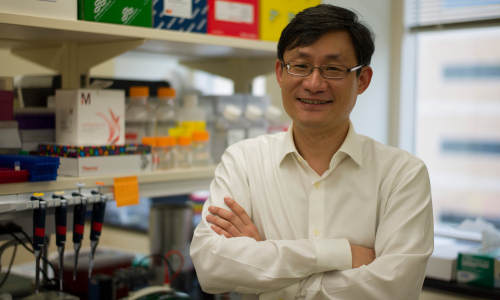
Newly discovered heart molecule could lead to effective treatment for heart failure

The newly discovered molecule provides the heart with a tool to block a protein that orchestrates genetic disruptions when the heart is subjected to stress, such as high blood pressure.

When the research team, led by Ching-Pin Chang, M.D., Ph.D., associate professor of medicine at the Indiana University School of Medicine, restored levels of the newly discovered molecule in mice experiencing heart failure, the progression to heart failure was stopped. The research was published in the online edition of the journal Nature.

The newly discovered molecule is known as a long non-coding RNA. RNA’s usual role is to carry instructions — the code — from the DNA in a cell’s nucleus to the machinery in the cell that produces proteins necessary for cell activities. In recent years, scientists have discovered several types of RNA that are not involved in protein coding but act on their own. The role in the heart of long non-coding RNA has been unknown.

But the researchers determined that the newly discovered non-coding RNA, which they named Myheart — for myosin heavy-chain-associated RNA transcript — is responsible for controlling a protein called BRG1 (pronounced “berg-1”). In earlier research published in Nature in 2010, Dr. Chang and his colleagues discovered that BRG1 plays a crucial role in the development of the heart in the fetus.
But as the heart grows and needs to mature into its adult form, BRG1 is no longer needed, so very little of it is produced. That is, until the adult heart is subjected to significant stress such as high blood pressure or damage from a heart attack. Dr. Chang’s previous research showed that in those conditions, BRG1 re-emerges and begins altering the heart’s genetic activity, leading to heart failure. At the same time, production of Myheart is suppressed, so BRG1 can latch onto the DNA and alter the genetic material unchecked.

In the current Nature paper, the researchers reported that in mice with stress-induced high levels of BRG1, they were able to restore Myheart to normal levels using gene transfer technology. Restoring Myheart levels blocked BRG1 actions and prevented heart failure, they said.

“I think of Myheart as a molecular crowbar that pries BRG1 off the genomic DNA and prevents it from manipulating genetic activity,” said Dr. Chang, director of molecular and translational medicine at the Krannert Institute of Cardiology.

Although the results in mice would suggest testing Myheart against heart failure in humans, it is too large — by molecular standards — to be delivered as a drug, Dr. Chang said.

So he and his colleagues now are working to identify smaller portions of the Myheart molecule that are key to its ability to block BRG1. Such a subsection of the Myheart molecule could lead to a compound to test in human trials.

Story Source:

The above story is based on materials provided by Indiana University.

Share12Tweet8Share2ShareShareShare2

Related Posts

Self-Assembled Cardiac Organoids Model Heart Chambers

June 2, 2026
Citrate-Functionalized Manganese Nanoparticles Tested in Newborns — Technology and Engineering

Citrate-Functionalized Manganese Nanoparticles Tested in Newborns

June 2, 2026

Glyphosate Exposure Linked to Kidney Health in Workers

June 2, 2026

Gladstone Unveils Center for PhAIge Therapy to Combat Drug-Resistant Infections Using AI

June 2, 2026
Please login to join discussion

POPULAR NEWS

  • ESMO 2025: mRNA COVID Vaccines Enhance Efficacy of Cancer Immunotherapy

    321 shares
    Share 128 Tweet 80
  • Multi-Hospital Study Reveals Long Covid Burden Is Twice as High as Current Estimates

    86 shares
    Share 34 Tweet 21
  • Saying Goodbye to PGY-6: Pediatric Fellowship Realities

    66 shares
    Share 26 Tweet 17
  • Common Food Preservatives Associated with Elevated Blood Pressure and Increased Heart Disease Risk

    57 shares
    Share 23 Tweet 14

About

We bring you the latest biotechnology news from best research centers and universities around the world. Check our website.

Follow us

Recent News

Self-Assembled Cardiac Organoids Model Heart Chambers

Citrate-Functionalized Manganese Nanoparticles Tested in Newborns

Glyphosate Exposure Linked to Kidney Health in Workers

Subscribe to Blog via Email

Enter your email address to subscribe to this blog and receive notifications of new posts by email.

Join 82 other subscribers
  • Contact Us

Bioengineer.org © Copyright 2023 All Rights Reserved.

Welcome Back!

Login to your account below

Forgotten Password?

Retrieve your password

Please enter your username or email address to reset your password.

Log In
No Result
View All Result
  • Homepages
    • Home Page 1
    • Home Page 2
  • News
  • National
  • Business
  • Health
  • Lifestyle
  • Science

Bioengineer.org © Copyright 2023 All Rights Reserved.