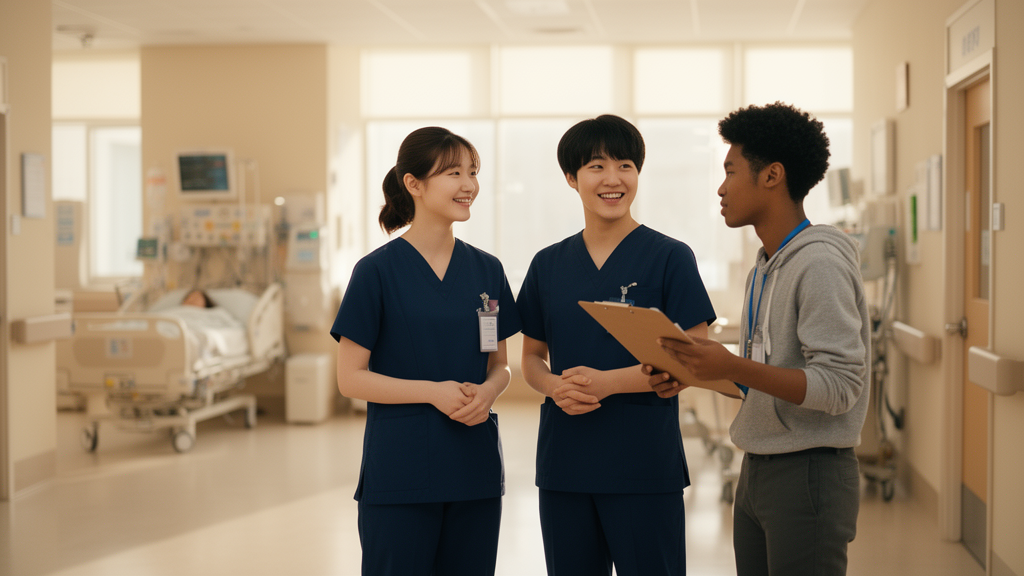
Undergraduate nursing, physiotherapy and dental hygiene students at one private South Korean university described international clinical placements in English-speaking, high-income countries as cross-disciplinary cultural encounters that fostered cultural awareness, critical reflection on healthcare systems and discipline-specific professional development, according to a qualitative study published in BMC Medical Education.
The researchers used a qualitative descriptive design and conducted four online focus group interviews with twenty students: ten from nursing, six from physiotherapy and four from dental hygiene. Transcripts were analysed using conventional content analysis. The study aimed to address a gap in the literature, since existing evidence on international clinical placements is concentrated in nursing and in Western sending countries, and cross-disciplinary evidence on how students experience these placements remains limited, particularly from East Asian sending countries.
Three themes emerged across all three disciplines. The first was navigating cultural and linguistic challenges, the second was reconceptualising patient-centred care, and the third was developing professional competence and identity. Although all disciplines shared a common adaptive trajectory from initial disorientation to active engagement, the researchers found that the challenges and growth took discipline-specific forms. Nursing students’ experiences centred on patient communication and holistic care, physiotherapy students’ on procedural instruction and patient participation in rehabilitation, and dental hygiene students’ on chairside reassurance and preventive education.
The authors concluded that integrating structured international clinical placements into undergraduate curricula, accompanied by linguistic and reflective preparation and discipline-sensitive learning goals, may enhance the preparation of health professions students for practice in diverse and globalised healthcare environments. International clinical placements are increasingly incorporated into undergraduate health professions curricula as a strategy to develop cultural competence and global perspectives.
As a qualitative descriptive study of twenty students at a single university, the findings describe the reported experiences of this particular group rather than measuring outcomes of the placements, and the authors note that the evidence base in this area remains limited for East Asian sending countries and for disciplines beyond nursing.
Subject of Research: Qualitative study of South Korean health professions students' experiences of international clinical placements
Article Title: Healthcare professions students’ experiences of international clinical placement: a qualitative study
Article References: Kang, Y., & Lee, I. (2026). Healthcare professions students’ experiences of international clinical placement: a qualitative study. BMC Medical Education. https://doi.org/10.1186/s12909-026-10379-4
Image Credits: AI Generated
DOI: 10.1186/s12909-026-10379-4
Keywords: international clinical placements, nursing students, physiotherapy students, dental hygiene students, qualitative research, cultural competence, medical education, South Korea, focus groups, professional identity, Healthcare, professions
News Source: Courtney Benton. (October 28, 2026). South Korean health students share what international clinical placements taught them. Scienmag.