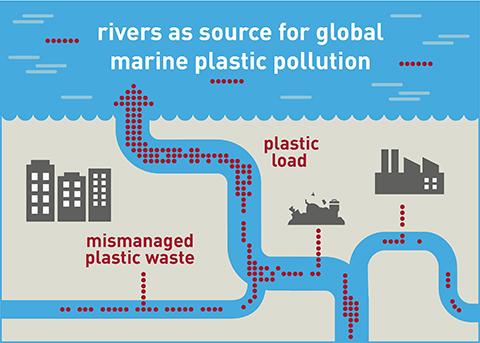
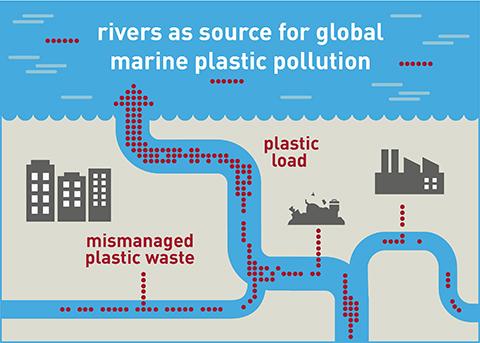
Credit: Graphic: Susan Walter, UFZ
In the meantime, minute plastic particles can be found in the water in virtually every sea and river. This constitutes a serious and growing global environmental problem. There are enormous quantities of input each year and plastic weathers only very slowly. Marine life can be harmed by the tiny plastic particles floating in the water. One example of how this happens is when fish, seabirds or marine mammals mistake the particles for food and consume them. "It is still impossible to foresee the ecological consequences of this. One thing is certain, however: this situation cannot continue," says Dr. Christian Schmidt, a hydrogeologist at the UFZ. "But as it is impossible to clean up the plastic debris that is already in the oceans, we must take precautions and reduce the input of plastic quickly and efficiently."
However, in order to take practical measures to reduce plastic input, it will be necessary to answer the initial questions: Where does all the plastic come from anyhow? And how does it get into the sea? Schmidt and his team addressed these questions in a study that recently appeared in the current issue of Environmental Science & Technology journal. For this purpose, the researchers analysed various scientific studies that examined the plastic load – that is the quantity of plastic carried by the water – in rivers. They converted the results of the studies into mutually comparable datasets and determined the ratio of these figures to the quantity of waste that is not disposed of properly in the respective catchment area. "We were able to demonstrate that there is a definite correlation in this respect," says Schmidt. "The more waste there is in a catchment area that is not disposed of properly, the more plastic ultimately ends up in the river and takes this route to the sea." In this context, large rivers obviously play a particularly large role – not only because they also carry a comparatively large volume of waste on account of their larger discharge. Schmidt says, "the concentrations of plastic, i.e. the quantity of plastic per cubic metre of water are significantly higher in large rivers than small ones. The plastic loads consequently increase at a disproportionately higher rate than the size of the river."
The researchers have also calculated that the ten river systems with the highest plastic loads (eight of them are in Asia and two in Africa) – areas in which hundreds of millions of people live, in some cases – are responsible for around 90 percent of the global input of plastic into the sea. "Halving the plastic input from the catchment areas of these rivers would already be a major success", says Schmidt. "To achieve this, it will be necessary to improve the waste management and raise public awareness for the issue. We hope that our study will make a contribution to a positive development so that the plastic problem in our oceans can be curbed in the long run."
In future investigations, the UFZ team intends to find out how long plastic debris takes to reach the sea once it gets into a river. Does it take only a few months or even decades? "It is important to be aware of this as the impact of a measure becomes apparent only with a corresponding time delay as existing pollution has yet to be washed into the sea", explains Schmidt. "Only when we are aware of roughly how long plastic debris remains in the respective river system will it also be possible to assess a measure to improve the waste management system in the catchment area."
###
Media Contact
Christian Schmidt
[email protected]
49-341-235-1986
@ufz_de
http://www.ufz.de/
Original Source
http://www.ufz.de/index.php?en=36336&webc_pm=34/2017 http://dx.doi.org/10.1021/acs.est.7b02368