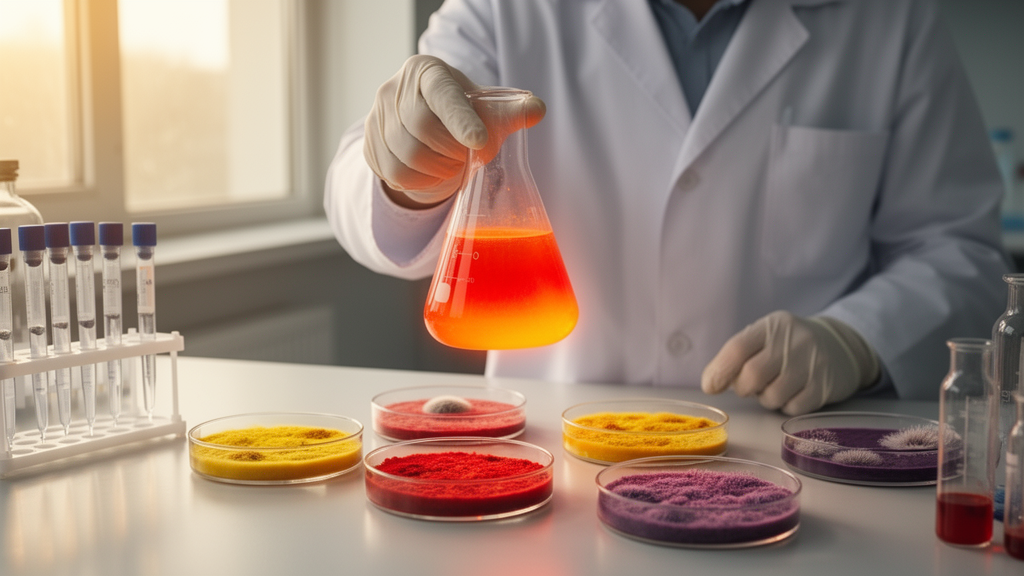
Filamentous fungi can produce an extraordinary palette of colours, from the grey of melanin to the maroon of anthraquinones, the orange and yellow of carotenoids, the purple and black of naphthoquinones, and the red-purple of azaphilones. A new review published on 2 June 2026 in Biotechnology for Sustainable Materials surveys two decades of patent activity and market data on these pigments, and concludes that while commercial interest is clearly growing, only a small number of fungal pigments have so far reached the market.
The patent search was conducted in the Espacenet database of the European Patent Office and the World Intellectual Property Organisation database, using combinations of the terms fungal, yeast, pigments and colourants in patent titles and abstracts, with the last search performed on 30 June 2024. From 535 patents identified between 2004 and 2024, the team screened for grant status and applied criteria covering strain isolation, production methods, biotechnological interventions, direct product formulation and indirect involvement of pigment-producing strains. After removing duplicates, 63 granted patents remained for descriptive analysis. The review notes that the period from 2015 to 2024 produced 37 of these patents, compared with 21 in the period from 2004 to 2014, a pattern the authors interpret as evidence that global markets have begun to acknowledge the potential of fungal pigments and to capture their value through intellectual property rights.
The geographical distribution of the granted patents is strikingly concentrated. China holds 41 of the 63 patents, while the United States and the Republic of Korea hold five each, followed by India, the Philippines and Russia with two each, and the Czech Republic, Denmark, Egypt, France and Japan with one each. The authors connect this pattern to the long-standing tradition of fermented foods in East Asia, which aligns with prominent contributions in the Monascus genus. Genus-wise, Monascus dominates with 60 percent of the filed patents, producing red, orange, yellow and purple pigments that have been used in products ranging from biscuits and yam beverages to wine, beer, curd and nutritional rice. Other genera with more than one patent include Penicillium, Phaffia and Trichoderma, with Penicillium species yielding Monascus-like azaphilone red pigments and a green pigment, and Phaffia featuring in strain development and cultivation patents for enhanced astaxanthin production.
Approximately half of the granted patents focus on pigment production methods and biotechnological interventions rather than end products. The primary research emphasis, the review reports, is on improving process efficiency, yield and cost-effectiveness through optimised growth conditions, strain modification, extraction techniques, fermentation processes, downstream processing and pigment stabilisation. Some patents also aim to reduce hazardous solvents and incorporate greener technologies for producing known pigments, reflecting an industry shift toward sustainable pipelines. Product-based patents cluster around food, beverages, cosmetics and other consumer commodities, while areas such as paints, coatings, automobiles, electronics, textiles and leather production have only small numbers of patents, which the authors describe as future opportunities.
The historical record of fungal colour production is longer than the patent window suggests. The first reported patent on a fungal pigment, based on astaxanthin production by the yeast-like fungus Phaffia rhodozyma, was filed by Danisco Bioteknologi AS in Denmark under patent number DK199887 in 1987. The first commercially available fungal pigment, according to the review, was Arpink Red, an anthraquinone-class pigment similar to the carminic acid found in insects, produced from Penicillium oxalicum var. Armeniaca and used in the food and beverage industry. The European Union has licensed Blakeslea trispora as an industrial fungus for producing the food pigment lycopene, and the United States Food and Drug Administration has granted Generally Recognized as Safe status to beta-carotene from Blakeslea trispora, riboflavin from Ashbya gossypii and Arpink Red from Penicillium oxalicum.
The market context explains much of the growing interest. The global organic colours market was valued at 4.4 billion US dollars in 2024 and is expected to reach 6.0 billion dollars by 2032, reflecting a compound annual growth rate of 8.7 percent, driven by rising demand for environmentally sustainable products, stricter regulatory standards and broader industrial applications. The Asia Pacific region accounts for more than half of the global market share, with Europe contributing a little over 15 percent of overall market revenue. Restrictions on certain azo dyes in India, China, Vietnam, Japan and the European Union, along with stricter regulation of inorganic pigments such as cadmium and lead sulfochromate yellow, are among the major reasons manufacturers are shifting investments toward bio-based pigments and dyes. In the current decade, the textile sector has been the biggest consumer of colours, while demand from plastics, paints, coatings and printing inks is projected to grow faster.
Yet the path from laboratory to market remains narrow, and the review is candid about the obstacles. The primary obstacle to large-scale production is the comparatively lower yield of desired pigments than synthetic counterparts. Fungi synthesize pigmented metabolites through the shikimic acid, polyketide and mevalonic acid pathways as well as through polysaccharide and amino acid derivatives, and enhancing commercial productivity requires a detailed understanding of each biosynthetic pathway, the environmental factors that induce production, and the relationship between biomass accumulation and pigment synthesis. Recent advances in genetics and omics technologies have helped by elucidating the relationships between biosynthetic gene clusters and target compounds, facilitating increased yields. A further significant challenge is the co-production of mycotoxins: Monascus, the most-patented genus, is known to co-secrete the hepato-neurotoxin citrinin, which has led to restrictions on its use in the European Union and the United States, although various fermentation conditions have been optimised to minimise citrinin while increasing pigment yield.
Downstream processing adds another layer of difficulty. Recovery of intracellular pigmented metabolites is often costly, because cell lysis and separation from unwanted compounds are energy- and time-intensive processes requiring large volumes of solvent, whereas extracellular pigments are generally more cost-effective to isolate. Extraction techniques such as ultrasonic, microwave, pulsed electric field or supercritical extraction, when used with solvents recognised as safe, can make the process less resource-intensive. The review also highlights a methodological gap that hinders the transition from research to industry: most studies identify pigments by spectrometry based on absorbance at specific wavelengths, while industrial shade identification relies on colorimetric analysis using additive, subtractive and device-independent colour spaces. For textile applications, the often-lower photostability of fungal pigments compared with synthetic dyes necessitates research into protective methods such as ultraviolet absorbers, antioxidants or hindered amine light stabilisers.
Regulatory frameworks vary substantially across jurisdictions and shape the commercialisation pathway. In the European Union, the European Food Safety Authority requires Novel Food authorisation if a pigment was not consumed to a significant degree in the EU before 15 May 1997, and Monascus-fermented red yeast rice is registered as a common ingredient in cosmetics and food with specific requirements of less than 2 milligrams per kilogram of citrinin and less than 3 milligrams of monacolin. In the United States, fungal pigments are regulated as food or colour additives under the Federal Food, Drug, and Cosmetic Act. In India, the Food Safety and Standards Authority of India requires testing for safety, efficacy and purity. Cosmetic registration similarly differs, requiring a Product Information File in the EU, a detailed safety assessment and manufacturing licence in India, and a record of product safety and adverse effects for the Cosmetic Ingredient Review committee in the United States.
Looking forward, the authors argue that bioprospecting for new pigment-producing fungi, including from extreme environments such as high temperature, salinity, pressure and altitude, could yield robust fungal cell factories, with marine ecosystems noted as still underexplored despite comprising over 80 percent of biota. They call for comprehensive life cycle assessments, multi-omics-based pathway elucidation and scalable downstream processing technologies, alongside robust safety protocols and targeted stability testing to ensure regulatory compliance across markets. The review cites a 2021 toxicity analysis by Poorniammal and colleagues covering multiple industrially significant fungal strains and assessing subacute, genotoxic, cytotoxic, acute oral, phytotoxic and subchronic toxicity outcomes. With coordinated efforts in strain improvement, yield and stability enhancement and regulatory approval, the authors conclude, full-scale industrial production of fungal pigments is attainable, and continued research, development and patenting will be essential to establish them as a sustainable, competitive alternative in the natural colour industry.
Subject of Research: Patent landscape and global market analysis of filamentous fungal pigments from 2004 to 2024
Article Title: Exploring the rainbow of filamentous fungal pigments: a comprehensive patent and global market analysis (2004–2024)
Article References: Kaur, M., Peshwani, H., Uniyal, P. L., Barrow, C. J., & Goel, M. (2026). Exploring the rainbow of filamentous fungal pigments: a comprehensive patent and global market analysis (2004–2024). Biotechnology for Sustainable Materials, 3(1), Article 9. https://doi.org/10.1186/s44316-026-00060-7
Image Credits: AI Generated
DOI: 10.1186/s44316-026-00060-7
Keywords: fungal pigments, filamentous fungi, patents, natural colorants, Monascus, azaphilones, carotenoids, melanin, mycotoxins, food industry, cosmetics, market analysis
News Source: Gregory Coleman. (October 28, 2026). Fungal Pigments Draw Rising Patent Interest as Industries Seek Natural Colours. Scienmag.