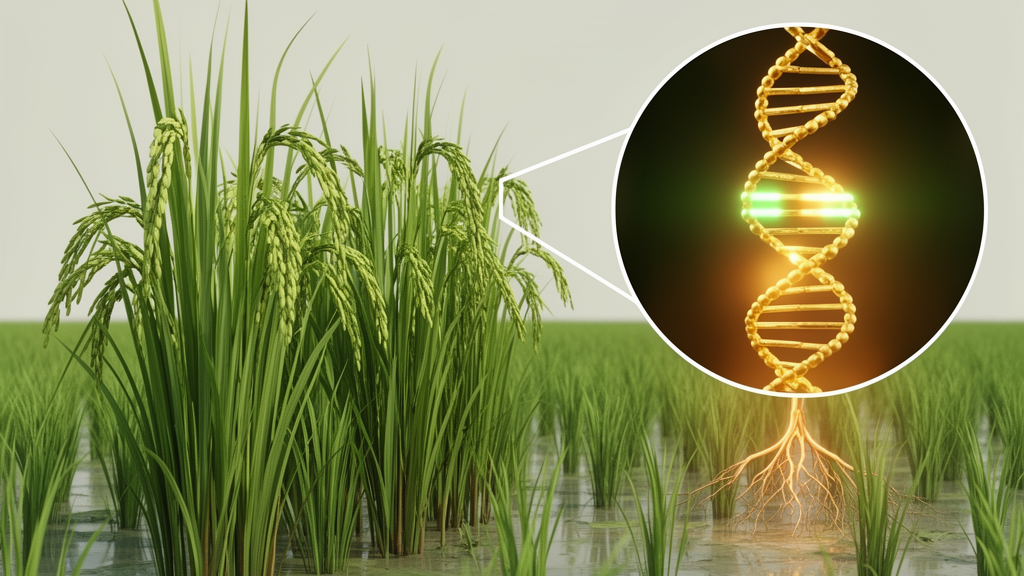
Sixty years after the semi-dwarf rice variety IR8 helped transform Asian agriculture, a new genomic analysis has traced the two genetic changes behind its success back to their roots. By combing through whole-genome sequences from the 3K Rice Genomes Project, Taiwanese landraces, and Asian wild rice, researchers reconstructed the evolutionary history of the SD1 gene, the master regulator of rice semi-dwarfism, and showed that a second gene controlling photoperiod sensitivity traveled alongside it. The study, published in Botanical Studies, argues that the Green Revolution depended not on one miracle mutation but on the combined loss of function of two genes, sd1 and hd1, both inherited from a single Taiwanese semi-dwarf landrace called Dee-Geo-Woo-Gen, or DGWG.
The semi-dwarf trait was the engine of the Green Revolution of the 1960s, which dramatically increased global production of rice and wheat and helped feed a rapidly expanding world population. Semi-dwarf rice plants have shorter, stiffer culms that resist lodging, the collapse of tall stems under wind, rain, or heavy nitrogen fertilizer. Before the Green Revolution, most indica landraces in Southeast Asia stood more than 160 centimeters tall at maturity, with some varieties such as Peta reaching 180 to 190 centimeters, and most were late maturing because of photoperiod sensitivity, meaning they flowered only when day length was right. The new semi-dwarf varieties broke both constraints, allowing heavier fertilization and, eventually, multiple harvests per year.
The key gene is sd1, which encodes GA20ox-2, an enzyme that catalyzes late steps in the biosynthesis of gibberellic acid, the plant hormone that drives stem elongation. IR8, bred at the International Rice Research Institute and released in late 1966, carried a 383-bp deletion in GA20ox-2 spanning parts of exons 1 and 2 that abolishes the gene’s function. The deletion came from DGWG, a Taiwanese native semi-dwarf indica landrace, which was crossed with the tall, high-quality Indonesian variety Peta to create IR8. An earlier cross between DGWG and the Taiwanese landrace Tsai-Yuan-Chung had already produced Taichung Native 1, released in 1957, the first semi-dwarf modern rice variety and itself a Green Revolution landmark.
In the new study, the team classified SD1 into 12 haplotypes, including two previously unknown loss-of-function alleles: a 1,279-bp deletion that removes the promoter, exon 1, and intron 1, and an E100/R340 amino acid variant. The ten other haplotypes had been described before, including the 383-bp DGWG deletion, the G94V substitution in the Japanese variety Jikkoku, the D349H substitution in the gamma-ray-induced mutant Reimei, the L266F substitution in Calrose 76, a 2-bp frameshift in Aijiao-Nante, a P240L substitution in Zhayeqing 8, a Tyr342 stop codon in 9311, and a Tyr300 stop codon in Pusa 1652. Using plant height data from the IRRI SNP-SEEK database, the researchers showed that plants carrying haplotypes 2 through 10 were significantly shorter than wild-type plants, while the newly found ER allele left plant height unchanged.
The phylogenetic detective work produced one of the study’s most striking findings: the famous 383-bp deletion traces back to a wild rice accession. A previous study had suggested the DGWG allele arose in wild rice in southern China, and the new analysis sharpened that picture. Of the two wild accessions previously implicated, only W1718, collected in Guangdong, southern China, actually carries the deletion; the other, W1944, does not, possibly a case of seed mixing in the stock center. The SNP patterns of twelve landraces and modern varieties with the 383-bp deletion, together with W1718, are essentially identical across a 2.7-kb region spanning the promoter, exons, introns, and untranslated regions of SD1. Tandem repeat patterns in the surrounding one megabase told the same story: the five Taiwanese semi-dwarf landraces and W1718 share nearly identical repeat landscapes, while other wild rice accessions from southern China each have unique patterns.
The researchers concluded that the 383-bp deletion originated in wild rice W1718 in southern China and was introgressed into neighboring landraces, probably in agro at least 500 years ago, before the mass migration of Han people to Taiwan during the Ming and Qing dynasties, primarily between the seventeenth and nineteenth centuries. When roughly a thousand rice lines were brought to Taiwan from southern China, some already carried the semi-dwarf mutation. Phylogenetic and whole-genome comparisons suggest that DGWG and another Taiwanese landrace, Hsinchu-Ai-Chueh-Chien, are the accessions most likely brought to Taiwan by Han migrants. Semi-dwarf landraces carrying the deletion were not preserved in southern China, but wild rice accessions such as W1718, untouched by human selection, continued to propagate and retain it.
Not all SD1 variation is ancient. The type 6 haplotype with the 1,279-bp deletion was found in ten tropical japonica accessions, all collected in mountainous regions of Laos and Thailand, and phylogenetic analysis showed it derives from a different lineage than the 383-bp deletion, despite the two deletions’ endpoints lying only 13 base pairs apart on chromosome 1. The Zhayeqing 8 allele appears to have arisen in insular Southeast Asia, since more than 95 percent of the traditional landraces carrying it were collected in Indonesia and Malaysia. The 9311 and Aijiao-Nante mutations both occurred in agro in China. Meanwhile, a selective sweep analysis of traditional japonica landraces found that only the E100/Q340 allele, the EQ variant, showed a significantly negative Tajima’s D, consistent with early selection: the EQ allele was chosen and maintained during japonica domestication roughly 5,000 years ago and is now homozygous in 89 percent of traditional japonica landraces, while about 81 percent of indica accessions carry the wild-type GR allele.
To understand how these mutations cripple the enzyme, the team built a structural model of GA20ox-2, since no crystal structure exists. Using the related enzyme GA2ox3 as a template, with which GA20ox-2 shares 42 percent sequence similarity, they generated a docking model with the substrate GA20 and the cofactor succinate. For the EQ variant, whose two substitutions did not map to obvious structural features, the authors hypothesize that the changes instead affect protein stability. These structural insights, the authors note, could guide genome-editing strategies aimed at precisely manipulating plant height, particularly given that CRISPR-Cas9 editing of SD1 has produced mixed results in previous studies, with some edited lines showing reduced seed production despite shorter stature.
The second half of the Green Revolution equation is Hd1, the rice ortholog of Arabidopsis CONSTANS, a key regulator of photoperiod sensitivity. Screening SD1 and Hd1 genotypes across the 3K dataset and Taiwanese landraces revealed that DGWG, IR8, Tsai-Yuan-Chung, and Taichung Native 1 all carry the type 7 hd1 loss-of-function allele, while Peta carries type 13. Both hd1 mutations, like the sd1 deletion, originated in insular Southeast Asia thousands of years ago, according to the authors’ earlier work. Among accessions from India, Indonesia, and the Philippines, the three major indica-producing countries in the dataset, the frequency of the type 7 hd1 allele rose 83 percent from before to after the Green Revolution, compared with only 20 percent for the Peta type 13 allele. Most modern indica varieties thus inherited both loss-of-function sd1 and hd1 alleles from DGWG.
The numbers underscore how heavily breeders leaned on the Taiwanese germplasm. The DGWG-type sd1 allele accounts for 17 percent of accessions in the 3K panel, and more than 400 modern varieties, about 35 percent of the modern varieties in the dataset, carry the 383-bp deletion. All modern indica varieties in the dataset carry a type 7 to 10 sd1 allele, whereas few modern japonica varieties have loss-of-function SD1 mutations, since most japonica cultivars are already shorter thanks to the partially functional EQ allele. Because indica rice accounts for roughly 80 percent of worldwide rice production, the mutated SD1 gene stands as one of the primary reasons for the increase in rice production since the mid-1960s. Combined with photoperiod insensitivity, which allowed earlier maturity and multiple cropping seasons, the dual genetic legacy of a single Taiwanese landrace, the authors conclude, formed the foundation of the Green Revolution in rice.
Subject of Research: Evolutionary origins and functional impacts of SD1 and Hd1 haplotypes underlying semi-dwarfism and photoperiod insensitivity in Green Revolution rice varieties
Article Title: Both semi-dwarf and photoperiod-insensitive traits in rice were important for the Green Revolution
Article References: Wu, C.-C., Tseng, Y.-T., Huang, L.-T., Liu, C.-K., Hsu, K.-C., Wang, H.-C., Hsing, Y.-I. C., & Chiou, W.-Y. (2026). Both semi-dwarf and photoperiod-insensitive traits in rice were important for the Green Revolution. Botanical Studies, 67(1), Article 6. https://doi.org/10.1186/s40529-026-00493-3
Image Credits: AI Generated
DOI: 10.1186/s40529-026-00493-3
Keywords: rice, Green Revolution, sd1 gene, GA20ox-2, semi-dwarfism, photoperiod insensitivity, hd1, DGWG, haplotypes, 3K Rice Genomes Project, wild rice, genomic analysis
News Source: Juliet Wilcox. (October 28, 2026). Rice’s Green Revolution traced to two key genes from a Taiwanese landrace. Scienmag.