


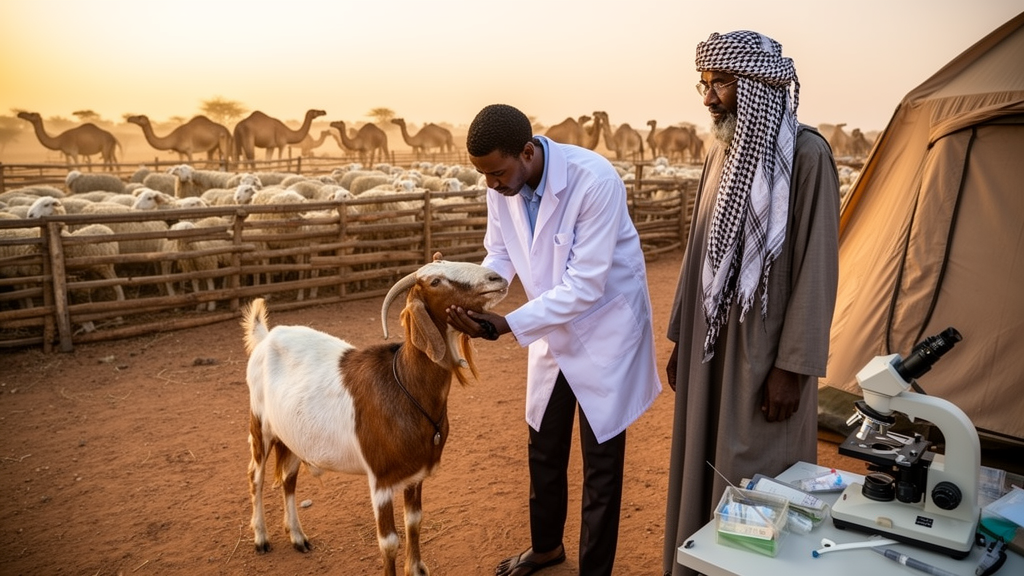
Somalia’s pastoral and livestock-trade systems bring people into repeated contact with camels, small ruminants, and disease-carrying vectors through mobile herds, livestock markets, export quarantine stations, slaughter points, and animal-product handling. In a Letter to the Editor published in New Microbes and New Infections, researchers argue that these same interfaces could serve as practical early-warning platforms for zoonotic infections, provided that animal, vector, and human health signals are monitored together rather than in isolation.
The authors focus on three viruses: Middle East respiratory syndrome coronavirus (MERS-CoV), Rift Valley fever virus (RVFV), and Crimean–Congo haemorrhagic fever virus (CCHFV). Their rationale for grouping these pathogens is explicitly operational rather than ecological. MERS-CoV and RVFV were among the zoonoses prioritized for multisectoral One Health action in Somalia in 2023, whereas CCHFV was not among the highest-ranked priorities. The authors therefore propose surveillance for each pathogen for different but complementary reasons: the first two reflect recognized national priorities, while CCHFV is a more evidence-limited target whose inclusion, they argue, warrants investigation at relevant livestock, tick, and occupational interfaces.
The strength of the underlying evidence differs considerably across the three infections. For MERS-CoV, the authors cite a study in northern Kenya in which viral RNA was detected in 83 of 243 prospectively followed camel calves, a detection rate of 34.2 percent. Three previously reported human PCR-positive cases clustered geographically and temporally with the camel outbreak, supporting probable sporadic spillover. The authors present this as a regional example of how targeted camel surveillance can identify animal infections and relevant human warning signals in a setting comparable to Somalia’s own camel-keeping systems.
For Rift Valley fever, Somalia has documented serological evidence of exposure in ruminants. In communities along livestock-movement routes in Kenya, an RVFV IgG prevalence of 36.4 percent was reported, with greater exposure among men and among people reporting regular livestock contact or participation in animal birthing. Taken together, the authors argue, these findings support surveillance focused on livestock movement corridors, where animal infections and human exposure risks are most likely to converge.
Contemporary in-country evidence for CCHFV in Somalia remains limited. The key supporting observation cited in the letter is the detection of CCHFV RNA in five Hyalomma tick pools collected from camels imported from Somalia into Egypt. The authors are careful about what this does and does not show: it supports CCHF as a surveillance hypothesis at relevant Somali livestock and vector interfaces, but it does not constitute evidence of established contemporary human transmission within Somalia. This distinction between a plausible signal and a documented national burden runs throughout their argument.
Although the three pathogens differ substantially in their transmission patterns, the authors note that their surveillance opportunities converge at a limited number of practical sentinel locations within Somalia’s livestock system. MERS-CoV is primarily associated with dromedary camels; RVFV involves ruminants, mosquitoes, and direct contact with infected animal tissues; and CCHFV is principally maintained through tick–livestock cycles, with occupational exposure to infected ticks, blood, and tissues. Mobile herd routes, livestock markets, export quarantine stations, and slaughter facilities could, in their view, capture complementary animal, vector, and occupational warning signals while retaining pathogen-specific triggers, sampling methods, and laboratory confirmation.
The proposed design is deliberately targeted rather than broad. The authors recommend selected high-volume livestock markets, export quarantine stations, and slaughter facilities as sentinel sites, with surveillance signals tailored to each pathogen: camel respiratory sampling and investigation of compatible severe respiratory illness among highly exposed workers for MERS-CoV; livestock abortion or unusual mortality clusters, seasonal mosquito surveillance, and compatible acute febrile illness for RVFV; and Hyalomma tick surveillance together with investigation of unexplained febrile or hemorrhagic illness among slaughterhouse, veterinary, and other highly exposed workers for CCHFV. Surveillance intensity could then increase following predefined triggers, such as abortion clusters, unusual livestock mortality, increased vector activity, or clusters of compatible human illnesses.
To make such a system operational, the authors propose feeding alerts, specimen referral, and laboratory confirmation into Somalia’s Integrated Disease Surveillance and Response system and District Health Information Software 2, alongside relevant animal health and One Health reporting mechanisms. Because entomological surveillance, molecular testing, and sequencing require specialized personnel and laboratory capacity, they suggest starting at a small number of high-volume sentinel sites, using event-based triggers to prioritize testing, and strengthening specimen referral while in-country diagnostic capacity develops.
The letter frames the broader question of preparedness in terms of capability rather than documented burden. Somalia’s zoonotic preparedness, the authors argue, should be judged not by whether every emerging infection is already documented nationally, but by whether animal, vector, and occupational surveillance can detect and act on credible warning signals before zoonotic spillover emerges as an unexplained severe human disease. As a Letter to the Editor based on previously published studies, the piece proposes a surveillance framework rather than presenting new data; its recommendations rest on regional findings from Kenya and Egypt and on Somalia’s own priority-setting exercise, and the authors acknowledge that the evidence base for each of the three pathogens differs in strength.
Subject of Research: A proposal for One Health sentinel surveillance of MERS-CoV, Rift Valley fever virus and Crimean–Congo haemorrhagic fever virus at Somalia's livestock–vector–human interfaces.
Article Title: Somalia’s Livestock–Vector–Human Interface as a One Health Early-Warning Gap: Sentinel Surveillance for MERS-CoV, Rift Valley Fever, and CCHF
Article References: Mohamed, S. H., Mohamed, H. A., Sudi, L. A., & Abdullahi, Y. B. (2026). Somalia’s Livestock–Vector–Human Interface as a One Health Early-Warning Gap: Sentinel Surveillance for MERS-CoV, Rift Valley Fever, and CCHF. New Microbes and New Infections, Article 101877. https://doi.org/10.1016/j.nmni.2026.101877
Image Credits: AI Generated
DOI: 10.1016/j.nmni.2026.101877
Keywords: Somalia, MERS-CoV, Rift Valley fever, Crimean-Congo haemorrhagic fever, One Health, sentinel surveillance, zoonoses, livestock, camels, Hyalomma ticks, early warning, livestock trade
News Source: Kristina Jarvis. (October 28, 2026). Somalia’s Livestock Sentinel Sites Could Give Early Warning for Three Zoonotic Viruses. Scienmag.



