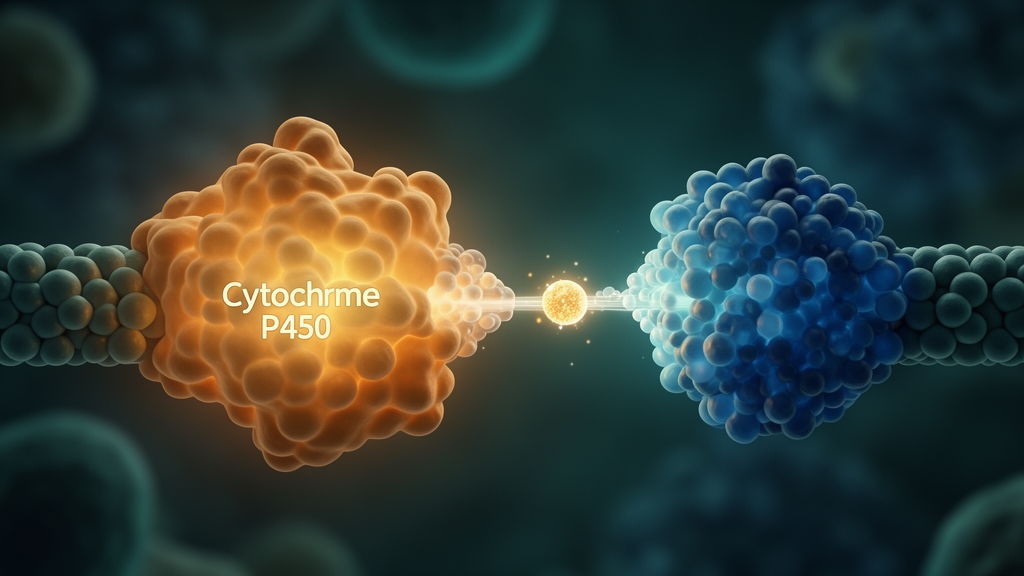
These monooxygenases depend on partner proteins that shuttle electrons from nicotinamide cofactors into the P450 active site.
Cytochrome P450 reductases, or CPRs, are microsomal diflavin oxidoreductases. They carry a dual complement of flavin cofactors, FAD and FMN, and pass electrons to class II cytochrome P450 monooxygenases. The team, led by Mphumzi Songezo Gidaga, Martha Sophia Smit, Ana Cristina Ebrecht and Diederik Johannes Opperman, set out to expand the structural landscape of these enzymes because, despite decades of study, the available data remain insufficient to fully explain how CPRs transfer electrons and how they interact with such a wide range of redox partners.
The study, published on 23 October 2026 and shared early as a citable, peer-reviewed accepted manuscript, compared the two fungal CPRs with previously characterized reductases. A practical hurdle had long limited such work: CPRs are membrane-associated proteins that are difficult to produce in soluble form. The researchers overcame this by truncating the N-terminal regions of the enzymes, which enabled soluble expression in Escherichia coli and allowed kinetic parameters to be measured using two standard nonphysiological electron acceptors, cytochrome c and ferricyanide.
The structural comparison produced a surprise. Although the M. maydis enzyme, UmaCPR, shares greater sequence similarity with ascomycete CPRs, which include the Candida enzyme, its overall three-dimensional structure displays features more closely resembling mammalian CPRs, including its FAD-binding topology.
Structure alone does not determine performance, however. The researchers tested whether the two truncated CPRs could support the activity of CYP52A21, a cytochrome P450 enzyme from Candida albicans. Both truncated reductases did support CYP activity, but the degree of support depended strongly on the reaction environment in which the enzyme pair was reconstituted.
The most striking result came from adding a third player to the reaction. When cytochrome b5 from Mycosarcoma maydis was included as a redox mediator, product formation by the P450 enzyme was significantly enhanced. Notably, this boost occurred even when a nonnative CPR was used, meaning the mediator could improve electron delivery across mismatched enzyme pairings rather than only fine-tuning a naturally matched pair.
This observation extends the complexity of P450 electron transfer beyond the canonical one-to-one picture in which a single reductase hands electrons directly to a single P450. CPRs are already known to reduce other proteins in cells, including cytochrome b5, heme oxygenase and components of the fatty acid elongation system, as well as nonphysiological acceptors such as cytochrome c, ferricyanide and various drugs. The new results show that such additional redox components are not passive background but can actively shape, and in this case improve, the output of a P450 reaction.
For biotechnology, the implications are concrete.
For basic biology, the work highlights both the structural diversity and the functional plasticity of cytochrome P450 reductases across the fungal kingdom. A basidiomycete enzyme that looks, structurally, like a mammalian CPR yet supports fungal P450 chemistry, and a mediator protein borrowed from the same fungus that rescues nonnative pairings, together paint a picture of electron transfer as a flexible, context-dependent system. As the authors note, the structural and functional data on CPRs remain too sparse to fully elucidate their electron transfer mechanism, making each newly characterized reductase a valuable addition to a still incomplete map.
Subject of Research: Structural and functional characterization of fungal cytochrome P450 reductases and the influence of redox mediators on P450-catalyzed reactions
Article Title: Expanding the structural landscape of cytochrome P450 reductases and the effect of redox mediators on CYP-catalyzed reactions
Article References: Gidaga, M. S., Smit, M. S., Ebrecht, A. C., & Opperman, D. J. (2026). Expanding the structural landscape of cytochrome P450 reductases and the effect of redox mediators on CYP-catalyzed reactions. Applied Microbiology and Biotechnology. https://doi.org/10.1007/s00253-026-14078-4
Image Credits: AI Generated
DOI: 10.1007/s00253-026-14078-4
Keywords: cytochrome P450, cytochrome P450 reductase, Candida albicans, Mycosarcoma maydis, cytochrome b5, electron transfer, redox mediators, diflavin oxidoreductase, fungal biocatalysis, CYP52A21, protein structure, enzyme kinetics
News Source: Gregory Coleman. (October 28, 2026). Fungal Enzyme Partners Reshape How Cytochrome P450 Reactions Are Powered. Scienmag.