


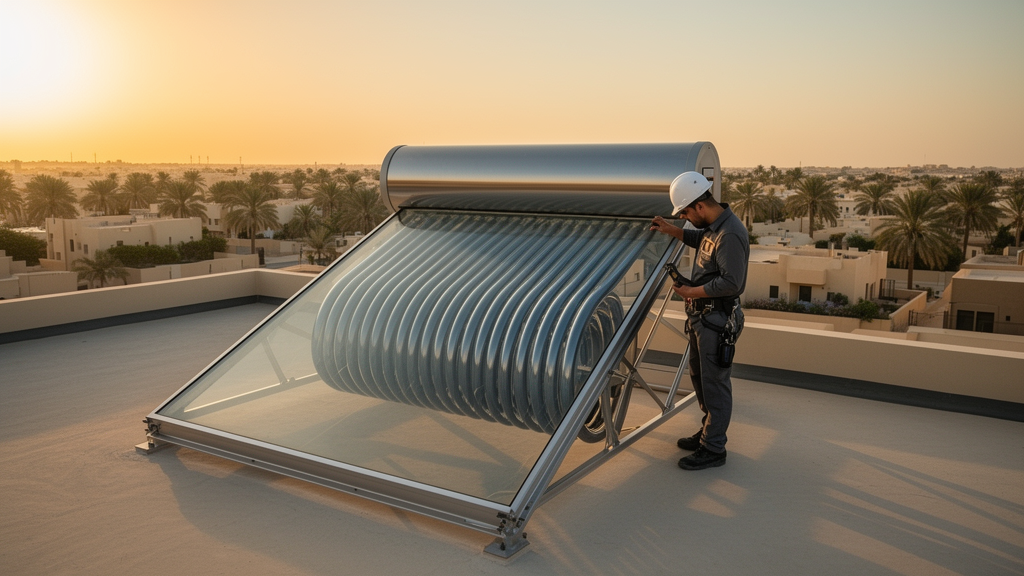
Engineers studying the residential districts of Jubail Industrial City in Saudi Arabia have put forward a detailed performance-based case for replacing conventional electric space and shower heaters with a redesigned flat plate solar collector. The proposed unit pairs a standard flat collector architecture with a black mirror absorber surface and helically wound riser tubes, and the analysis concludes that a household running one or two of these collectors could shave between 21.4 and 23.3 percent off its yearly electricity bill. The finding matters because Jubail’s residential consumers, who typically use between one thousand and six thousand kilowatt-hours per month, pay an average of no less than 0.18 Saudi riyals per kilowatt-hour, while households exceeding six thousand kilowatt-hours face a tariff of no less than 0.30 riyals per kilowatt-hour.
The economics of the existing heating load are central to the argument. Most space and shower heaters in the study’s scope run from a 120-volt outlet, draw no more than 15 amps depending on the model and its size, and require no less than 1,500 watts of power, that is 1.5 kilowatts, day and night. Across a year, the space and shower heater demand amounts to no less than 1,642 kilowatt-hours per flat solar collector equivalent, with a daily cost ranging from 6.48 to 10.8 riyals depending on the size of the heaters involved. Against that baseline, the annual saving from the space and shower heater substitution is estimated at approximately 2,700 riyals per year for a two-collector installation, a figure the authors derive by multiplying an annual offset of 7,500 kilowatt-hours by the 0.18 riyal-per-kilowatt-hour residential tariff and a factor of two collectors.
The design itself departs from conventional serpentine or U-shaped collector patterns. In a helical riser configuration, the working fluid travels a longer heat-transfer path, and the curvature generates a secondary swirl effect that promotes convective heat transfer between the absorber surface and the fluid, raising outlet temperatures for a given mass flow rate and collector area. The absorber is specified as a black mirror surface with high solar absorptivity, around 0.95, and low emissivity, in contrast to black-painted aluminum absorbers that absorb solar radiation but also emit thermal radiation back out of the collector. Reflective risers add further internal reflections that effectively lengthen the optical path of solar flux within the absorber cavity, and the authors state that these gains are achieved without enlarging the collector footprint or adding undue capital complexity.
The quantitative performance estimates rest on a transient mathematical model built from energy balances over each zone of the collector: the glass cover, the air gap between cover and absorber, the absorber plate, and the working fluid. The model accounts for convection with ambient air, radiation between the absorber and the glass cover, conduction into the insulation, and solar irradiance modified by the cover’s transmittance. Thermophysical properties were assumed constant. From this framework, the useful heat gain is calculated as 6.75 kilowatt-hours per day, and after accounting for system losses the net delivered heat is 4.5 kilowatt-hours per day. The helical riser tubes have a 10-millimeter inner diameter with a fluid flow rate of 0.0105 kilograms per second, giving a Reynolds number of roughly 4,100 to 5,200, a transitional-to-turbulent regime that the helical curvature enhances further.
Sizing and orientation follow directly from Jubail’s solar resource. To capture the most sunlight throughout the year, the collector should face south with an average tilt angle of about 27 degrees. The selected unit measures 2.0 meters by 1.0 meter with a 20-centimeter depth, and the model predicts a highest output temperature of 55 degrees Celsius against an inlet atmospheric temperature of 27 degrees Celsius for an eight-tube collector during the winter season, temperatures the authors judge sufficient to substitute for an electric space heater or hot water shower heater. The maximum heat flux reaches 700 watts per square meter. Varying the tube count at an average solar intensity of 4.5 kilowatt-hours per square meter per day and an average relative humidity of 80 percent, the maximum output temperature is approximately 56 degrees Celsius for seven or eight tubes on the 2-by-1-meter collector; eight to ten tubes were selected to balance uniform flow, pressure drop, and manufacturing constraints. The optimum collector length for temperature output is 2.0 meters at fixed width.
The regional resource data reinforce the case. Jubail Industrial City receives abundant sunlight, with the average daily output per installed kilowatt ranging from 4.03 to 7.37 kilowatt-hours per square meter per day depending on the season. Across Saudi Arabia more broadly, average solar radiation of 6.0 to 6.4 kilowatt-hours per square meter per day appears in various regions, indicating substantial scope for solar thermal utilization. Within the Eastern Province, the cities examined, including Dammam, Jubail, and Dhahran, show intensities between 5,700 and 6,000 watt-hours per square meter per day. Hafar Al Batin ranks highest at roughly 5,900 watt-hours per square meter per day, while Jubail and Dammam sit slightly lower at about 5,700 to 5,800, likely due to coastal humidity. The value of 4.5 kilowatt-hours per square meter per day used in the winter design case represents a seasonal daily average drawn from three consecutive years of data.
Humidity emerges as a genuine design constraint rather than a footnote. Estimated monthly relative humidity for Jubail across three consecutive years shows a clear seasonal pattern, with the highest levels in winter and the lowest in summer: humidity holds at 55 to 65 percent in January, declines through spring to a minimum of 29 to 35 percent in June, then climbs again to peak by December. The study focused the optimum collector length on these average solar intensity and humidity conditions, which correspond to the actual manufacturing dimensions, and the conclusion highlights design features intended to mitigate the impact of elevated atmospheric moisture on operational efficiency and performance longevity, notably the specialized black absorbing surface coating and the reflective mirror riser tubes. Peak ambient temperatures in Jubail reach approximately 45 degrees Celsius in July and August, with an overall annual average of 30 degrees Celsius.
The environmental accounting is equally explicit. With Saudi Arabia’s grid emission factor at 0.62 kilograms of carbon dioxide per kilowatt-hour, the average annual energy offset of 625 kilowatt-hours per month translates into an estimated reduction of 1.02 tons of carbon dioxide per year. On the cost side, the analysis assumes a capital cost of 2,250 riyals per square meter per collector, a total of 4,500 riyals for the two-square-meter two-collector system, a 20-year lifetime, and operation and maintenance costs of 1 percent of capital per year under the 0.18 to 0.30 riyal-per-kilowatt-hour tariff range. Dividing the total cost by the annual saving yields a payback period of roughly two years for the two-collector installation, a figure the authors present as evidence of the design’s economic viability alongside its thermal performance.
Context within the broader collector literature supports the claimed efficiency. Traditional flat plate collectors operate at efficiency rates of 60 to 65 percent, while more modernized plates using dual glass covers, CPC reflectors, evacuated plates, nanofluids, or phase change materials reach 70 to 78 percent. The present design records an efficiency of about 75 percent, which the authors attribute to the black mirror plate surfaces. The work situates itself within decades of flat plate collector research spanning energy-balance modeling, absorber surface treatments, computational fluid dynamics studies of tilt angle and flow channel optimization, phase change material integration for storage during non-sunshine hours, and nanofluid heat transfer fluids that have recorded up to 15 percent thermal efficiency enhancement with alumina-water mixtures. Flat plate collectors remain suited to moderate-temperature applications below 100 degrees Celsius, making domestic space and water heating a natural fit.
The authors frame the result as a holistic assessment across energy, environment, and economics, identifying the flat plate solar collector in Jubail’s residential sector as a viable model for sustainable energy. The caveats are worth stating plainly: the findings rest on mathematical modeling and regional NASA-derived climate and irradiance data rather than on a reported field installation, and the projected savings depend on the assumed tariffs, the 7,500 kilowatt-hour annual offset, and heater sizes that vary between households. Even so, the combination of a roughly two-year payback, a modeled 21.4 to 23.3 percent reduction in yearly electricity expenditure, and a tonne of avoided carbon dioxide per year per household gives the industrial city’s residential communities a concrete, quantified pathway toward cheaper, cleaner winter heating.
Subject of Research: Performance modeling of a flat plate solar collector with black mirror helical riser tubes for reducing residential electricity costs in Jubail Industrial City, Saudi Arabia
Article Title: Performance-based assessment of flat plate solar collectors for diminishing household electrical expenditures: a case study for Jubail Industrial City residential communities
Article References: Almalowi, S. J. (2026). Performance-based assessment of flat plate solar collectors for diminishing household electrical expenditures: a case study for Jubail Industrial City residential communities. Green Technology, Resilience, and Sustainability, 6(1), Article 9. https://doi.org/10.1007/s44173-026-00033-z
Image Credits: AI Generated
DOI: 10.1007/s44173-026-00033-z
Keywords: flat plate solar collector, solar thermal energy, Jubail Industrial City, Saudi Arabia, household energy savings, helical riser tubes, space heating, water heating, electricity tariff, carbon dioxide reduction, payback period, solar irradiance
News Source: Faith Mcneil. (October 28, 2026). Helical flat plate solar collectors could cut Jubail household power bills by over 20 percent. Scienmag.



