Doctors at a hospital in southern Italy report that a minimally invasive freezing technique destroyed small kidney tumors in all six patients they treated, with no major complications and no signs of recurrence during follow-up. The case series, published in the Egyptian Journal of Radiology and Nuclear Medicine, comes from the Interventional Radiology Division of Moscati Hospital in Avellino, where physicians used percutaneous cryoablation to treat patients who were largely unsuitable for surgery because of advanced age, serious comorbidities, or other contraindications.
Between January 2023 and October 2024, the team reviewed 100 cases and selected six patients with renal tumors that showed suspicious imaging findings, such as contrast-enhancing solid lesions. Tumor sizes ranged from 16 to 34 millimeters and included both exophytic growths and lesions closer to the center of the kidney. All cases were discussed in advance by a multidisciplinary tumor board, and treatment strategies followed the CIRSE guidelines for renal ablation. Patients gave written informed consent after being informed of the benefits, risks, and alternatives.
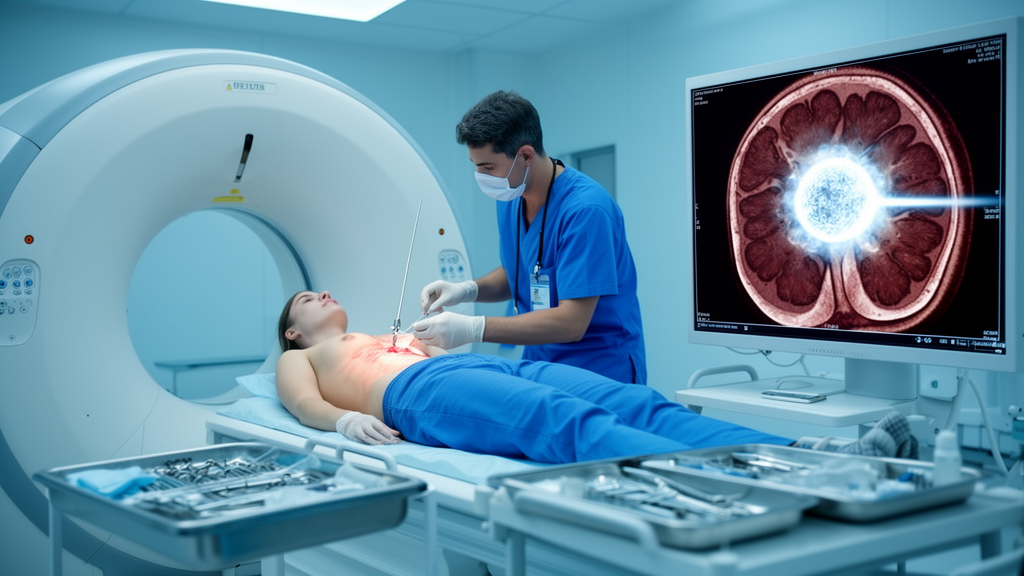
The procedure itself follows a standardized protocol. Patients were typically positioned prone on a CT table, with oblique or lateral positions and cone-beam CT guidance used when a tumor sat near critical structures such as the lung or bowel. After local anesthesia and, in some cases, mild sedation, radiologists inserted cryoprobes into the lesion. For tumors smaller than two centimeters a single probe was placed centrally, while larger lesions required multiple probes spaced half a centimeter to one centimeter apart to generate an ice ball with an adequate safety margin. Two ten-minute cooling cycles, separated by a ten-minute thawing phase, destroyed the tumor tissue, and non-contrast CT scans at five and ten minutes tracked the ice ball’s progression. Where organs were at risk, hydrodissection created a protective fluid separation, and the probe tract was cauterized on removal to reduce the risk of tumor seeding and hemorrhage.
The results were strikingly uniform. Cryoablation achieved a 100 percent technical success rate with no major complications, and imaging follow-up confirmed complete tumor ablation in every case, with no evidence of recurrence over a follow-up period of six to fifteen months, averaging 12.33 months. Patients experienced short recovery times and were discharged within days of the procedure.
The individual cases illustrate the range of clinical scenarios the technique can address. The first patient was an 87-year-old man with a recent episode of acute kidney injury who had a 3.3-centimeter mass in his right kidney; he was discharged after 48 hours with stable renal function. The second was a 78-year-old man who had received a kidney transplant in 2005 for congenital renal atrophy and carried a history of Kaposi’s sarcoma, chronic kidney disease, and cardiovascular disease; a biopsy confirmed renal cell carcinoma in his native left kidney, and although a post-procedural hematoma developed, it was managed conservatively and resolved without further problems. A third 78-year-old man, judged too high-risk for surgical resection, underwent cone-beam CT-guided ablation of a 16-millimeter hypervascular lesion; mild residual enhancement seen at one month resolved by three months, indicating a complete response.
The remaining cases pushed the technique further. A 58-year-old man with recurrent papillary renal cell carcinoma, who had already undergone two partial nephrectomies, had two progressing lesions in his right kidney ablated in a single session using two different cryoprobe sizes. An 83-year-old woman with an elongated, three-centimeter exophytic lesion was treated with two dedicated 17G cryoprobes placed under ultrasound guidance and confirmed by cone-beam CT. The sixth patient, a 56-year-old man with an aortic prosthesis and a suspected but unconfirmed diagnosis of multiple myeloma, had a 17-by-16-millimeter lesion near the mesorenal cortex of his left kidney ablated without complications, and six-month follow-up CT confirmed no recurrence.
Why does this matter more broadly? Renal cell carcinoma is the most frequent urogenital cancer, with roughly 400,000 new cases and 175,000 cancer-related deaths worldwide each year. Most tumors are now discovered incidentally on abdominal imaging, and many fall into the category of small renal masses, lesions under four centimeters. Among these, 20 to 30 percent turn out to be benign, while 10 to 20 percent pose a higher oncological risk, and the likelihood of malignancy rises with tumor size. For early-stage disease confined to the kidney, partial nephrectomy is the standard of care, but it carries risks including blood loss, urinary leakage, and, in some cases, the need for transfusions. For patients who cannot undergo surgery, ablative therapies offer an alternative, and cryoablation uses liquid nitrogen or argon to reach temperatures as low as minus 170 degrees Celsius, destroying cells through intracellular ice formation, osmotic dehydration, ischemia, and an immune response.
The wider literature supports the approach. A meta-analysis by Zargar and colleagues reported that cryoablation has a technical success rate exceeding 95 percent, with complication rates between 8 and 20 percent, and that for T1a tumors the long-term oncological results of image-guided ablation are comparable to surgery. Data from the European Registry for Renal Cryoablation, covering 70 patients with renal cell carcinoma and a solitary kidney, showed a statistically significant but modest reduction in estimated glomerular filtration rate three months after the procedure, with no patients progressing to severe chronic kidney disease or requiring dialysis. A large retrospective analysis of 1,024 patients found that cryoablation delivered comparable five-year recurrence-free survival to partial nephrectomy, at 80 percent versus 83 percent, while partial nephrectomy was associated with intraoperative ischemia and a higher rate of severe complications.
A meta-analysis by Wen and colleagues, pooling 13 cohort studies with 2,107 patients, found that ablation therapy compared with partial nephrectomy was associated with shorter hospital stays, shorter operating times, less postoperative creatinine increase, a smaller decline in glomerular filtration rate, a lower incidence of postoperative chronic kidney disease, less blood loss, and lower transfusion and complication rates. The trade-off was a higher risk of local recurrence in the ablation group, although the risk of distant metastasis was higher in the partial nephrectomy group, and no significant differences emerged in overall survival, postoperative dialysis rates, or tumor-specific survival. Cost analyses add another dimension: one study found cryoablation was 2.2 to 2.7 times less expensive than other nephron-sparing options, with savings per case ranging from 3,625 to 5,155 dollars, and an analysis at the Avellino institute found cryoablation cost 5,473 euros compared with 10,672 euros for robotic-assisted partial nephrectomy, though differing reimbursement rates partially offset that advantage. The technology’s reach extends beyond the kidney, with the ICE3 trial recently reporting a 4.3 percent five-year ipsilateral breast tumor recurrence rate when cryoablation was used for low-risk early-stage breast cancer in older women.
The authors are candid about the limits of their own work. The sample is small, the follow-up of six to fifteen months is short, and the single-center design with deliberate selection of high-risk patients may introduce selection bias. They note that long-term follow-up is critical to evaluating the oncological efficacy of cryoablation and call for larger, multicenter studies with longer follow-up, along with multicenter registries and randomized controlled trials, to confirm durable tumor control, functional preservation, and quality-of-life outcomes. Still, the Avellino experience demonstrates that the technique can be implemented effectively in smaller healthcare centers that have appropriate expertise and imaging access, offering a nephron-sparing, minimally invasive option for patients whose age or medical complexity makes conventional surgery a poor choice.
Subject of Research: Percutaneous cryoablation as a minimally invasive treatment for small renal tumors in patients unsuitable for surgery
Article Title: Renal cryoablation for the treatment of renal tumors: a case series of six patients and review of the literature from a single-center experience
Article References: Porcaro, P., Punzi, E., Porcaro, F., Amodeo, E. M., Voccola, S., Flora, E., Izzo, A., Basile, L., & Lombardi, G. (2026). Renal cryoablation for the treatment of renal tumors: a case series of six patients and review of the literature from a single-center experience. Egyptian Journal of Radiology and Nuclear Medicine, 57(1), Article 223. https://doi.org/10.1186/s43055-026-01888-9
Image Credits: AI Generated
DOI: 10.1186/s43055-026-01888-9
Keywords: cryoablation, renal cell carcinoma, small renal masses, interventional radiology, nephron-sparing, partial nephrectomy, case series, kidney tumors, CT guidance, minimally invasive, oncology, Renal
News Source: Nathaniel Bowman. (October 28, 2026). Freezing kidney tumors: six-patient series shows cryoablation’s promise for high-risk patients. Scienmag.