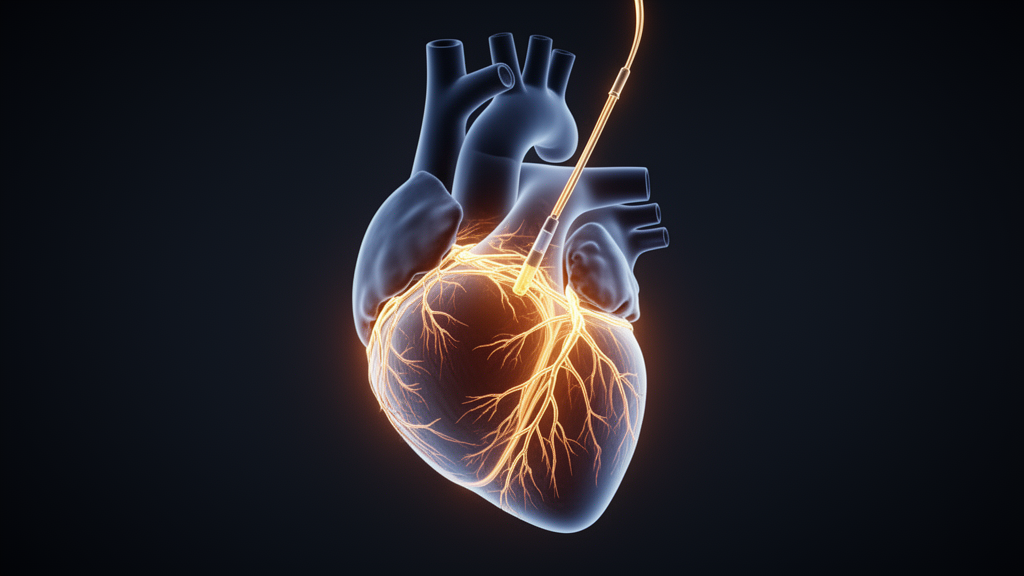
Cardiac pacing is undergoing a fundamental paradigm shift, according to a Review published in Nature Reviews Cardiology on 23 October 2026. Instead of pacing the right ventricular apex, the conventional approach of past decades, clinicians are increasingly engaging the heart’s intrinsic His–Purkinje conduction system to preserve or restore the natural ventricular activation sequence. The review, led by So-Ryoung Lee and Eue-Keun Choi with international co-authors including Pugazhendhi Vijayaraman, Haran Burri and Roderick Tung, brings ventricular and atrial physiological pacing strategies together under a single unifying framework.
The rationale for this shift rests on decades of evidence showing that chronic right ventricular pacing induces ventricular dyssynchrony, an abnormal and unsynchronised pattern of contraction that contributes to pacing-induced cardiomyopathy and adverse clinical outcomes. Conduction system pacing, or CSP, addresses this problem by capturing the native conduction network rather than working muscle alone, so the electrical impulse travels along the pathways the heart evolved to use.
His bundle pacing was the earliest form of CSP and provided proof of concept that direct engagement of the conduction system is feasible. However, the review notes that this modality is limited by technical challenges and high capture thresholds, meaning more energy is required to reliably stimulate the tissue and the procedure can be harder to perform consistently.
Left bundle branch area pacing has since become the dominant CSP modality. According to the review, it offers higher procedural success rates and more stable long-term pacing thresholds than His bundle pacing, along with broader applicability. Its uses now span the management of bradycardia, the prevention of pacing-induced cardiomyopathy, and cardiac resynchronization therapy in heart failure. The review also describes electrophysiological criteria for confirming left bundle branch capture, a key procedural step, and discusses complications such as septal perforation during left bundle branch pacing.
Emerging data from randomized trials support CSP as a primary pacing strategy over conventional right ventricular pacing, and the review states that CSP effectively prevents pacing-induced cardiomyopathy in patients with high anticipated pacing burdens. This positions physiological pacing not merely as an alternative for difficult cases but as a candidate default for patients who will depend on their pacemaker extensively.
In heart failure with reduced ejection fraction, CSP-based cardiac resynchronization therapy can provide physiological resynchronization in appropriately selected patients with effective conduction system capture, particularly those with left bundle branch block.
The review also addresses atrial fibrillation. CSP followed by atrioventricular node ablation is described as an effective rate-control strategy, offering ventricular synchrony and haemodynamic benefit similar to that achieved with conventional biventricular pacing. In this approach, the ablation controls the rate while the conduction system lead maintains a coordinated ventricular activation pattern.
An emerging atrial counterpart, Bachmann bundle area pacing, captures a preferential interatrial conduction pathway. By doing so, it reduces interatrial conduction delay and produces a more physiological atrial activation sequence than conventional right atrial appendage pacing. The review suggests this approach might improve left-sided atrioventricular synchrony and could therefore help to prevent atrial fibrillation, although evidence from randomized trials is still awaited.
The authors emphasise that important practical questions remain in clinical application and that more evidence is required in several areas. As a review article, the paper synthesises existing mechanistic understanding, technical evolution and trial data rather than presenting new clinical findings of its own.
Subject of Research: Conduction system pacing as a physiological alternative to conventional right ventricular and right atrial pacing
Article Title: The evolution and future of conduction system pacing
Article References: Lee, S.-R., Vijayaraman, P., Huang, W., Jastrzębski, M., Joza, J., Burri, H., Ponnusamy, S. S., Tung, R., Lustgarten, D., & Choi, E.-K. (2026). The evolution and future of conduction system pacing. Nature Reviews Cardiology. https://doi.org/10.1038/s41569-026-01354-z
Image Credits: AI Generated
DOI: 10.1038/s41569-026-01354-z
Keywords: conduction system pacing, His bundle pacing, left bundle branch area pacing, Bachmann bundle pacing, cardiac resynchronization therapy, pacing-induced cardiomyopathy, heart failure, atrial fibrillation, right ventricular pacing, ventricular dyssynchrony, physiological pacing, cardiac electrophysiology
News Source: Frances Kline. (October 28, 2026). Conduction system pacing shifts cardiac care toward the heart’s native wiring. Scienmag.