


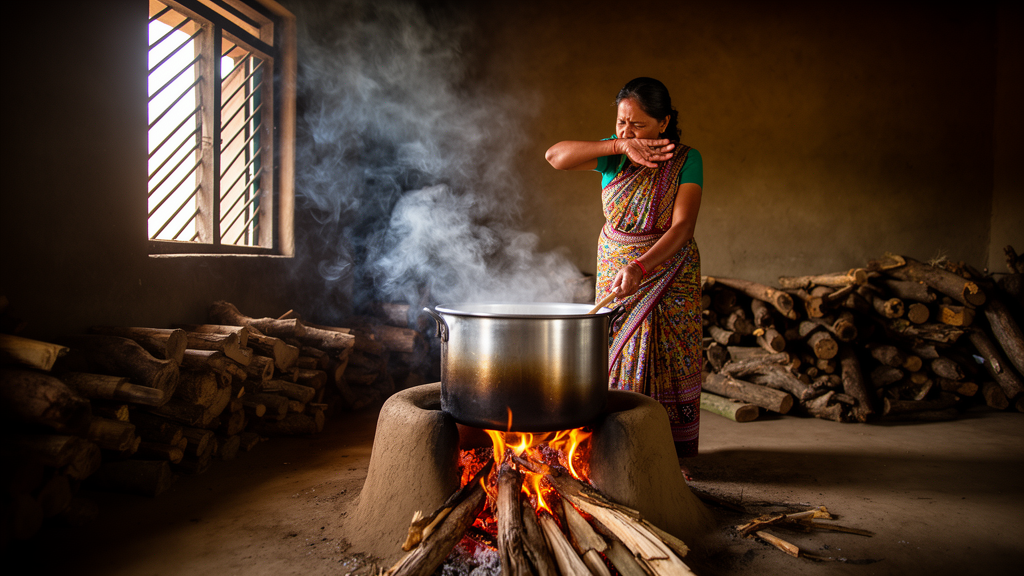
Cook-cum-helpers who prepare school meals over firewood in rural Assam show markedly worse respiratory health than colleagues working in liquefied petroleum gas kitchens, according to a cross-sectional study of 130 workers published in Discover Public Health. After statistically balancing the two groups, workers in firewood-based kitchens had a 28.4 percentage-point higher probability of reporting at least one respiratory symptom (95% CI 15.6 to 41.2) and a 22.1 percentage-point higher probability of airway obstruction (95% CI 8.4 to 35.8) than those using LPG. The exposed workers also showed a 13.95 percentage-point greater decline in mean FEV1 percent-predicted, a measure of how much air a person can force out of their lungs in one second relative to healthy expectations for their age, sex and body size.
The study focused on a workforce that has largely escaped the attention of household air pollution research. The participants were cook-cum-helpers employed under India’s Mid-Day Meal scheme, a public nutrition programme that employs predominantly women from socioeconomically disadvantaged backgrounds to prepare daily meals in government primary and upper-primary schools. In many rural schools these kitchens still burn firewood, and the workers typically spend five to eight hours per day in enclosed or semi-enclosed kitchens with limited ventilation, rudimentary stoves and no chimneys. Because these women often also cook with solid fuels at home, their exposure is layered: the workplace adds repeated, paid, multi-hour exposure on top of any domestic exposure.
The sample was predominantly female, 95.4% in firewood schools and 93.8% in LPG schools, with a mean age of 38.0 years and an average employment duration of 6.7 years.
Before any statistical adjustment, the contrast between the two workplace environments was stark. Chronic cough was reported by 52.3% of firewood workers compared with 18.5% of LPG workers, an unadjusted odds ratio of 4.82 (95% CI 2.31 to 10.05). Airway obstruction was observed in 21 of 65 firewood workers (32.3%) versus 4 of 65 LPG workers (6.2%). Mean FEV1 differed by 0.50 litres between the groups and FEV1 percent-predicted differed by 16.8 percentage points, both unadjusted comparisons. Spot measurements of indoor air quality during active cooking confirmed that firewood kitchens had substantially higher concentrations of fine particulate matter (PM2.5) and carbon monoxide than LPG kitchens, although these values were not used as continuous exposure variables in the regression models because of limited repeated sampling.
Because the study was observational, the two groups differed substantially at baseline in ways that could distort the comparison. Household biomass fuel use and passive smoke exposure were both far more common among workers in firewood kitchens, with standardized mean differences of 0.972 and 0.798 respectively, far above the conventional 0.10 threshold for adequate balance.
Within this matched sample, the Average Treatment Effect on the Treated, which estimates how outcomes of the actually exposed workers would have differed had they worked in LPG kitchens with comparable observed characteristics, showed the 28.4 percentage-point excess in any respiratory symptom and the 22.1 percentage-point excess in airway obstruction. Matched regression models confirmed the associations, with effect sizes attenuated by 17 to 23% relative to the crude comparisons, indicating that part of the unadjusted difference was explained by baseline household and environmental factors, but substantial and statistically significant associations persisted. Standard errors were clustered at the school level across 28 clusters, and mixed-effects models with school-level random intercepts gave comparable results. Within the matched sample, 18 airway obstruction cases were observed, 16 among firewood workers and 2 among LPG workers, and events-per-variable ratios exceeded 12, supporting model stability, although the authors note that the limited number of obstruction cases in the LPG group produced wider confidence intervals for that outcome.
The study also found a graded relationship with length of employment. Adjusted odds ratios for respiratory symptoms rose from 3.15 among workers with one to two years of employment to 6.84 among those with more than ten years, with a statistically significant trend across duration categories (p-trend < 0.001). The authors interpret this monotonic gradient as consistent with cumulative exposure, while cautioning that because the data are cross-sectional, the estimates reflect differences between groups rather than direct longitudinal progression within individuals. The consistency of the gradient across employment-duration strata, together with the persistence of associations across multiple modelling specifications, was presented as supporting the biological plausibility of a link between biomass smoke and respiratory impairment, with proposed mechanisms including oxidative stress, chronic airway inflammation, epithelial injury and airway remodelling from repeated inhalation of fine particulate matter and combustion gases.
The authors are explicit that the design limits causal interpretation. Because exposure status and respiratory outcomes were measured at the same time, the temporal relationship between occupational biomass exposure and respiratory impairment cannot be established directly, and the findings should be read as evidence of association rather than definitive causation. Matching can balance only measured covariates, and the study did not collect detailed information on the duration, intensity or lifetime history of household fuel use, so residual confounding from long-term domestic exposure cannot be excluded. Fuel type also served only as a proxy for exposure intensity, since continuous personal exposure monitoring was not conducted, and detailed socioeconomic indicators such as household income and asset ownership were not collected. The authors add that generalizability may be constrained to comparable rural institutional contexts and that replication across other states and settings is needed.
Despite these limitations, the authors argue that the findings identify institutional biomass combustion in school kitchens as an underrecognized occupational health hazard within the Mid-Day Meal scheme. They note that national clean-fuel initiatives such as the Pradhan Mantri Ujjwala Yojana have focused largely on household transitions, while institutional cooking environments have received comparatively less support, and that rural schools may continue relying on firewood because of irregular LPG refilling, transport constraints, budgetary limitations and dependence on locally available biomass. They suggest a phased integration of school kitchens into the broader clean-fuel ecosystem, alongside interim measures such as improved ventilation, chimney installation and structural redesign of enclosed kitchens, and periodic respiratory health screening for cook-cum-helpers, framing such steps as a way to reduce preventable respiratory risk among a predominantly female and socioeconomically vulnerable workforce.
Subject of Research: Occupational biomass smoke exposure and respiratory health among cook-cum-helpers in rural Assam school kitchens
Article Title: Respiratory health effects of occupational biomass smoke exposure among cook cum helpers in rural Assam school kitchens using propensity score matching
Article References: Paul, S. (2026). Respiratory health effects of occupational biomass smoke exposure among cook cum helpers in rural Assam school kitchens using propensity score matching. Discover Public Health, 23(1), Article 1722. https://doi.org/10.1186/s12982-026-02866-2
Image Credits: AI Generated
DOI: 10.1186/s12982-026-02866-2
Keywords: biomass smoke, airway obstruction, occupational health, propensity score matching, spirometry, Mid-Day Meal scheme, Assam, household air pollution, PM2.5, FEV1, school kitchens, LPG
News Source: Ophelia Keating. (October 28, 2026). Firewood school kitchens linked to respiratory harm in rural Assam workers. Scienmag.



