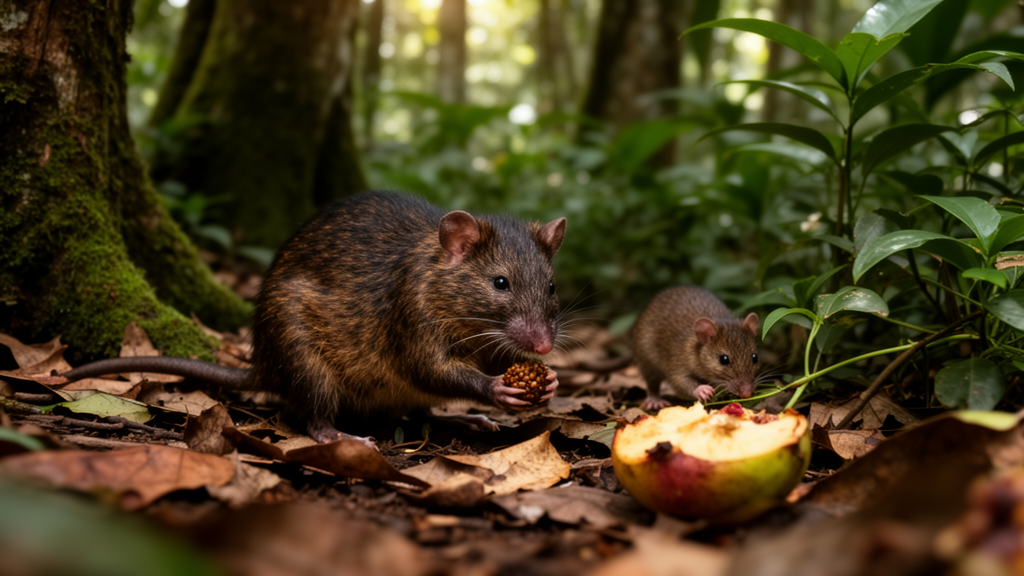
In the cloud-wrapped forests of Mount Rungwe in southern Tanzania, the size of a rodent’s body appears to shape the width of its palate. A new field study of four cohabiting rodent species in the Mount Rungwe Forest Nature Reserve reports that dietary niche breadth rises with body size, with the smallest species feeding on a narrow set of foods and the largest consuming the broadest array. The research, published in the journal Discover Life, analysed stomach contents from 166 trapped individuals and found niche breadth values ranging from 0.28 to 0.71 alongside mean body masses spanning 26 grams to 74 grams.
The study focused on four species that coexist across the reserve’s elevational gradient: Lophuromys machangui, Beamys hindei, Montemys delectorum and Grammomys cometes. These species were selected because each was captured at least five times, providing sufficient sample size for dietary comparison, and because they span a considerable size range, from the small-bodied M. delectorum to the relatively large B. hindei. The researchers set out to test whether dietary niche breadth increases with body size among these rodents, and whether observed feeding patterns align with long-standing ecological theory.
Fieldwork took place over eight sessions between March 2020 and September 2021, covering both wet and dry seasons. The team established three elevation bands — low (1,600 to 1,900 metres above sea level), mid (1,901 to 2,300 metres) and high (2,301 to 2,800 metres) — with two fixed sampling points per band. Within each band, five 100-metre transects carried 11 snap traps apiece at 10-metre intervals, yielding 495 traps per session across the reserve. Snap traps were chosen deliberately: they minimise digestion after capture, allowing accurate identification of stomach contents. Traps were baited with roasted coconut and peanut butter and checked each morning for six consecutive nights per band.
In the laboratory, the researchers measured body mass, body length, tail length, hind foot length and ear length for each specimen, then dissected out the stomachs and preserved them in 70 percent ethanol. Under a binocular microscope at 25 and 50 times magnification, stomach contents were sorted into broad categories: seeds and grains, leaves, roots, stems, invertebrates, mammalian hairs and unidentified organic matter. Lugol’s iodine solution was used where necessary to detect starch granules and confirm the presence of seeds. Dietary niche breadth was quantified with Levins’ standardised index, with values at or below 0.40 treated as indicating a dietary specialist, values between 0.40 and 0.75 as moderate, and values at or above 0.75 as generalist feeding.
The results showed a clear pattern in what the rodents ate. Across all four species, diets consisted of seeds and grains, invertebrates, stems, roots and leaves, with invertebrates the most abundant category and roots the least. But the proportions differed sharply between species. Beamys hindei took a large share of its diet from seeds and grains — a pattern the authors link to its habits as a pouched rat that carries and stores food, since seeds keep far longer than other food types. The other three species, L. machangui, M. delectorum and G. cometes, all showed significantly higher levels of invertebrates in their diets, likely reflecting the availability and nutritional value of this prey.
When the numbers were crunched, the relationship between body size and diet breadth held. Dietary niche breadth differed significantly among species (ANOVA: F(3,162) = 6.49, p < 0.001), with M. delectorum showing the narrowest niche and B. hindei the broadest. Post-hoc Tukey tests showed M. delectorum differed significantly from the other three species, while G. cometes, B. hindei and L. machangui did not differ significantly from one another. Because body mass and body length were highly collinear (r = 0.85), the team ran a principal component analysis on five morphological traits; two axes explained 74.6 percent of the variance, with the first dominated by body length and mass.
The headline statistical result came from a Pearson correlation on 165 individuals — one specimen was excluded for incomplete data. Body size and dietary niche breadth were positively related (r = 0.225, p = 0.0036, 95 percent confidence interval 0.075 to 0.365), though the authors are careful to note the relationship is weak, suggesting larger-bodied species tend to have slightly broader dietary niches. By contrast, hind foot length and ear length showed no significant relationship with niche breadth, indicating these traits are not reliable predictors of dietary variation. A regression model also found that body size had a positive influence on niche breadth with increasing elevation, although a mixed model showed elevation itself did not have a significant main effect on dietary niche breadth.
One species stood out in ways the size–diet relationship alone cannot explain. Montemys delectorum accounted for 72 percent of all captures, yet it exhibited the narrowest niche breadth of the four species, specialising heavily on energy-rich invertebrates. The authors suggest this specialisation, combined with the species’ ability to meet its high mass-specific metabolic demands, helps explain its high local abundance, and they invoke the niche positioning hypothesis: M. delectorum appears highly adapted to the dominant habitat in the reserve. Grammomys cometes showed the opposite profile — a narrow niche and low abundance, captured only at low and mid elevations and in just 7 percent of captures, a pattern the authors attribute to possible interspecific competition driving dietary specialisation and restricting the species to a specific environment.
The elevational picture added nuance rather than contradiction. Across elevations overall, niche breadth and body size were positively correlated, but when examined species by species within each band the pattern varied. B. hindei showed a positive association between body size and niche breadth at low and mid elevations but not at high elevations, with similar shifts in M. delectorum and L. machangui. The authors note that habitats at higher elevations are typically less productive, with reduced food availability, which may limit species’ abilities to exploit more resources regardless of their size; relationships between body size and niche breadth were stronger at mid and low elevations and weaker higher up. These species-level trends, however, were not statistically significant.
The findings support the hypothesis the researchers set out to test: that dietary niche breadth increases with body size among small mammals, consistent with Optimal Foraging Theory, Kleiber’s Law and the Niche Breadth Hypothesis. Larger species face lower metabolic demands per unit body mass and can exploit more fibrous, low-energy diets in larger quantities, while smaller species with higher metabolic rates must target energy-dense foods such as seeds, insects or fruits. The authors argue that this balance of strategies — larger generalists flexible in resource use, smaller specialists efficient at narrow resource targeting — helps reduce interspecific competition and promote stable coexistence. They conclude that preserving habitat heterogeneity in Mount Rungwe is important for maintaining both generalist and specialist small mammals, and that understanding these dynamics can help predict species responses to environmental change and inform conservation priorities in the eastern Afromontane biodiversity hotspot.
Subject of Research: The relationship between body size and dietary niche breadth among cohabiting rodent species in a tropical montane forest in Tanzania
Article Title: Functional traits and dietary ecology of cohabiting rodents in a tropical montane forest, Tanzania
Article References: Ngoda, U. R., & Mpondo, F. T. (2026). Functional traits and dietary ecology of cohabiting rodents in a tropical montane forest, Tanzania. Discover Life, 56(1), Article 42. https://doi.org/10.1007/s11084-026-09755-3
Image Credits: AI Generated
DOI: 10.1007/s11084-026-09755-3
Keywords: rodents, dietary niche breadth, body size, Mount Rungwe, Tanzania, tropical montane forest, optimal foraging theory, Kleiber's Law, ecology, seed dispersers, elevation gradient, conservation
News Source: Daisy Hatcher. (October 28, 2026). Bigger Rodents Eat a Wider Menu in Tanzania’s Mount Rungwe Forest. Scienmag.