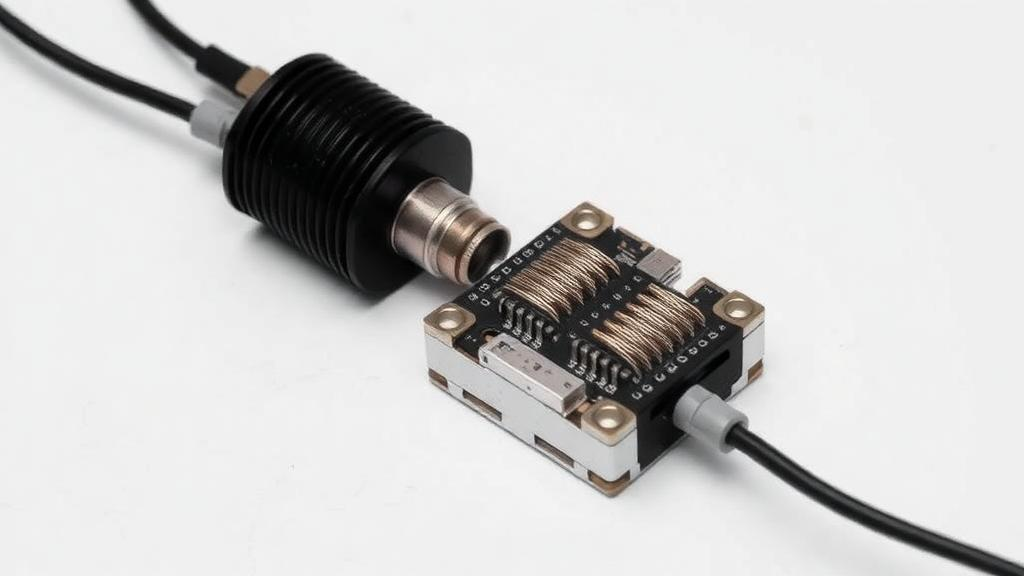
A pivoted electromagnetic vibration energy harvester that deliberately taps its own stopper, rather than treating contact as a nuisance, has been shown to widen the frequency band over which it can both harvest power and suppress vibration. The device, described in an open-access study published in Discover Mechanical Engineering, uses a compliant one-sided stopper that engages the lever only intermittently during each vibration cycle. That intermittent engagement acts as a phase-control element, steering the coupled mechanical parts into a stable antiphase motion that boosts the relative velocity seen by the electromagnetic transducer while simultaneously reducing the vibration transmitted to the payload.
The research team, led by Tunde Isaiah Toluwaloju with Chung Ket Thein, Yaoxin Huang and Yufei Wang, modelled the system as a piecewise-smooth dynamical system with three degrees of freedom: the levered primary mass, the stopper mass and a magnet suspended on its own spring-guided rail. The magnet couples to a coil mounted on the lever tip purely through electromagnetic interaction, with no mechanical contact between them. A clearance gap separates the lever from the stopper, so contact occurs only when the relative displacement between the two exceeds that gap. The fraction of each excitation cycle during which the stopper is engaged, called the contact ratio, becomes the key quantity distinguishing three operating regimes: fully separated, intermittently engaged and permanently constrained.
Conventional harvesters typically use grounded stoppers, which remain permanently engaged and impose a fixed stiffness, or semi-grounded stoppers, which are attached to another free degree of freedom and produce continuous linear coupling. Both configurations are smooth and time-invariant, with no switching in stiffness during motion. The proposed non-smooth architecture sits between these limits, activating the contact force only after the clearance threshold is crossed and releasing it when the relative displacement falls back inside the gap. This state-dependent switching introduces a time-varying effective stiffness that the grounded and semi-grounded designs cannot replicate, and it is precisely this mechanism that redirects the relative motion toward a favourable antiphase condition over a broader frequency region.
Phase analysis of the system revealed an intermediate-frequency region between the resonances of the lever and the stopper spring where stiffness switching and phasor reversal enable sustained antiphase motion. In this regime, the antiphase evolution between the lever and the magnet maximises the relative velocity at the transducer, which is what drives the electrical output. The study found that the contact criterion sets the limit of the usable bandwidth, while the antiphase evolution modulates the range of frequencies over which useful voltage can be harvested. The electromagnetic cross-coupling between the magnet and the coil was found to be trivial in its effect on the resonance shift, though its influence on voltage amplification and bandwidth extension becomes substantial once the magnet degree of freedom is engaged.
Experimental validation was carried out on an electrodynamic shaker with frequency-swept base excitation from 10 to 25 Hz at an acceleration of 0.7 g, using non-contact laser displacement sensors to measure the base and both ends of the lever. Two stiffness configurations were tested, sharing the same magnet stiffness of 1786.00 N m⁻¹ but differing substantially in stopper stiffness, at 188.00 N m⁻¹ for configuration 1 and 826.70 N m⁻¹ for configuration 2. Both configurations exhibited closely aligned, magnet-motion-dominated resonance locations at approximately 15.40 Hz, while the uncoupled lever and stopper resonances were 17.10 Hz and 14.60 Hz respectively. When the clearance was removed entirely, contact became permanently engaged and the phase evolution followed the characteristic abrupt jumps of an over-constrained system, whereas finite clearance enabled gradual phase transitions through resonance.
The non-smooth configuration achieved a broader effective operating bandwidth than the grounded and semi-grounded benchmarks. In the region associated with the primary and stopper masses, the system produced a peak output power of 419.02 mW at 15.69 Hz with a bandwidth of 0.30 Hz. In the second region, around 17.40 Hz, the intermittent contact between the primary and stopper masses generated an additional response with an output power of 37.92 mW and a bandwidth of 2.65 Hz. Taken together, these two non-overlapping regions gave an effective operating bandwidth of approximately 2.95 Hz. The authors note that this bandwidth extension comes from the transfer of vibrational energy between the primary and stopper subsystem and the electromagnetic subsystem through intermittent contact, though it may occur with a reduction in peak power away from the primary resonance.
Parametric sensitivity analysis showed that the peak harvested power is governed by the interaction among geometric amplification, clearance-controlled switching and contact stiffness rather than by any single parameter. Increasing the lever ratio advanced contact onset and broadened the frequency band over which intermittent contact occurred, with intermediate lever ratios sustaining intermittent contact over a finite bandwidth of roughly 3 to 4 Hz and typical contact ratios between 0.3 and 0.5. The clearance itself had only a weak influence on the amplitude-frequency characteristics once contact was established, and contact stiffness did not govern the onset of engagement, though a stiffer interface promoted more rapid disengagement once peak motion subsided. The most favourable operating regime occurred at intermediate lever ratios, where nonlinear stiffness modulation enhanced performance without excessive mechanical loading on the primary structural spring.
Phase portraits, Poincaré sections and bifurcation diagrams confirmed that the enhanced performance arises from stable, impact-modulated period-1 dynamics rather than chaotic or unstable responses. The Poincaré points remained bounded across the tested frequencies, with the most pronounced spreading occurring between 14 and 17 Hz, where repeated contact engagement and release modified the trajectory from cycle to cycle. Quantitative comparison between numerical predictions and experimental measurements showed mean relative errors of approximately 9.05 percent for the left-hand-side lever response, 2.94 percent for the right-hand-side response and 6.00 percent for the magnet displacement over the complete 10 to 25 Hz range. The authors attribute the difference between the two lever-end errors to electromechanical cross-coupling between the magnet and the coil, which they identify as a factor that helped reduce the effect of chaotic energy transfer from the stopper interaction on the left-hand side to the right-hand side of the lever.
Beyond power generation, the team demonstrated the harvester as a self-powered sensing and communication node. The harvested energy was rectified, regulated, stored in 7500 μF capacitors and boosted to 3.30 V DC to power a Nordic nRF52832 Bluetooth transceiver and a BME280 environmental sensor capable of measuring temperature, humidity and pressure. Under 23 Hz excitation, the harvested energy charged the storage capacitor until the voltage exceeded the Bluetooth activation threshold of approximately 1.5 to 1.6 V, after which the module switched on and began transmitting data. The voltage continued to rise during sustained excitation, reaching about 2.55 V after roughly 20 seconds. When the vibration was switched off at around 22 seconds, the stored energy supported continued Bluetooth operation for an additional 15 to 16 seconds before the voltage decayed below the operating threshold. A comparative test at 20 Hz showed that the harvested energy remained below the activation threshold and the Bluetooth module stayed off throughout, confirming that wireless sensing was automatically enabled only when sufficient energy was available.
The study frames this as a shift in design philosophy: rather than treating contact and frictional nonlinearities as parasitic effects to be minimised, the architecture exploits them as functional elements that regulate stiffness, phase evolution and energy transfer. The result is a single device that simultaneously senses vibration, isolates the payload from it and converts the relative motion into electrical power, with a unified operational window bounded by a −3 dB isolation criterion in which all three functions coexist. The authors acknowledge that the one-way coupling assumption used in the model neglects electromagnetic back-action, which could introduce additional damping near resonance and reduce predicted vibration amplitude and harvested power, and they suggest that a fully coupled electromechanical model could address this limitation in future work.
Subject of Research: Non-smooth contact dynamics in a lever-type electromagnetic vibration energy harvester for broadband power harvesting and vibration isolation
Article Title: Controlled intermittent non smoothed contact induced antiphase dynamics for broadband electromagnetic vibration energy harvesting
Article References: Toluwaloju, T. I., Thein, C. K., Huang, Y., & Wang, Y. (2026). Controlled intermittent non smoothed contact induced antiphase dynamics for broadband electromagnetic vibration energy harvesting. Discover Mechanical Engineering, 5(1), Article 201. https://doi.org/10.1007/s44245-026-00393-7
Image Credits: AI Generated
DOI: 10.1007/s44245-026-00393-7
Keywords: vibration energy harvesting, electromagnetic transduction, non-smooth dynamics, antiphase motion, intermittent contact, broadband harvesting, vibration isolation, lever amplification, Poincaré sections, Bluetooth sensing, self-powered sensors, piecewise-smooth systems
News Source: Denise Maddox. (October 28, 2026). Intermittent Contact Turns a Vibration Harvester Into a Phase Controller for Broadband Power and Isolation in One Device. Scienmag.