


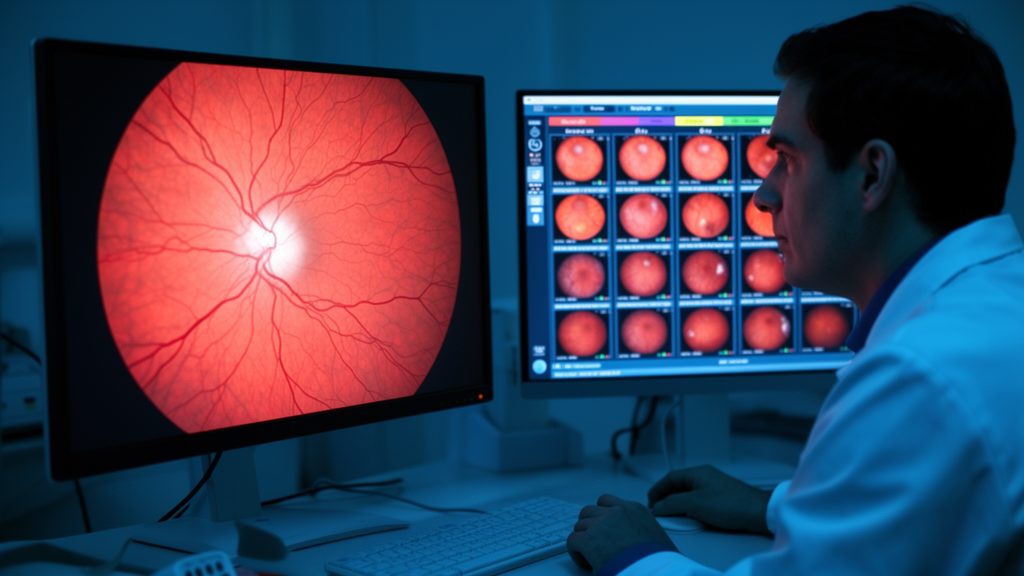
Diabetic retinopathy, a microvascular complication of diabetes, remains one of the most common causes of preventable blindness in working-age adults worldwide, and it often goes undetected until vision loss becomes permanent. A new study now reports a computationally efficient deep learning pipeline that grades the severity of the disease from retinal fundus images across five classes, from no retinopathy through mild, moderate and severe disease to proliferative retinopathy. The work, published in Discover Computing, combines an Inception-V3 convolutional neural network pretrained on ImageNet with two classical optimizers, stochastic gradient descent with momentum and Nesterov Accelerated Gradient, and was tested on the publicly available APTOS 2019 dataset of 3,662 retinal fundus images.
The reported headline results are striking for a relatively modest architecture. Across five diabetic retinopathy severity classes, the framework achieved a classification accuracy of 93.45 percent and a macro-averaged area under the receiver operating characteristic curve of 0.9917. The macro-AUC was computed with a one-versus-rest scheme, in which each of the five severity classes was treated in turn as the positive class against all others, and the five class-wise AUC values were averaged without weighting. The authors emphasize that this averaging choice matters because the APTOS 2019 dataset is heavily imbalanced, with the no-diabetic-retinopathy and moderate classes dominating while severe and proliferative cases are comparatively rare.
Accuracy alone can flatter a model trained on imbalanced data, so the team prioritized macro-level metrics throughout the evaluation. Notably, the macro-F1 score came in considerably lower than the macro-AUC, at 0.8887. The authors explain that this gap is expected in multi-class imbalanced classification: AUC is threshold-independent and measures how well the model ranks samples at any decision threshold, whereas F1 is computed at a fixed threshold, where confusion between clinically adjacent severity grades, especially mild, moderate and severe disease, weighs heavily. A model can therefore rank cases very well yet still make threshold-dependent errors on minority classes, and the reported numbers reflect exactly that pattern.
The experimental design followed a careful leakage-prevention protocol. The dataset was split with stratified sampling into 70 percent training, 10 percent validation and 20 percent test subsets before any augmentation was applied, so that no augmented copies of training images could leak into validation or test data. Duplicate and near-duplicate images were screened out before partitioning. Pixel normalization used training-set statistics only. Online augmentation, limited to the training subset, included random rotations of plus or minus 20 degrees, horizontal flipping with 50 percent probability, scaling between 0.9 and 1.1, and translation of up to 10 pixels with 30 percent probability. Images were resized to 299 by 299 pixels to match the Inception-V3 input requirement.
Transfer learning formed the backbone of the approach. The pretrained Inception-V3 network kept its early convolutional layers frozen to preserve generic low-level features such as edges and textures, while deeper layers were fine-tuned to learn diabetic-retinopathy-specific features, and the final classification layer was replaced with a five-class output. Training ran in MATLAB R2025b on an Intel Core i5 CPU with 8 GB of RAM, a deliberately modest hardware setup that the authors present as evidence of the method’s suitability for moderate-scale screening settings where large GPUs and transformer-scale compute are unavailable. Validation data guided hyperparameter tuning, convergence monitoring and early stopping, while the test set was touched only once, at final evaluation.
Convergence behavior supported the optimizer choice. Validation accuracy plateaued after roughly 28 epochs with little fluctuation, and validation loss stayed low and stable as training loss fell, which the authors read as limited evidence of overfitting. A moderate train-validation gap appeared at later epochs but remained controlled. In optimizer comparisons against plain SGD, Adam, RMSProp and SGDM without Nesterov acceleration, the SGDM-plus-NAG configuration converged faster and showed steadier optimization behavior. Nesterov Accelerated Gradient computes gradients at an anticipatory look-ahead position rather than the current parameter position, which speeds convergence and reduces oscillation, while momentum damps gradient oscillations and improves training stability.
Class-wise results revealed the expected clinical pattern. The no-diabetic-retinopathy category performed best across all metrics, benefiting from strong representation in the data, lower lesion variability and clear separation from pathological classes. Mild disease showed high recall but relatively low precision, suggesting early lesions can visually resemble moderate-stage features. Severe disease likewise combined high recall with low precision, indicating the model sometimes over-predicts severe pathology when lesion density and hemorrhagic areas resemble later stages. Confusion analysis confirmed that most misclassifications occurred between clinically adjacent grades: mild versus moderate, moderate versus severe, and severe versus proliferative disease, a behavior the authors describe as clinically expected because lesion boundaries between successive stages are not always distinct.
Explainability received attention through Grad-CAM visualizations, which highlighted regions of the retina that influenced predictions. On correctly classified cases, the attention maps concentrated on clinically meaningful pathological structures such as microaneurysms, hemorrhages, hard exudates and neovascular formations, suggesting the model learned lesion-relevant patterns rather than background artifacts. Misclassified cases frequently showed diffuse attention regions, incomplete lesion localization, or attention overlapping adjacent severity patterns. The authors caution, however, that these explanations remain qualitative; the Grad-CAM outputs were not quantitatively validated against lesion-level annotations or independent ophthalmologist assessment, which they flag as a key future research direction.
Reproducibility was addressed by repeating the experiments with five random seeds and reporting mean values with 95 percent confidence intervals, whose relatively small widths suggested stable performance across runs. Comparisons against ResNet101 and DenseNet201 baselines under the same conditions showed the proposed Inception-V3 model achieving the highest accuracy, the highest recall at 0.9151 and the highest AUC, while ResNet101 reached 92.83 percent accuracy with lower recall of 0.7867 and DenseNet201 reached 91.15 percent accuracy. Against architectures such as EfficientNet-B0, DenseNet-121 and ViT-Base/16, the authors position Inception-V3 as a balanced trade-off between performance, memory footprint and training cost, though they note EfficientNet-B0 was more efficient in FLOPs and memory while slightly less accurate.
The authors are careful about what these numbers do and do not prove. Evaluation was confined to a single public dataset, and patient-level separation could not be guaranteed because APTOS 2019 lacks complete patient identifiers, leaving open the possibility that images from the same patient appeared in different splits. Class imbalance, particularly for severe and proliferative classes, was mitigated but not fully resolved, as the low precision for severe disease shows. Calibration analyses such as expected calibration error or Brier scores were not performed, and the framework was not tested under domain shift, varying image quality or real tele-ophthalmology conditions. The authors state that the results demonstrate performance on APTOS 2019 rather than generalizability or clinical readiness, and they call for external multi-center validation with patient-wise partitioning, robustness testing across imaging devices, imbalance-aware learning strategies, quantitative explainability studies and calibration and uncertainty analyses before any large-scale clinical deployment.
Subject of Research: Multi-class diabetic retinopathy severity classification using Inception-V3 transfer learning on retinal fundus images
Article Title: Multi-class diabetic retinopathy severity classification using Inception-V3 transfer learning with SGDM and Nesterov Accelerated Gradient
Article References: Sravani, C., & Reddy, R. P. K. (2026). Multi-class diabetic retinopathy severity classification using Inception-V3 transfer learning with SGDM and Nesterov Accelerated Gradient. Discover Computing, 29(1), Article 814. https://doi.org/10.1007/s10791-026-10647-3
Image Credits: AI Generated
DOI: 10.1007/s10791-026-10647-3
Keywords: diabetic retinopathy, Inception-V3, transfer learning, deep learning, APTOS 2019 dataset, retinal fundus images, SGDM, Nesterov Accelerated Gradient, macro-AUC, Grad-CAM, medical image classification, class imbalance
News Source: Blake Davidson. (October 28, 2026). Inception-V3 transfer learning grades diabetic retinopathy severity with 93.45% accuracy. Scienmag.



