Researchers have shown that the choice between sodium hydroxide and potassium hydroxide as an alkali activator can dramatically reshape the surfaces of waste-derived ash particles destined for aluminum matrix composites. In a study published in Advanced Metamaterials, a team led by Obinna O. Barah and Stephen N. Nnamchi treated ash from periwinkle shells, plantain stems, and eucalyptus wood with 4 M solutions of each hydroxide and then examined the particles with scanning electron microscopy, energy-dispersive spectroscopy, Fourier-transform infrared spectroscopy, and X-ray diffraction. The work addresses a persistent obstacle in eco-composites: bio-derived ashes often present inconsistent surface characteristics that weaken the bond between reinforcement and metal, limiting industrial adoption of sustainable materials.
The central result concerns crystallinity, a structural property widely linked to rigidity and load-transfer capacity in composite systems. Untreated control samples showed low peak intensity of roughly 22 percent, characteristic of the amorphous, poorly ordered structure typical of untreated biomass and waste-derived precursors. Heat treatment alone nudged this figure to only 22.4 percent, indicating limited phase reorganization. Alkali activation changed the picture substantially: NaOH-treated samples reached about 57.5 percent, while NaOH combined with heat treatment delivered the highest peak intensities measured in the study, up to 76.4 percent. KOH treatments followed a parallel but slightly lower trajectory, reaching approximately 55.2 percent alone and about 74.1 percent when paired with heating.
The authors attribute the NaOH advantage to the chemistry of the smaller sodium ion. NaOH rapidly dissociates into sodium and hydroxide ions, efficiently dissolving silica and alumina phases and promoting the dissolution of amorphous regions followed by re-precipitation of more ordered structures. When heat is applied afterward, the team proposes a synergistic mechanism: alkali-induced breakdown of disordered phases is followed by thermally driven reorganization and stabilization of crystalline domains, with heat facilitating ion migration and nucleation. KOH, whose larger potassium ion diffuses less deeply into the matrix, still disrupts amorphous bonds and promotes recrystallization but lags slightly behind under identical conditions.
Surface morphology diverged in equally telling ways. Scanning electron micrographs showed that NaOH-treated particles developed significantly smoother and more uniform surfaces than both untreated material and KOH-treated counterparts. The researchers connect this to NaOH’s ability to dissolve surface impurities and selectively etch amorphous silica, producing particles with more homogeneous size and surface features that should wet more readily against molten aluminum and support better stress transfer. KOH-treated particles, by contrast, displayed denser, rougher morphologies with pronounced texturing and surface irregularities, attributed to the higher viscosity and more aggressive leaching behavior of potassium silicates, which attack siliceous structures less uniformly and can cause localized over-etching and micro-fracturing.
That roughness cuts both ways. The authors note that textured KOH surfaces can enhance mechanical interlocking at the composite interface, a mechanism that anchors particles physically within the solidifying metal. Yet the same lack of uniformity may introduce stress concentrators that could compromise fatigue life and tensile strength in a finished part, so KOH treatment must be carefully optimized to balance enhanced bonding against structural inhomogeneity. NaOH’s smoother finish carries its own trade-off profile: the rapid reaction rate that makes it attractive for high-speed production can cause non-uniform surface modification or over-etching if not precisely controlled.
Chemical analysis reinforced the morphological findings. Energy-dispersive spectroscopy revealed a marked increase in surface oxygen content for both treated particle types, indicating the formation of hydroxyl groups essential for chemical bonding with the aluminum matrix. FTIR spectra confirmed hydroxyl functionalization in the 3200 to 3600 per centimeter region. The distribution of these hydroxyl-rich regions was less uniform on KOH-treated samples, which the researchers suggest could cause inconsistencies in interfacial bonding and the resulting mechanical properties. The underlying reactions are well understood: silica reacts with NaOH to form sodium silicate and water, while alumina dissolves to yield sodium aluminate, with parallel reactions producing potassium silicate and potassium aluminate under KOH.
Pore structure added a further dimension to the comparison. The KOH-treated sample exhibited a sharp pore-size peak centered near 1.2 nanometers, signaling a high concentration of micropores below 2 nanometers, a morphology associated with aggressive chemical etching and selective leaching of mineral phases. The NaOH-treated sample showed a broader distribution peaking around 2.5 nanometers, marking a shift toward mesopore dominance that the authors link to the lower viscosity of sodium silicate precursors, which allows more uniform condensation and less structural collapse. Narrow micropore networks favor applications such as adsorption and catalysis, while mesoporous accessibility favors mass transport and polymer-matrix reinforcement, so the pore signature of each activator offers another lever for tailoring reinforcements to specific end uses.
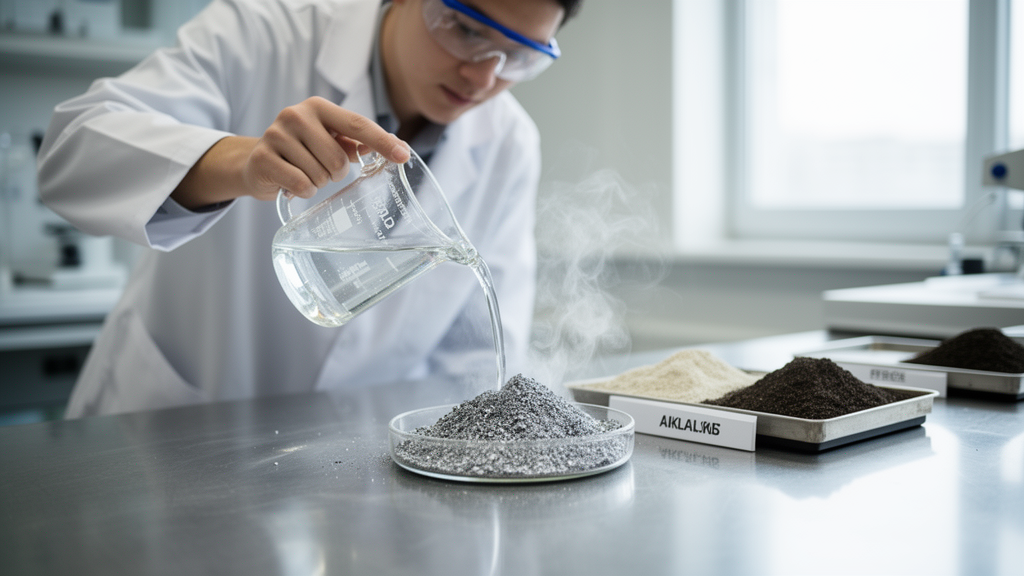
The processing recipe matters as much as the chemistry. The team prepared analytical-grade 4 M solutions, dissolving 160 grams of NaOH or 224.44 grams of KOH per liter of deionized water, verified the molarities by acid-base titration to within 2 percent of target, and monitored pH hourly, recording typical values of 13.6 plus or minus 0.2 for NaOH and 13.8 plus or minus 0.3 for KOH. The 4 M concentration emerged from preliminary trials spanning 2, 4, and 6 M as the level that modified surfaces without excessive particle degradation. Reinforcement particles were immersed at a 1:10 solid-to-liquid ratio for 24 hours at room temperature, washed in deionized water until the rinse reached neutral pH, and dried at 105 degrees Celsius for 12 hours before integration.
Activation timing also differed between the two hydroxides. Optimal conditions were identified at 4 M concentration, with NaOH requiring shorter activation times of 30 to 60 minutes compared with 60 to 120 minutes for KOH, whose slower dissolution of silica reflects its larger ionic radius. The matrix chosen for the composites was AA6061 aluminum alloy, selected over higher-strength alternatives such as AA2024 and AA7075 for its superior resistance to stress, corrosion, and cracking and its better compatibility with surface treatments. Composites were fabricated by stir casting, a cost-effective route in which the molten alloy is mechanically stirred with pre-heated reinforcements, degassed to remove trapped air, and cast into molds under controlled solidification.
An important caveat frames the entire study: no mechanical properties were directly measured. The authors are explicit that tensile strength, hardness, and wear resistance were not experimentally quantified, and they position the microstructural and chemical transformations they observed as strong predictors, rather than proof, of improved structural integrity. Enhanced crystallinity, surface hydroxylation, and refined particle morphology have been correlated with mechanical performance in similar composite systems, but the team calls for future work incorporating tensile, compressive, and tribological testing to validate these inferences directly. Within that scope, the study establishes a foundation for application-specific design: NaOH for lightweight, high-strength, and ductility-oriented composites suited to aerospace, KOH for durability and thermal stability under cyclic loading in automotive and marine environments, and combined alkali-plus-heat treatment as the most effective crystallinity-enhancing strategy. By valorizing agro-marine waste through selective alkali activation, the work outlines a low-cost, scalable route toward sustainable, high-performance metal matrix composites.
Subject of Research: Effects of NaOH and KOH alkali activation on agro-marine ash reinforcements for aluminum matrix composites
Article Title: Effects of NaOH and KOH activator agents on the aluminization process
Article References: Barah, O. O., Nnamchi, S. N., Onyelowe, K. C., Dennison, M. S., & Olotu, E. B. O. (2025). Effects of NaOH and KOH activator agents on the aluminization process. Advanced Metamaterials, 1(1), Article 2. https://doi.org/10.1007/s44468-025-00001-1
Image Credits: AI Generated
DOI: 10.1007/s44468-025-00001-1
Keywords: aluminum matrix composites, alkali activation, NaOH, KOH, agro-marine waste ash, XRD crystallinity, surface modification, stir casting, AA6061, sustainability, interfacial bonding, microporosity
News Source: Denise Maddox. (October 28, 2026). NaOH or KOH? Alkali choice reshapes ash surfaces for greener aluminum composites. Scienmag.