


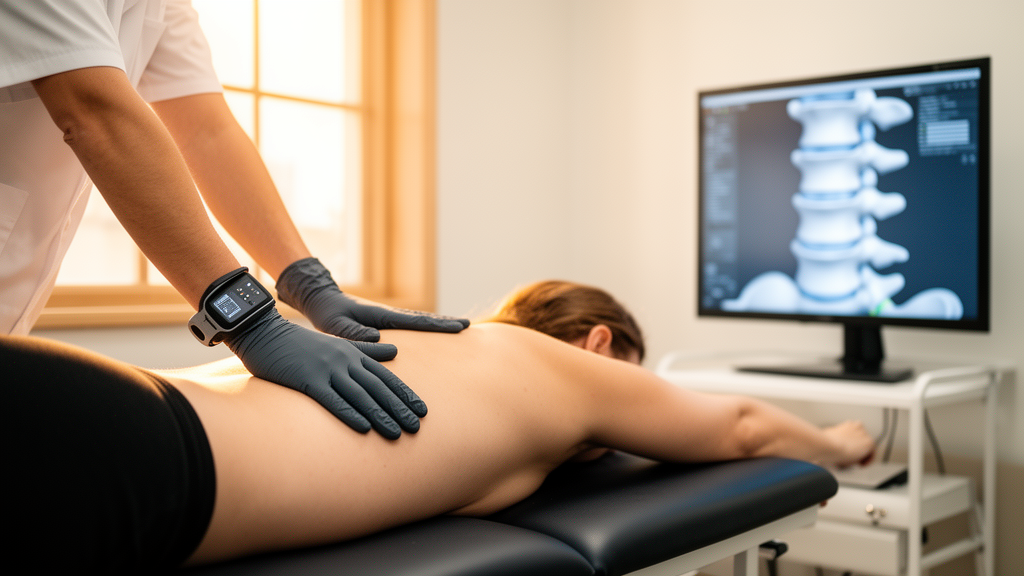
Chiropractors and manual therapists have long used two main ways to deliver lumbar rotational manipulation: with the patient lying on their side, and with the patient sitting astride a stool. A new study has now put both techniques under the combined scrutiny of instrumented force-sensing gloves and a three-dimensional finite element model of the lumbar spine, and the results show that the two approaches place markedly different mechanical demands on different regions of the lower back. The work, published in Chiropractic & Manual Therapies, combined direct measurement of the forces a practitioner generates during manipulation with computational simulation of how those forces propagate through intervertebral discs and facet cartilage.
The research team, led by Jiasi Shen, Xilin Gao and colleagues at the China Academy of Chinese Medical Sciences together with collaborators at the Beijing Institute of Technology, recruited twenty healthy volunteers aged between 20 and 30 years with body mass indices between 18 and 24 kilograms per square metre and no history of spinal disease. The volunteers were randomly assigned to one of two groups of ten. Ten received lateral decubitus manipulation, in which the subject lies on one side with the lower leg extended and the upper leg flexed, while the other ten received sitting manipulation, in which the subject sits astride a wooden stool while the operator rotates the spine. All procedures were performed by the same experienced senior clinician, and each participant received three manipulations on each side during a single experimental session, yielding 120 valid force datasets after quality control, sixty for each technique.
To capture the forces involved, the researchers used an intelligent force-sensing glove developed jointly by the Orthopedic Technology Laboratory of the China Academy of Chinese Medical Sciences and the Beijing Institute of Technology. Thin-film pressure sensors adhered to the glove surface capture mechanical signals, which are transmitted wirelessly to a computer for real-time recording. In the lateral decubitus technique, the operator places one hand on the posterior aspect of the hip and the other on the anterior aspect of the shoulder, then delivers a short, synchronised oblique thrust once joint elastic fixation is achieved. In the sitting technique, the operator places a thumb pad against the side of the L4 spinous process while the other arm passes through the subject’s axilla to rest on the opposite shoulder, then delivers a brief rotational thrust once a sense of joint locking is reached.
Statistical analysis of the measured forces revealed a fundamental asymmetry difference between the two techniques. For lateral decubitus manipulation, no statistically significant left-right differences in practitioner-generated forces were observed, with all comparisons returning P values above 0.05, suggesting bilaterally symmetric loading regardless of which side was treated. The sitting technique told a different story. The force applied at the shoulder was significantly lower on the left than on the right, at 62.56 plus or minus 15.58 newtons compared with 77.70 plus or minus 7.72 newtons, a difference with a t statistic of minus 10.088 and a P value below 0.001. Meanwhile, the force applied at the waist was higher on the left than on the right, at a median of 32.80 newtons with an interquartile range of 27.75 to 38.20 newtons, compared with a median of 26.06 newtons and an interquartile range of 22.66 to 33.54 newtons, a difference with a Wilcoxon Z statistic of 2.129 and a P value of 0.042.
Beyond simple left-right comparisons, the researchers applied k-means clustering to the force data, using the elbow method and silhouette score to determine the optimal number of clusters. For the lateral decubitus technique, two distinct operational patterns emerged. The first, termed the shoulder-hip coordinated pattern, showed comparable shoulder and hip forces of 64.61 newtons and 71.37 newtons respectively, indicating synergistic contribution from both contact points. The second, the hip-dominant pattern, featured a relatively low shoulder force of 41.26 newtons alongside a substantially higher hip force of 121.62 newtons, characterising a mode in which the hip dominates loading while the shoulder plays only a supporting role. For the sitting technique, three clusters emerged. The shoulder-waist coordinated pattern showed moderate shoulder force of 70.13 newtons and the highest waist force of 47.37 newtons. The shoulder-dominant pattern, which accounted for the largest proportion at 55.0 percent, had the highest shoulder force at 78.59 newtons and the lowest waist force at 26.16 newtons. The gentle-loading pattern showed the lowest shoulder force at 50.20 newtons and moderate waist force of 30.85 newtons, possibly corresponding to smaller-bodied subjects.
With the measured forces in hand, the team turned to computational simulation. They recruited a healthy adult female volunteer, 25 years old, 165 centimetres tall and weighing 60 kilograms, and acquired high-resolution computed tomography images covering vertebral levels T10 to S5 using a 64-slice spiral CT scanner with a slice thickness of 0.30 millimetres. The imaging data were processed through a pipeline involving Mimics 21.0 for three-dimensional segmentation, Geomagic Wrap 2021 for surface reconstruction, and SolidWorks 2021 for model assembly, before import into Ansys Workbench 21.0 for finite element analysis. The resulting model comprised 892,026 nodes and 556,078 elements, with ligaments represented as spring elements and solid tissues modelled as homogeneous, isotropic, linear elastic materials. The final model was validated by comparing predicted segmental ranges of motion under a 10 newton-metre moment in six directions against previously published cadaveric data, with exploratory Bland-Altman analysis showing mean model-minus-reference differences of minus 0.125 degrees for flexion-extension, minus 1.575 degrees for lateral bending and 0.525 degrees for axial rotation, supporting the biomechanical plausibility of the model.
The researchers then applied the clustered force parameters as loading conditions on the validated model. For lateral decubitus manipulation, the shoulder force was multiplied by a 20 centimetre horizontal distance from the shoulder contact point to the spinal axis to calculate a rotational moment applied to L1, while the hip force was multiplied by a 20 centimetre distance from the hip contact point to the spinal axis to determine a counter-rotational moment applied to L5. For sitting manipulation, a 400 newton axial compressive load, representing approximately two-thirds of body weight, was first applied to the superior surface of L1, and the shoulder and waist forces were converted into rotational moments applied to L1 and L4 respectively, the latter using a 6 centimetre distance from the waist contact point to the spinal axis.
The finite element results revealed starkly contrasting mechanical signatures. Across the two lateral decubitus clusters, the maximum intervertebral disc stress ranged from 7.87 to 13.40 megapascals and the maximum deformation from 7.22 to 12.31 millimetres, with the main mechanical effects concentrated at the L3/4 and L4/5 segments. Peak disc stress occurred at L3/4, while maximum total deformation was observed at L4/5. For facet cartilage, peak stress was localised to the left side of L4/5, whereas maximum deformation appeared on the right side of L4/5. The hip-dominant pattern produced higher stress and displacement values in the discs and cartilage at L3/4 and L4/5 but lower values at L1/2 and L2/3, indicating a more concentrated mechanical effect in the lower lumbar region. Across the three sitting clusters, the maximum disc stress ranged from 5.87 to 8.09 megapascals and the maximum deformation from 11.68 to 16.44 millimetres, with greater displacement mainly involving L1/2 and L2/3. Peak disc stress occurred at L2/3, maximum deformation at L1/2, and facet cartilage showed peak stress on the left side of L4/5 with peak deformation on the left side of L1/2. The shoulder-dominant sitting pattern consistently produced greater stress and displacement across segments, particularly at L1/2 and L2/3, while the gentle-loading pattern demonstrated substantially lower values at the same levels.
The authors interpret these divergent patterns through distinct load transmission pathways. In the lateral decubitus manipulation, rigid pelvic loading creates a short lever arm, channeling stress through the sacroiliac joint directly to the lower lumbar region, producing stress and displacement peaks at the L3/4 disc and L4/5 facet cartilage. In contrast, the sitting manipulation relies on axial spinal rotation with a long lever-arm effect, requiring greater displacement to reach the end range, with peaks localised in the upper lumbar spine. Because forces are distributed over longer spinal segments, stress magnitudes in the discs and facet cartilage are substantially reduced. The researchers also note that the predicted peak stresses in the lateral decubitus technique were of a similar magnitude to the reported yield strength of cancellous bone at approximately 10 megapascals, suggesting caution may be warranted in patients with poor bony tolerance, endplate vulnerability or marked degeneration, although they emphasise that the calculated von-Mises stresses cannot be directly equated with tissue failure loads because of differences in evaluated mechanical parameters, tissue types and loading conditions, and that no tissue-specific failure criterion was incorporated into the linear elastic model.
The study carries important limitations that the authors themselves acknowledge. Force data were collected exclusively from healthy young adults with a limited sample size, without stratification by age or body mass index, restricting generalisability to broader or at-risk populations. The sample size was relatively small for cluster analysis, meaning the identified clusters should be regarded as preliminary exploratory patterns requiring validation in larger cohorts. All manipulations were performed by a single clinician, which improved procedural consistency but limits generalisability to other practitioners. Three repetitions were performed on each side during the same session, and later recordings may have been influenced by joint gapping, tissue relaxation or other transient physiological changes caused by preceding procedures. The finite element model was based on healthy anatomy without pathological features of lumbar disc herniation, and simulations were performed under idealised conditions without inclusion of lumbar musculature, likely underestimating the complexity of in vivo stress distributions. Static loading was applied, capturing only peak forces without accounting for the temporal profile or acceleration effects of the thrust phase. The authors frame their findings as providing a quantitative biomechanical basis for further investigation of technique-specific loading characteristics, tissue safety and individualised clinical application, rather than as direct evidence of clinical benefit or absolute safety.
Subject of Research: Biomechanical comparison of lateral decubitus and sitting lumbar rotational manipulation techniques using measured practitioner forces and finite element analysis of the lumbar spine
Article Title: Biomechanical comparison of lumbar rotational manipulations in two different positions using force measurement and finite element analysis
Article References: Shen, J., Gao, X., Zheng, H., Zhang, X., Li, Z., Fan, Y., Zhang, W., & Wang, P. (2026). Biomechanical comparison of lumbar rotational manipulations in two different positions using force measurement and finite element analysis. Chiropractic & Manual Therapies, 34(1), Article 56. https://doi.org/10.1186/s12998-026-00683-7
Image Credits: AI Generated
DOI: 10.1186/s12998-026-00683-7
Keywords: lumbar rotational manipulation, finite element analysis, force-sensing glove, lateral decubitus position, sitting manipulation, intervertebral disc stress, facet cartilage, spinal biomechanics, k-means clustering, chiropractic technique, load transmission, lumbar spine
News Source: Ophelia Keating. (October 28, 2026). Force-sensing gloves and spine simulations reveal how two chiropractic techniques load the lower and upper lumbar spine differently, study finds. Scienmag.



