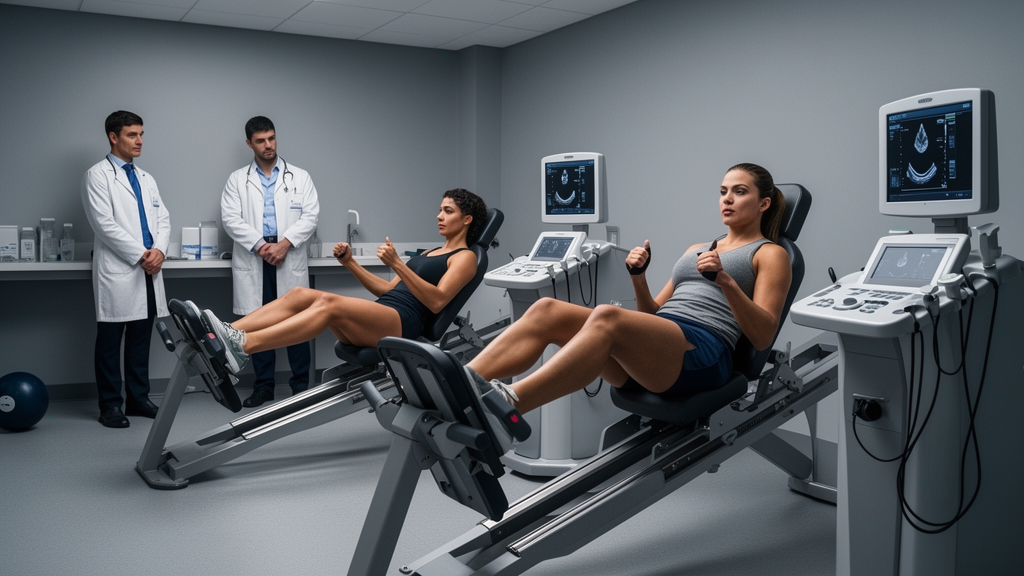
When young men and women performed a demanding bout of leg press exercise in a laboratory, their blood pressure responses told two different stories. The men’s mean arterial and diastolic pressures climbed significantly higher than the women’s during the lifting sets. Yet when researchers looked upstream at the brain’s blood vessels, the picture converged: increases in cerebral pulsatility, pulsatile damping, and carotid artery stiffness were statistically indistinguishable between the sexes. That unexpected convergence is the central finding of a new study published in Artery Research, an open-access paper from a team at Iowa State University led by Spencer Romanowski and Wesley Lefferts.
The study enrolled forty young adults, twenty men and twenty women, all screened to be free of cardiovascular, cerebrovascular, metabolic, pulmonary, renal, and neurological disease. None smoked or vaped, none had a recent concussion, and all had resting blood pressure below 140/90 mmHg. The men and women were similar in age, averaging around 23 to 25 years old, with comparable body mass index, resting blood pressure, and heart rate. The men were taller, heavier, and substantially stronger, a difference that would matter later in the interpretation. Resistance training habits, measured both as meeting physical activity guidelines and as self-reported weekly minutes, did not differ between the groups.
Each participant completed two visits separated by at least 72 hours. The first visit established eligibility and estimated one-repetition maximum leg press strength through a five-repetition maximum test. The second visit was the exercise challenge itself: after ten minutes of seated rest and baseline vascular measurements, participants performed five sets on a leg press machine, beginning with warm-up sets and then three working sets of twelve repetitions at 65 percent of their one-repetition maximum. Each repetition was paced by a metronome at three seconds per cycle, and participants were instructed to avoid the Valsalva maneuver, the forceful exhalation against a closed airway that is known to exaggerate blood pressure responses. Technicians reviewed end-tidal carbon dioxide and respiration traces afterward to confirm compliance, and only one individual was suspected of using the maneuver.
Measuring blood vessels in the brain while a person is lifting weights is technically difficult, which is why most prior studies have assessed vascular hemodynamics only after exercise ends. The researchers instead captured data during the lifting itself, at sets one and three of the 65 percent load. Beat-to-beat blood pressure was recorded continuously through finger photoplethysmography, with height corrections applied to account for gravitational differences between the finger, heart, and carotid measurement sites in the seated position. Carotid pressure waveforms came from applanation tonometry, and middle cerebral artery blood velocity was measured with transcranial Doppler ultrasound in the right temporal window, with insonation confirmed by a carotid vibration test. Four participants had inadequate temporal windows for Doppler insonation and were excluded from those specific measures.
From these recordings the team derived a suite of pulsatile hemodynamic indices. Middle cerebral artery pulsatility and resistive indices were calculated from systolic, diastolic, and mean velocities. Pulsatile damping, a measure of how much the downstream cerebral circulation smooths incoming pressure oscillations, was computed as the ratio of proximal carotid to distal MCA pulsatility. Carotid stiffness was quantified as beta-stiffness, an index that accounts for blood pressure, and additional pressure-flow analyses yielded carotid characteristic impedance, forward and reflected wave magnitudes, and a wave reflection index. Cerebrovascular conductance, the ratio of cerebral blood velocity to mean arterial pressure, served as an index of the brain’s vascular tone.
The results showed a clear sex difference in the pressor response. Men exhibited significantly greater increases in mean arterial and diastolic blood pressure from rest to sets one and three, with a statistically significant interaction between sex and time. Brachial systolic pressure was on average higher in men overall and rose progressively in both groups across the exercise bout. Men also showed greater increases in middle cerebral artery mean velocity, driven by their larger pressure responses. When blood velocity was expressed relative to pressure, however, as cerebrovascular conductance, the sex difference vanished: conductance fell significantly in both men and women, a pattern the authors interpret as evidence of intact compensatory autoregulation that limits, but does not eliminate, pressure-driven increases in cerebral flow.
Crucially, the pulsatile measures that the study was designed to test did not differ between the sexes. MCA pulsatility index and resistive index increased, and conductance decreased, from rest to both exercise sets in both groups. Carotid pulsatility index, resistive index, and pulse pressure all increased during exercise, while carotid mean velocity and conductance fell. Forward wave magnitude increased and wave reflection index decreased in both sexes, suggesting greater generation and propagation of pulsatile hemodynamic energy toward the cerebrovasculature during lifting, regardless of sex.
A few secondary observations complicate the clean picture. Significant interactions were detected for carotid diameter, beta-stiffness, and carotid diastolic pressure, with beta-stiffness and diameter increasing more in men from rest to set one before falling during set three. However, sensitivity analyses restricted to participants with complete data attenuated those interactions below statistical significance, while the time effects for carotid stiffness and diameter remained. The authors also ran a secondary analysis in a subset of eight men and eight women matched for the absolute load lifted, roughly 141 to 142 kilograms, and found that diastolic blood pressure still increased more in men, with medium-to-large effect sizes for sex differences in systolic and mean pressure responses that did not reach significance. This suggests the greater male pressor response is not fully explained by men simply lifting heavier loads.
The study has limitations the authors acknowledge candidly. Collecting vascular data during exercise produced substantial missing data across outcomes, which the mixed-effects modeling handled under a missing-at-random assumption and which sensitivity analyses partially addressed. Menstrual cycle phase was not standardized, a choice made to preserve external validity, though prior work suggests large artery stiffness responses do not differ by cycle phase, and cerebrovascular hemodynamics may be more pressure-sensitive in the mid-luteal phase. Transcranial Doppler measures blood velocity rather than flow, and end-tidal carbon dioxide changes during exercise were modest and not statistically significant. The findings apply to upright, seated leg press exercise in young, healthy adults with low cardiovascular risk, and cannot be extended to other body positions, other exercises, or older populations.
Why does any of this matter? Resistance exercise is widely recommended to reduce cardiovascular and cerebrovascular disease risk, and recent evidence suggests women who train regularly may reap a greater reduction in cardiovascular mortality than men, despite lower reported engagement. The authors propose that the similar pulsatile responses despite divergent pressures may hint that women possess greater hemodynamic sensitivity to acute blood pressure changes, a speculative interpretation they flag for confirmation. They also note that clinical data indicate women incur greater target organ damage from high blood pressure. The team frames these results as a rationale for longitudinal training studies to explore how sex-specific pressor responses and their hemodynamic consequences shape vascular adaptation over repeated bouts of resistance exercise.
Subject of Research: Sex differences in blood pressure and cerebrovascular pulsatile hemodynamic responses during an acute bout of lower-body resistance exercise in young adults
Article Title: Cerebrovascular Responses During an Acute Bout of Resistance Exercise Do Not Differ Between Sex
Article References: Romanowski, S. M., Reed, K. S., Crew, M. R., Murley, A. R., Kaftousian, K., Johnson, A. G., Lefferts, E. C., & Lefferts, W. K. (2026). Cerebrovascular Responses During an Acute Bout of Resistance Exercise Do Not Differ Between Sex. Artery Research, 32(1), Article 40. https://doi.org/10.1007/s44200-026-00139-6
Image Credits: AI Generated
DOI: 10.1007/s44200-026-00139-6
Keywords: resistance exercise, cerebrovascular hemodynamics, blood pressure, carotid stiffness, middle cerebral artery, pulsatility, pulsatile damping, leg press, sex differences, autoregulation, transcranial Doppler, vascular physiology
News Source: Ophelia Keating. (October 28, 2026). Despite Higher Blood Pressure Responses in Men, Cerebral Pulsatile Hemodynamics During Leg Press Exercise Do Not Differ Between Sex. Scienmag.