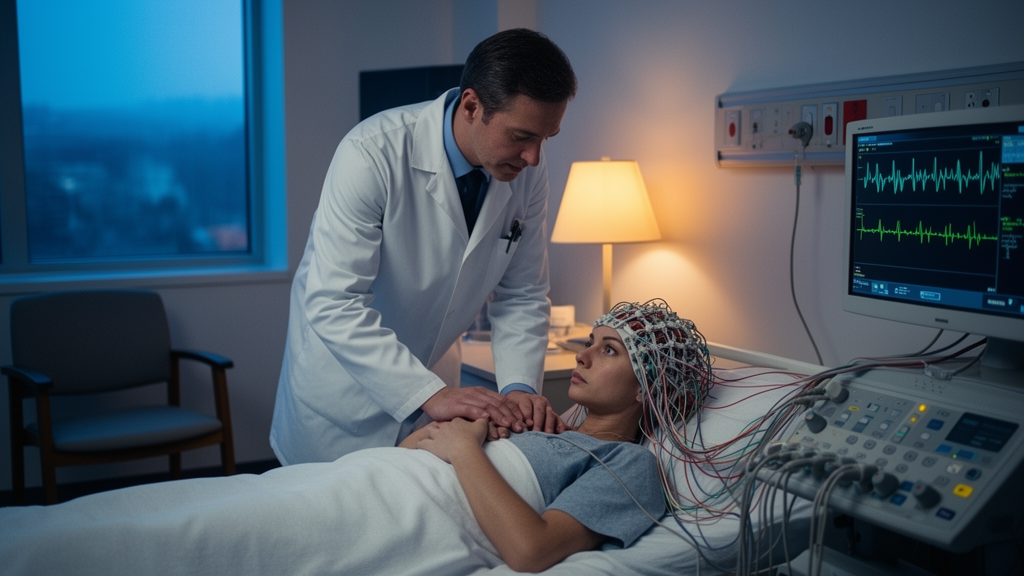
Patients with severe brain injuries who appear completely unresponsive may in fact show faint signs of awareness that a single bedside examination misses. A new observational study from a German neurorehabilitation center, published in BMC Neurology, followed 213 patients admitted for early rehabilitation between January 2023 and May 2025 and found that more than one in ten patients initially classified as being in an unresponsive wakefulness syndrome were actually in a minimally conscious state once clinicians repeated their assessments and cross-checked the results with the whole treatment team.
The research team, led by Melanie Boltzmann and Jens D. Rollnik, assessed consciousness with the Coma Recovery Scale-Revised, widely regarded as the most reliable behavioral tool for this purpose. The scale probes six domains—auditory, visual, motor, oromotor and verbal function, communication, and arousal—using standardized stimuli and strictly defined behavioral criteria. At the initial assessment, conducted on day 8 of rehabilitation between 9:00 and 11:00 a.m., 61 of the 213 patients were classified as unresponsive wakefulness syndrome, a state in which eyes may open spontaneously but responses remain purely reflexive.
For every patient labeled unresponsive on that first morning examination, the researchers applied a deliberately demanding protocol. A second assessment followed the same afternoon between 1:00 and 3:00 p.m., and if the diagnosis persisted, a third took place the next morning. Only when all three examinations concordantly showed reflexive behavior alone was the unresponsive wakefulness syndrome diagnosis accepted as the reference classification.
The answer was: often enough to matter. Five of the 61 patients—8.2 percent—were reclassified as minimally conscious when the second or third examination picked up signs of awareness the first one had missed. Two further patients, another 3.3 percent, were reclassified on the basis of interdisciplinary clinical consensus even though all three scale examinations had concordantly indicated unresponsiveness. In those two cases, the treatment team, which included physicians, nurses, occupational therapists and physiotherapists observing patients continuously and independently of the scale results, reported visual fixation that no standardized assessment had captured. In total, seven patients, or 11.5 percent of those initially judged unresponsive, received a revised diagnosis.
The specific behaviors that had slipped past the first examination are telling. They included visual fixation in two patients, visual pursuit in two, and nonfunctional communication in one—all hallmarks of the minimally conscious state, which is defined by minimal but clearly discernible and reproducible signs of awareness. The authors note that such signs are often brief, easily misread as reflexive, or masked by confounding factors such as motor impairment, language deficits, tracheostomy, fluctuating arousal, or rapidly habituating responses. Sedatives, infections, seizures, hydrocephalus and metabolic disturbances can further muddy the behavioral picture.
After these corrections, the final classification at week 2 comprised 54 patients with unresponsive wakefulness syndrome, 92 with minimally conscious state, and 67 with no disorder of consciousness at all—patients who already met criteria for emergence, meaning functional communication or functional object use, at their first assessment. The minimally conscious group itself split into 49 patients with MCS minus, marked by non-language behaviors such as visual pursuit or object manipulation, and 43 with MCS plus, marked by language-related abilities such as command following or intelligible verbalization. The most common signs of minimal consciousness at admission were object manipulation in 40 patients, visual pursuit in 37, and reproducible movement to command in 29.
Visual behavior emerged as a diagnostic linchpin. Among patients showing only a single indicator of the minimally conscious state, 90 percent displayed a response in the visual domain, and among those initially diagnosed as unresponsive who later showed awareness, 43 percent were identified through the visual subscale alone, with 86 percent showing at least one conscious visual behavior. The authors argue that visual fixation in particular may be overlooked because it is fleeting and hard to interpret, and they point to prior work questioning whether fixation is inherently a sign of consciousness, whereas visual pursuit appears to be a more robust and specific marker supported by measures of visual cortex function and metabolism.
Recovery trajectories differed sharply across the diagnostic groups. By week 4, more than a third of the unresponsive group—16 patients—had improved to the minimally conscious state and three had emerged from it entirely, with most upward transitions across the whole sample occurring by that early checkpoint. At the final assessment, conducted on average roughly 94 days after the first, nine unresponsive patients remained in or had returned to that state, 12 were minimally conscious, and six had emerged. In the minimally conscious group, 66 percent had emerged by the final assessment, with emergence significantly more frequent among MCS plus patients than MCS minus patients. Change in scale scores between weeks 2 and 4 was the only independent predictor of improved consciousness in the unresponsive group, while time since injury, the week-2 score, and early score change predicted emergence among minimally conscious patients.
Mortality tracked the depth of the consciousness disorder with grim precision. Half of the patients initially diagnosed as unresponsive died during the study, at a mean of about 60 days after injury, and in 26 of those 27 cases treatment goals shifted from curative to palliative care. Ten minimally conscious patients died, and not a single patient in the non-disorder group did. The authors frame this gradient as evidence that early, accurate classification is essential not only for choosing rehabilitation strategies, which differ substantially between unresponsive and minimally conscious patients, but also for mortality risk stratification and for guiding individualized, and sometimes end-of-life, decisions.
The study has clear limits that the authors themselves enumerate. The analyses were retrospective, drawing on routinely collected clinical data from a single specialized center; patients with ongoing sedation or severe premorbid neurological, psychiatric or substance-related conditions were excluded; follow-up ended with discharge, so late recovery may have been underestimated; and no family members were present during assessments, even though prior work by Moretta and colleagues showed that caregiver-assisted examinations with personally meaningful stimuli such as a patient’s own name yield higher scores and better detection of residual behaviors. Even so, the core message stands: in routine subacute care, a pragmatic combination of repeated standardized assessments at different times of day, plus interdisciplinary consensus, caught signs of consciousness that single examinations missed—without requiring the five or more assessments over ten days that earlier work in chronic patients recommended, a burden many clinics cannot shoulder.
Subject of Research: Diagnostic accuracy of repeated Coma Recovery Scale-Revised assessments for disorders of consciousness after severe brain injury
Article Title: Early changes in consciousness after severe brain injury: diagnostic accuracy and patient characteristics
Article References: Boltzmann, M., Jenner, S. B., Krauss, J. K., Tegtbur, U., Haghikia, A., Weimar, C., & Rollnik, J. D. (2026). Early changes in consciousness after severe brain injury: diagnostic accuracy and patient characteristics. BMC Neurology, 26(1), Article 672. https://doi.org/10.1186/s12883-026-05566-1
Image Credits: AI Generated
DOI: 10.1186/s12883-026-05566-1
Keywords: disorders of consciousness, unresponsive wakefulness syndrome, minimally conscious state, Coma Recovery Scale-Revised, misdiagnosis, severe brain injury, neurorehabilitation, visual fixation, visual pursuit, mortality, early rehabilitation, interdisciplinary consensus
News Source: Cassandra Pierce. (October 28, 2026). Repeated bedside checks reveal hidden consciousness in brain injury patients. Scienmag.