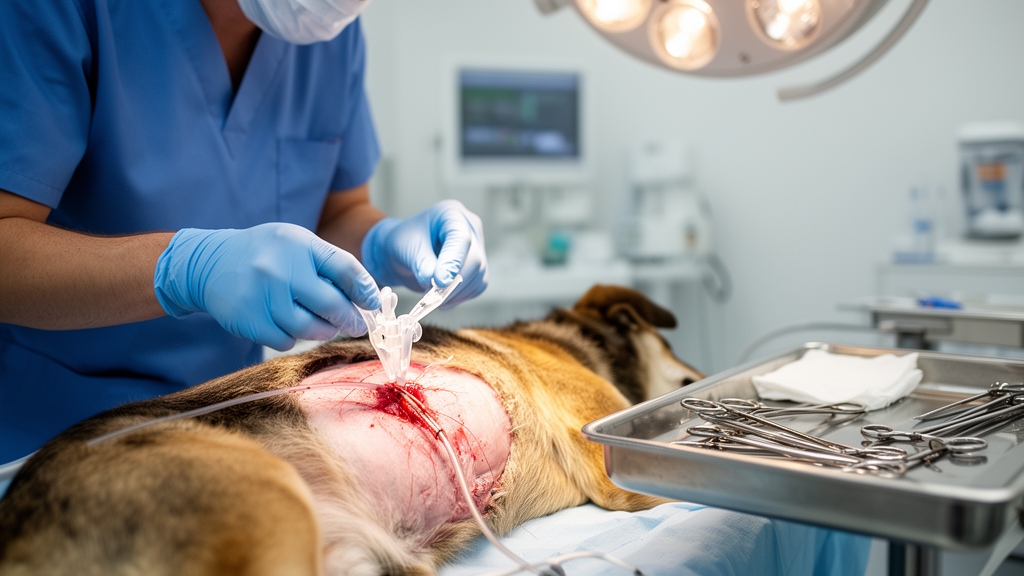
Haemorrhage from the ovarian pedicle is one of the recognised complications of removing ovaries in dogs, and a new multicentre study reports that a resorbable self-locking ligation device could be used to compress tissue of the ovarian pedicle, provide haemostasis and support the tissue throughout the healing period. The prospective controlled study, published in Acta Veterinaria Scandinavica, enrolled 72 intact female dogs destined for elective ovariohysterectomy at four centres. Thirty-six dogs were ligated with the device and 36 served as controls ligated with a traditional double ligature technique. No postoperative complications were observed in either group and all dogs recovered uneventfully, while two cases of intraoperative bleeding from the ovarian pedicles occurred in the control group.
The device, known as LigaTie and manufactured by Resorbable Devices AB in Uppsala, Sweden, consists of a flexible band, partially perforated along its length, and a locking case. The band is passed through the case to form a loop around the tissue, and when the locking mechanism engages with the perforations the band can only be advanced in one direction, allowing progressive tightening of the loop. Design features intended to achieve a secured tissue grip were added to the locking case to increase friction between the device and the tissue compressed inside the loop. The material is a resorbable block co-polymer of glycolide and trimethylene carbonate, injection-moulded into the device components, equivalent to the resorbable suture Maxon. The devices were packaged in pairs in Tyvek pouches under clean-room conditions, sealed in aluminium foil pouches after vacuum drying, and sterilised by electron beam radiation at a dose of 25 kGy.
The device was originally developed in a university research project with a specific goal: to keep the advantage of a self-locking loop at ligation while avoiding the chronic tissue reactions associated with non-resorbable materials. Conventional cable ties, which became popular in veterinary surgery in the 1970s, are made of nylon, a non-resorbable material that may cause chronic tissue reactions; they are not designed for surgery, are manufactured without declared good manufacturing practice, and can contain substances not suited for long-term implantation. The authors note that the use of traditional cable ties in surgery is strongly discouraged, as is the use of non-resorbable material for ligation purposes. The device was first manufactured in the resorbable polymer polydioxanone and later in the glycolide and trimethylene carbonate co-polymer used in the present study.
Earlier work had suggested promise, but only in limited settings. A previous feasibility study at a single centre involving 21 dogs suggested the device could be used to ligate the canine mesovarium, and compared with traditional suture ligation with one encircling ligation, the device enabled a reduced time to ligate the ovarian pedicle and a shorter duration of surgery. The device has also been subjected to pilot tests in cholecystectomy, lung lobectomy and lung biopsies, and equine laparoscopic cryptorchidectomy. However, as the authors point out, previous studies had demonstrated feasibility and potential efficiency advantages in single-centre settings with limited numbers and controlled conditions, and it remained unclear whether these findings were reproducible across different clinical environments, surgeons and practice settings. The primary aim of the new study was therefore to continue evaluating the feasibility and clinical performance of the device for ligation of the canine mesovarium in a multicentre setting, with secondary aims of comparing perioperative complications, ligation time and duration of surgery between the device and a traditional double ligature technique.
The dogs included were privately owned animals or dogs from “spay and adopt” programmes destined for gonadectomy, with signed owner consent where applicable; the only exclusion criterion was an owner declining to participate, and there were no limits regarding age or bodyweight. Each centre included roughly equal numbers of device and control dogs, allocated in an alternating sequence based on the order of completion of preoperative evaluation and the scheduled date of the procedure. Across all centres, body weights in the device and control groups were 14.5 ± 1.0 kg and 14.9 ± 1.3 kg respectively, while the device group was 2.5 ± 0.3 years old and the controls 3.6 ± 0.4 years old. At each centre, ovariohysterectomies were performed by an experienced surgeon, with anaesthesia and analgesia protocols chosen according to each centre’s preferences.
The surgical techniques differed between groups in ways that reflect the two approaches. In the device group, a hole was made in the broad ligament at the junction of the mesovarium and mesometrium, the flexible band was applied around the ovarian pedicle and the loop was tightened, with a needle holder optionally used for improved grip. After tightening, haemostatic forceps were applied between the device and the ovary and the pedicle was transected distal to the implanted device. Notably, no haemostatic forceps were applied to crush the tissue before ligation with the device, because crushing could contribute to haemostasis independently of the device and confound assessment of its effect. In the control group, the ovarian pedicle was double ligated with resorbable suture: the mesovarium was first crushed with haemostatic forceps to create a groove, a ligature was placed in the groove, a circular ligature was applied, and an additional anchored figure-of-eight ligature was placed distal to the first circular ligature before transection.
The timing results showed no overall advantage for either technique when groups were summed across centres. Estimated from linear mixed models, ligation times were 4.4 ± 1.3 minutes for the device group and 4.5 ± 0.4 minutes for the controls, while durations of surgery were 21.3 ± 4.0 minutes and 16.7 ± 0.7 minutes respectively. Both surgery and ligation times showed a significant centre-specific treatment effect, although there was no significant treatment effect in the tested model. Staff at centres A and C had previous experience of using the device, whereas the surgeons at centres B and D were first-time users, and the authors report that centres with previous experience recorded shorter ligation times and durations of surgery. This pattern, they write, suggests a learning curve: the device enabled a shortened duration of surgery if the user had experience of the technology, although the observed centre-specific effect may reflect differences in prior experience that were not formally investigated.
On safety, the findings were reassuring within the scope of the study. No intra- or postoperative bleeding was observed in the device group, while the two control-group bleeding events, one from the right ovarian pedicle of a six-year-old 24 kg dog at centre A and one from the left ovarian pedicle of a three-year-old 14 kg dog at centre C, were re-ligated with haemostasis confirmed and uneventful remaining procedures. The authors note these two dogs could be described as medium and large, in agreement with previous studies in which complication risk was considered high in large breeds, whose deeper chests increase the distance from the skin incision to the tissue to be ligated. They also cite prior reports in which intraoperative bleeding from the ovarian pedicle occurred in 10 percent of dogs operated by clinicians in a non-teaching institution, and major intraoperative haemorrhage was reported in 4 to 22 percent of cases in studies where students performed the surgery.
The study had limitations the authors set out explicitly. Inclusion criteria were broad, anaesthetic and perioperative analgesic protocols varied between centres, the use of haemostatic forceps differed between groups, and the number of cases was limited and not evenly distributed between centres. The low number of bleeding events limits statistical power, no power analysis was performed, and the ages of dogs were not matched between the device and control groups. The study was prospective, but no attempt was made to evaluate outcomes in a blinded fashion, and the small number of centres may have limited the power to detect a centre-specific treatment effect. At centre C, two bitches, one from each group, had an enlarged uterus due to pyometra, but the authors state that the inclusion of these two cases did not affect the main conclusion of the study.
The authors conclude that the device could be used for compression of tissue of the ovarian pedicle, provided haemostasis and adequate support of tissue throughout the healing period, and that time for double ligation and duration of surgery did not differ between groups. They also note that establishing the safety of a surgical device requires that a number of devices be tested in vivo, and that an important aspect of biocompatibility is the success of an implantable medical device in fulfilling its intended function. Canine gonadectomy, an elective and highly standardised procedure, was considered suitable for such tests, and the use of “spay-and-adopt” settings offered an opportunity to reduce the use of experimental animals in agreement with the 3R principles. Whether the device, when used by novice surgeons, affects ligation time and duration of surgery remains to be studied, and the authors caution that their findings on the learning curve should be interpreted cautiously because the study material was limited.
Subject of Research: Evaluation of a resorbable self-locking device for ligation of the canine ovarian pedicle during ovariohysterectomy in a multicentre controlled study.
Article Title: Ligation of the canine mesovarium with a resorbable self-locking device: a multicentre study
Article References: Paula Coelho, L. D., da Mota Costa, M. R., Ramos, R. M., de Abreu Oliveira, A. L., Minto, B. W., Franco, G. G., Thuroczy, J., Guedes, R. L., Dornbusch, P. T., & Höglund, O. V. (2026). Ligation of the canine mesovarium with a resorbable self-locking device: a multicentre study. Acta Veterinaria Scandinavica, 68(1), Article 41. https://doi.org/10.1186/s13028-026-00884-3
Image Credits: AI Generated
DOI: 10.1186/s13028-026-00884-3
Keywords: veterinary surgery, dogs, ovariohysterectomy, ovarian pedicle, ligation device, resorbable polymer, haemostasis, multicentre study, surgical time, learning curve, spay and adopt, LigaTie
News Source: William Thompson. (October 28, 2026). Resorbable Self-Locking Device for Canine Ovarian Pedicle Ligation Tested Across Four Veterinary Centres. Scienmag.