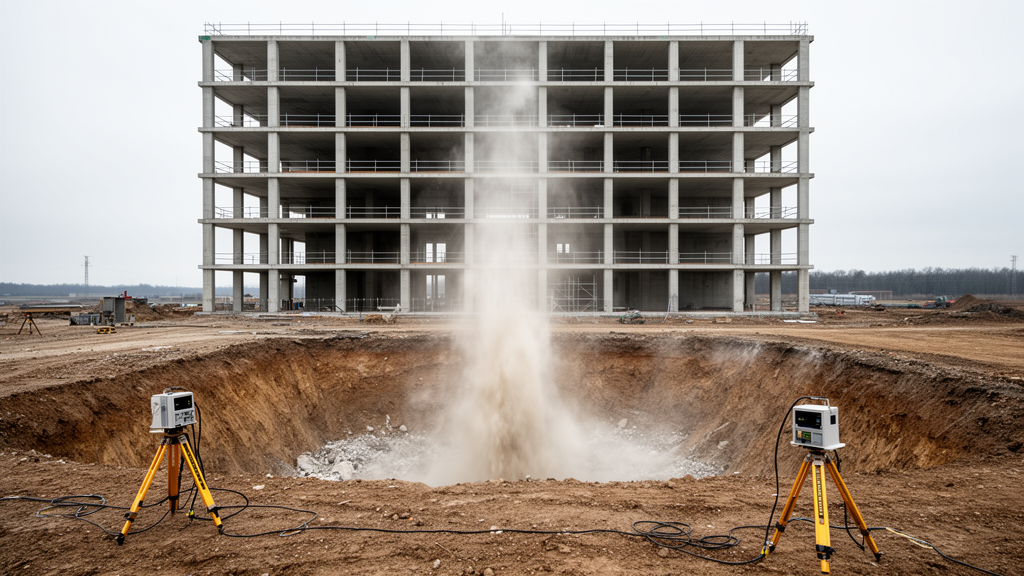
A 3 kg TNT charge buried in sandy soil and detonated just 4 meters from a reinforced concrete frame building can produce global floor displacements roughly equivalent to those caused by an earthquake with a peak ground acceleration of 0.2 g to 0.3 g, according to a new numerical study published in Discover Civil Engineering. The finding comes with heavy caveats: the comparison holds only for linear elastic displacement magnitudes under a very specific scenario, and the authors explicitly warn that it does not constitute a general equivalence suitable for blast-resistant design.
The study, conducted by Ewineta Assefa Yisayas and Yihenew Telay Addisu, addresses a long-standing gap in structural engineering practice. Earthquake and blast loading are usually analyzed in separate professional silos: seismic design focuses on global performance indicators such as drift, ductility, and collapse prevention, while blast design emphasizes local member damage and pressure resistance. Despite both being dynamic hazards, there has been no established relationship between subsurface blast loading and equivalent seismic ground motion, leaving engineers unable to directly apply conventional seismic analysis tools to blast scenarios.
To build that comparison, the researchers modeled four reinforced concrete frame configurations in SAP2000: 6-story and 12-story buildings, each with either 3×3 or 3×4 bays. The buildings were designed according to the Ethiopian standard ES EN 1998-1:2015, with concrete of 30 MPa compressive strength, steel rebar of 400 MPa yield strength, dead and live loads of 2.5 kN/m² each, and a behavior factor of 3.9 derived for frames regular in elevation. The strong column–weak beam criterion and second-order effect checks were applied in the preliminary design.
The blast side of the analysis used a 3 kg TNT equivalent charge buried in sandy soil at standoff distances of 4, 7, and 10 meters. Ground shock parameters were derived from the Krauthammer empirical formulation, which applies to all soil types and provides time-dependent velocity histories. For dense sand, the study used a seismic velocity of 1600 fps, an attenuation coefficient of 2.5, and a coupling factor of approximately 0.3 at the relevant scaled depth. At 4 meters, the scaled distance works out to about 2.77 m/kg^(1/3), yielding a peak particle velocity of roughly 0.023 m/s. The velocity histories were integrated to displacement and differentiated to acceleration using the trapezoidal rule, then applied as uniform base acceleration in linear direct integration time-history analysis with Newmark’s average acceleration method and a time step of 0.002 seconds.
The earthquake side used ES EN 1998-1:2015 response spectra with peak ground accelerations from 0.05 g to 2 g, 5 percent damping, soil types A through D, and both Spectrum Type 1 and Type 2. Response spectrum analysis was performed elastically, with a behavior factor of 1.0 and no dynamic increase factors, since seismic strain rates are far lower than blast-induced rates. The SAP2000 implementation of the code spectrum was verified by comparing output base shear for a single-story frame against the analytical code value, with agreement within 1 percent.
The results show that standoff distance is the dominant factor governing blast response. Increasing the distance from 4 to 10 meters reduced maximum floor displacements by approximately 85 to 90 percent for all building configurations, indicating that far-field blast effects are negligible for the studied charge weight. Displacement fell by 72 to 76 percent between 4 and 7 meters alone. The largest story drifts consistently occurred at the lower stories, on the second or third floor, suggesting that most blast-induced displacement concentrates near the base of the structure. Building height also mattered greatly: doubling the height from 6 to 12 stories increased top displacement by 107 to 139 percent for 3×3 bay frames and by 323 to 492 percent for 3×4 bay frames under blast loading.
Bay configuration produced a surprising divergence between building heights. Adding a bay, from 3×3 to 3×4, reduced maximum displacement by 54 percent in the 6-story building at 4 meters standoff but increased it by 19 percent in the 12-story building. The authors are careful not to over-interpret this result: without modal analysis, which was not performed, the cause cannot be determined conclusively. Possible explanations include added mass increasing inertial forces more than added stiffness, a fundamental period shifting closer to the dominant blast frequency, or significant higher-mode participation in the taller building. The notion that a mass effect dominates in taller buildings therefore remains a hypothesis rather than a conclusion from the current data.
Under earthquake loading, displacements increased linearly with peak ground acceleration for all ground and spectrum types. Ground Type D, representing soft soil, produced the largest responses, while Ground Type A, representing rock, produced the smallest. Spectrum Type 2 generally induced greater displacements than Type 1 at the same peak ground acceleration, reflecting its lower corner periods and broader acceleration plateau. Doubling building height approximately doubled the top displacement under seismic loading, an average increase of about 119 percent.
The headline comparison emerged from matching these two sets of results. For the specific scenario studied, a 3 kg TNT subsurface blast at 4 meters standoff produced global floor displacements roughly equivalent to an earthquake of 0.2 g to 0.3 g peak ground acceleration on Ground Types A or B with Spectrum Type 1. At 7 meters, blast effects were comparable to about 0.1 g, and at 10 meters, blast-induced displacements fell below the 0.05 g response level and were considered practically insignificant. However, additional response parameters extracted from the analyses showed that this displacement-based equivalence does not extend to other design metrics. For the 6-story, 3×3 bay frame, the 4-meter blast and the 0.2 g seismic case produced similar top displacements, 0.0318 meters versus 0.0175 meters for Ground A, yet base shear values differed significantly, at 342 kN for blast versus 218 kN for seismic. Peak floor acceleration amplified up the height to 0.31 g at the roof against a 0.023 g input, indicating substantial higher-mode participation in the blast response, in contrast to the fundamental-mode-dominated seismic response of this regular frame. The blast loading’s dominant frequencies of 10 to 100 Hz correspond to periods of 0.01 to 0.1 seconds, far shorter than the fundamental periods of 0.76 to 0.89 seconds for the 6-story frames and 1.41 to 1.52 seconds for the 12-story frames.
The authors are unusually explicit about the limitations that prevent generalization. The linear elastic assumption is likely invalid for near-field blast, since a 4-meter standoff would probably drive reinforced concrete into the inelastic range, and no plastic hinges were modeled. Only a single charge weight was studied, so results do not generalize to other explosive masses. The fixed-base assumption is internally inconsistent with the soil-dependent ground motion computation, since no soil-structure interaction was modeled. Applying the same acceleration history to all supports ignores the spatial variation of blast-induced ground motion and likely overestimates the structural response for near-field blast. No experimental validation of the structural response was performed; the Krauthammer formulation has been validated for peak particle velocity within about 30 percent, but the velocity-to-acceleration conversion and uniform base acceleration application have not. The dynamic increase factors applied for blast loading, drawn from UFC 3-340-02, are also an approximation at 4 meters, where the scaled distance falls near the boundary between close-range and far-range regimes. The authors position the proposed equivalent seismic load only as a preliminary screening tool for comparing global elastic displacement magnitudes, and they recommend future work on nonlinear time-history analysis with material plasticity, parametric studies with varying charge weights, soil-structure interaction modeling with spatially varying input, modal analysis, and experimental validation of structural response to subsurface blast.
Subject of Research: Comparative numerical analysis of multistory reinforced concrete frame buildings under subsurface blast and earthquake loading
Article Title: Comparative response of multistory reinforced concrete frame buildings to subsurface blast and earthquake loading based on ES EN 1998–1:2015
Article References: Yisayas, E. A., & Addisu, Y. T. (2026). Comparative response of multistory reinforced concrete frame buildings to subsurface blast and earthquake loading based on ES EN 1998–1:2015. Discover Civil Engineering, 3(1), Article 265. https://doi.org/10.1007/s44290-026-00617-5
Image Credits: AI Generated
DOI: 10.1007/s44290-026-00617-5
Keywords: reinforced concrete, blast loading, earthquake engineering, subsurface explosion, ES EN 1998-1:2015, SAP2000, time-history analysis, response spectrum, standoff distance, structural dynamics, ground shock, displacement comparison
News Source: Violet Maxwell. (October 28, 2026). Subsurface Blast at Four Meters Matches a 0.2 g Earthquake for RC Frame Displacements, Study Finds. Scienmag.