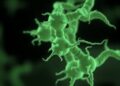
Patients with a rare bone cancer of the skull and spine – chordoma – could be helped by existing drugs, suggest scientists from the Wellcome Trust Sanger Institute, University College London Cancer Institute and the Royal National Orthopaedic Hospital NHS Trust. In the largest genomics study of chordoma to date, published today (12th October) in Nature Communications, scientists show that a group of chordoma patients have mutations in genes that are the target of existing drugs, known as PI3K inhibitors.
Researchers suggest a clinical trial of PI3K inhibitors for this particular group of chordoma patients, who could benefit from existing treatments.
Chordoma is a rare form of bone cancer that strikes individuals of all ages and affects 1 in every 800,000 people in the UK*. Chordomas are slow-growing, yet aggressive and life-threatening tumours that form in the vertebral bodies of the spine, the sacrum and base of the skull. The cancerous tumour is considered to develop from persistent embryonic tissue, known as the notochord.
As they involve critical structures such as the brainstem, spinal cord, and important nerves and arteries, chordomas are difficult to treat. Surgery and radiation are currently the only effective forms of treatment .
For the first time, scientists have used whole genome sequencing to gain a better understanding of the biology underlying chordoma. The results reveal promising new treatment options for a cancer with a poor prognosis.
The team studied chordoma tumours from 104 patients and found that 16 per cent of the tumour samples had genetic changes, or mutations, in PI3K signalling genes. These genes are the target of existing drugs, known as PI3K inhibitors, which are being used to treat many cancers, including breast cancer, lung cancer and lymphoma**, but have not yet been considered for chordoma.
The gene brachyury, or T, has been known for some time to play a role in chordoma but for the first time the team used genomic sequencing to demonstrate that only one additional copy of the T gene seems to drive these tumours. The team also discovered a new cancer gene that is specific to chordoma, known as LYST, which has not been found in any other cancer. This finding warrants future research.
Dr Sam Behjati, joint first author from the Wellcome Trust Sanger Institute, said: "By sequencing the tumours' DNA, we get a much clearer view of the genetic changes that drive chordoma. We have shown that a particular group of chordoma patients could be treated with PI3K inhibitors, based on their mutations. This would have been missed had we not done genomic sequencing of their tumours."
Josh Sommer, a survivor of chordoma and Executive Director of the Chordoma Foundation, USA, said: "These findings represent a major step forward in understanding the underlying causes of chordoma, and provide hope that better treatments may soon be available for some patients."
Professor Adrienne Flanagan, joint lead author from the Royal National Orthopaedic Hospital NHS Trust and University College London Cancer Institute, said: "This study provides a resource for chordoma research for years to come. In the future we hope to target chordoma from three angles: trialling PI3K inhibitors in chordoma; developing a therapeutic approach to switching off the extra copy of the T gene and studying the function of LYST as a cancer gene and its role in the development of chordoma".
###
Notes to Editors:
Sources:
* https://www.bcrt.org.uk/information/information-by-type/chordoma/
** https://www.ncbi.nlm.nih.gov/pmc/articles/PMC4708174/
Publication:
Patrick Tarpey, Sam Behjati et al. (2017) The driver landscape of sporadic chordoma. Nature Communications. DOI: 10.1038/s41467-017-01026-0
Selected websites:
Chordoma Foundation
The Chordoma Foundation is an international nonprofit organization working to improve the lives of those affected by chordoma and lead the search for a cure. Founded by patients and family members in 2007, the Foundation proactively invests in research to develop better treatments, supports healthcare providers in improving the standard of care for chordoma patients, and provides a comprehensive suite of services to support patients and caregivers throughout their journey with the disease. http://www.chordoma.org
Royal National Orthopaedic Hospital NHS Trust
The RNOH is the largest specialist orthopaedic hospital in the UK, and a recognised world leader in the field of orthopaedics and neuro-musculoskeletal medicine. It treats more than 125,000 patients a year for conditions ranging from acute spinal injuries and bone cancer to prosthetic rehabilitation and chronic back pain. http://www.rnoh.nhs.uk/
About UCL (University College London)
Founded in 1826, UCL was the first English university established after Oxford and Cambridge, the first to admit students regardless of race, class, religion or gender, and the first to provide systematic teaching of law, architecture and medicine. We are among the world's top universities, as reflected by performance in a range of international rankings and tables. UCL currently has over 35,000 students from 150 countries and more than 11,000 staff. Our annual income is more than £1 billion. http://www.ucl.ac.uk | Follow us on Twitter @uclnews | Watch our YouTube channel YouTube.com/UCLTV
UCL Cancer Institute, London, is the hub for cancer research at University College London (UCL), one of the world's leading universities. The UCL Cancer Institute draws together over 300 researchers/clinicians working to translate research discoveries into new strategies to prevent, diagnose and treat cancer. Visit http://www.ucl.ac.uk/cancer | Follow us on Twitter @uclcancer
The Wellcome Trust Sanger Institute
The Wellcome Trust Sanger Institute is one of the world's leading genome centres. Through its ability to conduct research at scale, it is able to engage in bold and long-term exploratory projects that are designed to influence and empower medical science globally. Institute research findings, generated through its own research programmes and through its leading role in international consortia, are being used to develop new diagnostics and treatments for human disease. http://www.sanger.ac.uk
Wellcome
Wellcome exists to improve health for everyone by helping great ideas to thrive. We're a global charitable foundation, both politically and financially independent. We support scientists and researchers, take on big problems, fuel imaginations and spark debate. http://www.wellcome.ac.uk
Media Contact
Emily Mobley
[email protected]
01-223-496-851
@sangerinstitute
http://www.sanger.ac.uk
http://dx.doi.org/10.1038/s41467-017-01026-0