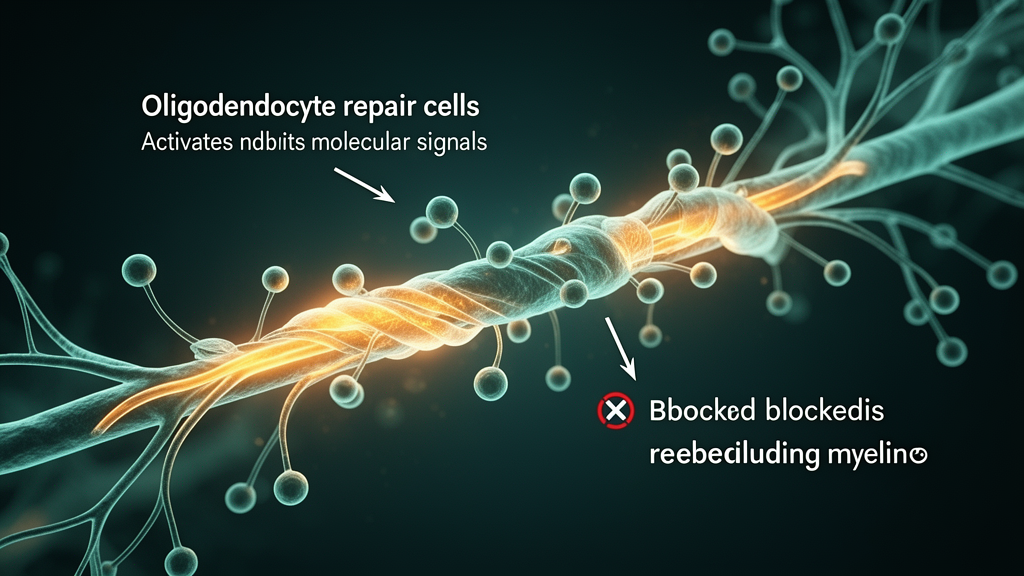
Oligodendrocyte precursor cells, or OPCs, are a widely distributed glial population in the adult central nervous system that normally retain the ability to mature into oligodendrocytes, the cells responsible for building and maintaining myelin. When the nervous system is injured, however, these cells can instead undergo an alternative phenotypic transition, and which path they take critically determines how efficiently myelin is repaired. A new study in a mouse model of focal demyelination reports that the molecular cues steering this decision involve two major signaling pathways acting in opposition to each other.
Using PDGFRα-CreER; Rosa-YFP transgenic mice for lineage tracing, combined with a lysophosphatidylcholine-induced focal demyelination model, researchers tracked what happens to OPCs inside lesions. They found that OPCs within the lesions acquire astrocytic characteristics, a transformation accompanied by opposing changes in bone morphogenic protein (BMP) and Wnt signaling. In other words, one pathway becomes more active while the other is dialed down at the same time.
The molecular signature of the transforming cells was specific. OPCs undergoing the astrocyte-like transition showed marked downregulation of β-catenin, of phosphorylated glycogen synthase kinase-3 beta at serine 9 (p-Ser9-GSK-3β), and of Smad7, together with upregulation of phosphorylated Smad1/5 (p-Smad1/5). Together, these changes reflect concurrent activation of BMP signaling and inhibition of Wnt signaling within the transforming cells.
To test whether these pathway changes actually control the fate decision, the team manipulated the signals pharmacologically. Interestingly, activating BMP or inhibiting Wnt alone had no effect, a result the authors interpret as evidence of an antagonistic interplay between the two pathways. Because each pathway was already shifting in opposite directions in the lesions, pushing either one on its own apparently was not enough to change the balance.
The picture changed when the researchers counteracted the endogenous shifts. Blocking the natural upregulation of BMP, or blocking the natural downregulation of Wnt, effectively governed the balance between OPC differentiation into oligodendrocytes and transformation toward an astrocyte-like phenotype. This suggests that the opposing activation pattern itself, rather than the absolute level of either pathway, is what locks OPCs into the non-reparative state.
The most striking result came from targeting both pathways at once. Combined inhibition of BMP and Wnt significantly reduced astrocyte accumulation in the lesions and expanded the MBP-positive remyelinated area. According to the authors, blocking both signals diverts OPCs away from the astrocyte-like phenotypic transition and toward their repair-promoting fate.
The findings position the BMP-Wnt signaling axis as a promising therapeutic target for enhancing remyelination in multiple sclerosis, a disease in which myelin damage and failed repair are central features. Because the work was carried out in a chemically induced focal demyelination model in mice, with lineage tracing confined to OPCs, the results demonstrate a mechanism in an animal model rather than an established treatment, and translation to patients would require further study.
Within the scope of the study, the work clarifies why remyelination often stalls after injury: the very precursor cells that should regenerate myelin can be diverted into an astrocyte-like state by a coordinated shift in two developmental signaling pathways. By showing that the fate of OPCs after injury hinges on the balance between BMP activation and Wnt inhibition, and that restoring that balance improves myelin repair in the mouse model, the research provides a defined molecular framework for future strategies aimed at promoting myelin regeneration.
Subject of Research: How opposing BMP and Wnt signaling drive astrocyte-like transformation of oligodendrocyte precursor cells and impair remyelination in a mouse demyelination model.
Article Title: Opposing BMP and Wnt signaling drive astrocyte-like phenotypic transition of oligodendrocyte precursor cells at the expense of remyelination in a mouse model of demyelination
Article References: Wang, S., Wu, Z., Chen, X., Niu, J., & Wang, Y. (2026). Opposing BMP and Wnt signaling drive astrocyte-like phenotypic transition of oligodendrocyte precursor cells at the expense of remyelination in a mouse model of demyelination. Frontiers in Cellular Neuroscience, 20, Article 1869788. https://doi.org/10.3389/fncel.2026.1869788
Image Credits: AI Generated
DOI: 10.3389/fncel.2026.1869788
Keywords: oligodendrocyte precursor cells, remyelination, BMP signaling, Wnt signaling, astrocyte-like transition, demyelination, multiple sclerosis, myelin repair, lineage tracing, mouse model, Opposing, signaling
News Source: Drew Townsend. (October 28, 2026). Blocking Two Opposing Signals Steers Repair Cells Back to Rebuilding Myelin in Mice. Scienmag.