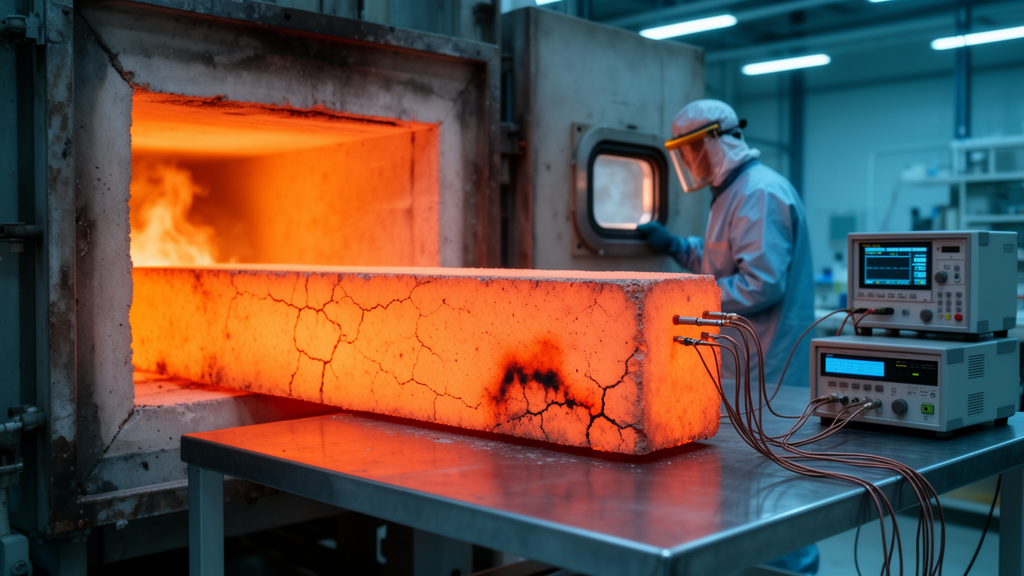
Engineers have long struggled to predict how concrete behaves when fire heats it to hundreds of degrees, because the material suffers two intertwined kinds of damage at once: thermal damage driven by heat alone and mechanical damage driven by stress. A new modelling study addresses this by treating the two processes separately, using independent, energy-based evolution laws within a thermodynamically consistent damage–plasticity framework. The work, published in Frontiers in Materials, is a computational modelling study whose predictions were checked against previously published experimental data over the range 20–600 °C.
The model couples temperature-dependent plasticity with a full strain decomposition that explicitly accounts for thermal expansion and transient creep, two effects that are often handled inconsistently in existing constitutive models. According to the abstract, existing approaches frequently lump thermal and mechanical damage together or treat them in a manner that is not thermodynamically consistent, which limits their reliability when concrete is exposed to elevated temperatures. The new formulation was implemented as a UMAT subroutine for the finite element software ABAQUS, allowing the same material description to be applied from the scale of a single material specimen up to full structural analysis.
At the material scale, the model predicts that compressive strength falls from 39 megapascals at ambient temperature to 30 megapascals at 400 °C, which is 77 percent of the ambient value, and further down to 14 megapascals at 600 °C, or 36 percent of the ambient value. Alongside these strength losses, the thermal damage variable in the model reaches 0.36 at 400 °C and 0.75 at 600 °C, quantifying how much of the material’s integrity is lost to heat-driven degradation alone. These are model predictions validated against published test data, not new laboratory measurements made in this study.
The structural-scale results follow the same pattern. The predicted peak capacity of reinforced concrete beams drops from 470 kilonewtons at ambient temperature to 360 kilonewtons at 400 °C and 175 kilonewtons at 600 °C, values the authors describe as consistent with the test data used for validation.
Beyond validation, the study includes a fire-protection design example. The authors emphasise that this conclusion applies to the particular configuration they examined rather than to columns in general, and the finding comes from the model’s design study rather than from physical fire tests.
When thermal and mechanical damage are separated, the contribution of each mechanism to strength loss can be traced, and the temperature-dependent plasticity and transient creep terms capture how concrete deforms under sustained load while it heats. The abstract notes that predicting the response of concrete to fire remains difficult precisely because of this complex, coupled damage development, and the proposed framework is offered as a way of assessing high-temperature performance with a more consistent theoretical foundation.
As with any modelling study, the results are predictions whose reliability depends on the experimental data used for validation, which in this case covers temperatures up to 600 °C. The authors present the framework as a tool for assessing the high-temperature performance of concrete structures, from material characterisation through to structural fire design.
Subject of Research: A thermodynamically consistent thermal–mechanical damage and plasticity model for concrete at elevated temperatures, implemented in ABAQUS and validated against published experiments from 20 to 600 °C.
Article Title: Separated thermal–mechanical damage modelling of concrete at elevated temperatures: formulation, ABAQUS implementation, and fire performance prediction
Article References: Zhan, S. (2026). Separated thermal–mechanical damage modelling of concrete at elevated temperatures: formulation, ABAQUS implementation, and fire performance prediction. Frontiers in Materials, 13, Article 1938234. https://doi.org/10.3389/fmats.2026.1938234
Image Credits: AI Generated
DOI: 10.3389/fmats.2026.1938234
Keywords: concrete, fire resistance, elevated temperature, damage mechanics, plasticity, constitutive model, ABAQUS, thermal damage, transient creep, reinforced concrete beams, R120 rating, structural fire design
News Source: Denise Maddox. (October 28, 2026). New Damage Model Predicts How Concrete Weakens in Fires from 20 to 600 Degrees Celsius. Scienmag.