Supplementary feeding has become a routine part of reindeer husbandry in Norway and Sweden, and a new survey of herders suggests that the way animals are fed may shape which health problems appear in their herds. The study, published in Acta Veterinaria Scandinavica, analysed questionnaire responses from 76 reindeer herders — 33 in Norway and 43 in Sweden — and found that feeding reindeer in enclosures was significantly associated with observations of diarrhoea, one of the most commonly reported conditions during the study period.
The questionnaire, open from April to September 2021, was distributed to the registered contact person or chairperson of each herding district in Norway and Sweden, potentially reaching 1,583 active herding groups. Respondents were asked about supplementary feeding practices between 2015 and 2021, with particular focus on the winter of 2019–2020, when pasture conditions were especially challenging. Supplementary feeding was defined as supplying feedstuff to a winter herd for more than two weeks. Disease observations from the winter of 2019–2020 until the end of the survey were also collected, covering signs such as acidosis, diarrhoea, bloating, wet belly, contagious ecthyma, necrobacillosis, pneumonia, parasites, brainworm, ataxia, abortion and unspecified mortality.
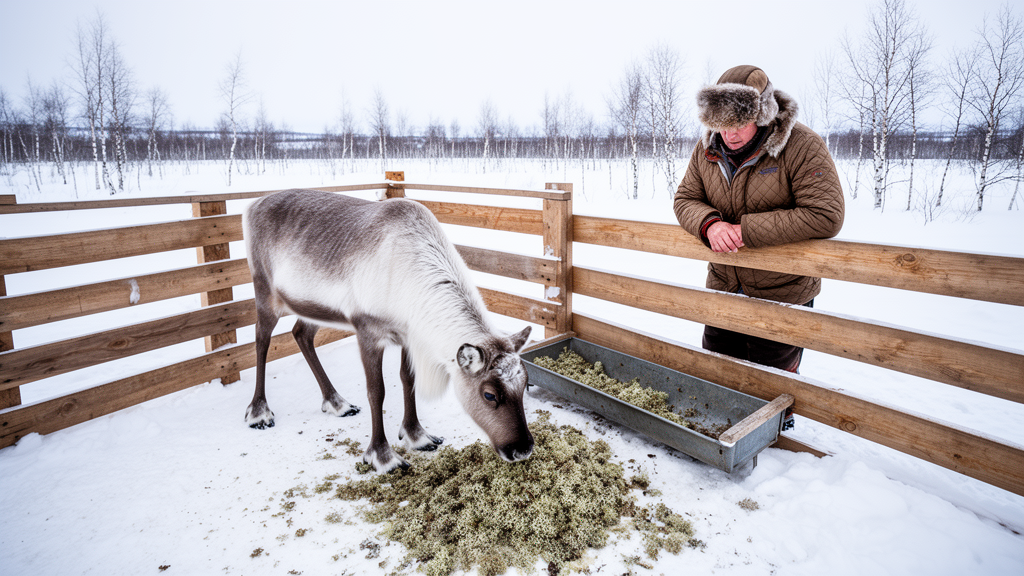
The results show how widespread feeding has become. Of the 76 respondents, 66 — 87 percent — reported using supplementary feeding during 2015–2021, with a higher proportion in Sweden (91 percent) than in Norway (82 percent). Feeding on free-range pasture was the most common practice overall, followed by a combination of pasture and enclosure feeding. Feeding exclusively in enclosures was the least common practice in both countries. The number of respondents reporting enclosure feeding increased across the study period, but when accounting for variation in response rate between years, the proportion showed only a modest, statistically non-significant increase, with an odds ratio of 1.05 per year.
The winter of 2019–2020 saw the highest feeding rate in the study period, with 59 respondents — 78 percent — reporting supplementary feeding. The most used feed type was a combination of pellets and roughage, reported by 73 percent of those feeding on pasture and 91 percent feeding in enclosures. Feeding usually lasted longer than one month, and in Sweden a significantly larger proportion of herders fed in enclosures for more than three months (52 percent) than in Norway (11 percent). Feeding in enclosures was more common among smaller herds, whereas larger herds were typically fed on pasture. Several herders noted that annual feeding of specific groups, such as calves, weak individuals and tamed reindeer, was routine practice.
The most frequently reported health conditions were parasites (66 percent of respondents), diarrhoea (57 percent), abortion (36 percent), wet belly (30 percent) and fluid-filled rumen indicating acidosis (26 percent). Diarrhoea, wet belly and necrobacillosis were reported significantly more often in Sweden than in Norway. The authors caution that observation of parasites does not necessarily indicate a disease or a pronounced health problem, since these observations included the presence of warble fly larvae, which are very common in semidomesticated reindeer and easily observable.
Across multiple analytical approaches, feeding in enclosures emerged as the management factor most consistently associated with reported digestive disturbances. Multiple correspondence analysis positioned diarrhoea close to enclosure feeding and pelleted feed along the first dimension, and hierarchical clustering placed reports of diarrhoea and feeding in an enclosure in the same cluster, with fully non-overlapping confidence ellipses. Logistic regression confirmed the pattern: observation of diarrhoea was significantly more common with feeding in enclosures, with odds ratios varying between 9 and 15 for categories including enclosure feeding, and the highest odds seen when a combination of pellets and roughage was fed. Reports of wet belly and unspecified mortality were more common with longer enclosure feeding of more than three months, with odds ratios of 5.44 and 4.5 respectively. Wet belly and diarrhoea were also both significantly more commonly observed in Sweden than in Norway.
The researchers offer several possible explanations for the link between enclosure feeding and diarrhoea. Diarrhoea in reindeer is rarely seen during free-range grazing but may occur following abrupt changes in diet, such as an acute transition from natural pastures to supplementary feed, as the rumen and intestinal microbiota may be disrupted by the dietary shift. Increased animal density and faecal contamination at feeding sites and enclosures may also raise the risk of parasite transmission, and a previous study found that higher animal density was a risk factor for reindeer calves shedding Eimeria oocysts. The authors also flag an important limitation: herders feeding in enclosures may observe disease signs more frequently simply because the animals are closer and easier to monitor, a potential detection bias. All disease observations were based on herders’ own assessments of observable signs rather than clinical diagnoses, and the survey’s voluntary nature means the responses may not be fully representative of all herding districts or herd sizes.
Not every condition could be tied to feeding. Although abortion was among the most reported conditions, no distinct clustering pattern in relation to feeding strategy was observed, and the authors note that reduced fecundity in ruminants can stem from many causes, including stress, starvation and a range of infectious agents. No significant associations were identified between feeding and necrobacillosis, contagious ecthyma, pneumonia or ataxia. Interestingly, internally observable conditions such as ruminal acidosis, bloating and brainworm were more likely to be reported from herds where necropsies had been performed, either by the herder or by a veterinarian, suggesting that necropsy improves diagnostic certainty for conditions that are otherwise less visible.
The survey also examined how herders manage disease. Eighteen respondents (24 percent) reported performing necropsies themselves, and 26 (34 percent) reported necropsy performed by a veterinarian. Of 69 responses, 38 respondents — 55 percent — had requested veterinary assistance for disease issues, with similar rates in Norway (50 percent) and Sweden (59 percent). Yet barriers were common: 33 percent of those not seeking help cited a perceived lack of knowledge and expertise among veterinarians on reindeer health issues, 20 percent believed they could manage the issue themselves, and 7 percent cited cost. Only 15 percent of all respondents noted having access to satisfactory veterinary assistance. Fisher’s tests revealed no significant associations between seeking veterinary assistance and herd size, geographic location, feeding practices, treatment against warble fly larvae or necropsy performance.
The study’s context is a livelihood under pressure. Reindeer husbandry in Norway and Sweden is a northern pastoralist system based on natural pastures, and in 2024 the spring populations of semidomesticated reindeer counted approximately 215,000 in Norway and 250,000 in Sweden. Increased frequency and severity of ice-locked pastures from freeze–thaw cycles and rain-on-snow events, along with fragmentation of pastures and migratory routes by roads, wind farms, powerlines, mining and forestry, have reduced the availability and accessibility of grazing land. Supplementary feeding has increased markedly in recent decades in Norway and Sweden — it has been common in Finland since the 1980s — and can improve body condition and survival through harsh winters, but it also raises concerns about changes in natural foraging behaviour, increased stress, greater animal density and disease transmission. The authors conclude that continued competence building for good management decisions and veterinary services is essential for sustainable reindeer husbandry, and that an integrated One Health approach is key to promoting reindeer health and welfare and to preparedness for transmissible diseases among reindeer, domestic livestock and wildlife. They also note that education on reindeer health is not thoroughly integrated into veterinary curricula in either country, despite the approximately 465,000 semidomesticated reindeer there, and point to initiatives such as strengthened veterinary support in Sweden and the recently established Reindeer Health Advisory Service in Norway as important steps — while stressing that further evaluation is needed to determine how these initiatives can best address the needs of reindeer and their herders.
Subject of Research: Supplementary feeding practices and reported disease observations among reindeer herders in Norway and Sweden
Article Title: Reindeer health and supplementary feeding practices – a survey among herders in Norway and Sweden
Article References: Bull-Aurbakken, S., Malmström, E., Baron, J., Romano, J. S., Philippot, K. W., Rautiainen, H., Omazic, A., Nymo, I. H., & Tryland, M. (2026). Reindeer health and supplementary feeding practices – a survey among herders in Norway and Sweden. Acta Veterinaria Scandinavica, 68(1), Article 36. https://doi.org/10.1186/s13028-026-00868-3
Image Credits: AI Generated
DOI: 10.1186/s13028-026-00868-3
Keywords: reindeer, supplementary feeding, reindeer husbandry, Norway, Sweden, diarrhoea, wet belly, enclosure feeding, veterinary services, questionnaire survey, One Health, Sámi herding
News Source: Drew Townsend. (October 28, 2026). Feeding reindeer in enclosures linked to diarrhoea, survey of herders finds. Scienmag.