


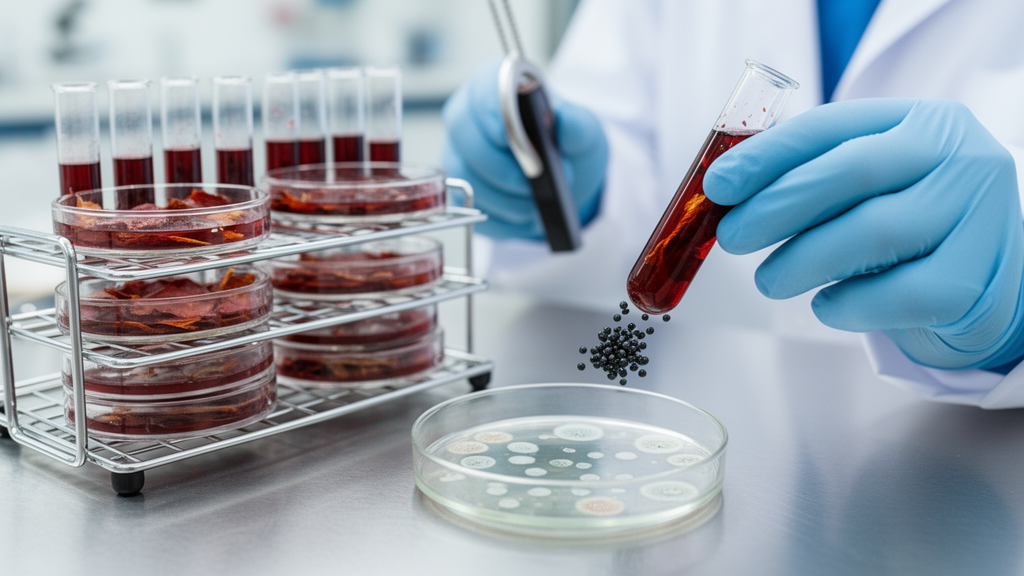
Scientists in Bangladesh have combined an extract from the peel of the Burmese grape, Baccaurea ramiflora Lour., with fluorescent magnetic submicronic polymer nanoparticles and found that the resulting nanocomposite showed enhanced antibacterial and antibiofilm activity against two notoriously drug-resistant laboratory strains: multidrug-resistant Pseudomonas aeruginosa and methicillin-resistant Staphylococcus aureus. The study, published in Clinical Phytoscience, is reported by its authors as the first test of B. ramiflora peel and seed extracts against any bacterial pathogen and the first time this particular nanoparticle platform has been functionalized with a plant extract for antibacterial and antibiofilm purposes. The work combined laboratory assays with computational molecular docking, and its authors are careful to frame the results as preliminary in vitro evidence rather than a clinical finding.
The nanoparticles at the center of the study, known as FMSP-NPs, are a distinctive class of polymer-based, magnetically responsive particles. Unlike the metal and metal-oxide nanoparticle systems that dominate the antibacterial nanoparticle literature, such as titanium dioxide, copper oxide, silver, and iron oxide nanoparticles, FMSP-NPs offer magnetic recoverability and fluorescence-based traceability. They have previously been applied in diagnostics, bioimaging, and drug delivery, and have been used to detect foodborne bacteria. Earlier reports also described their ability to induce cell death in MCF-7 breast cancer cells and to enhance targeted actions toward cancer cells when combined with crude clove extracts. What had remained unexplored, according to the researchers, was their use as a phytochemical-functionalized platform against multidrug-resistant pathogens.
The plant itself is a nutritionally valuable fruit of the Phyllanthaceae family, commonly known as Burmese grape, rich in vitamin C, protein, and iron. Previous phytochemical investigations had identified saturated and unsaturated fatty acids, proanthocyanidins, phenolic compounds, flavonoids, and terpenes in its peel and seeds, and its fruit pericarp extract had shown significant antioxidant activity in DPPH radical scavenging tests. Traditional medicine records describe its use in treating skin disorders. However, none of the earlier studies had assessed antibacterial or antibiofilm potential against drug-resistant pathogens, either alone or with a nanoparticle carrier, a gap the present study set out to address directly.
For the experimental work, fresh fruits were purchased from a local market in Rajshahi, Bangladesh, authenticated by a taxonomist, and a voucher specimen deposited at the University of Rajshahi. Peel and seed powders were macerated in 96 percent ethanol for fourteen days and concentrated, yielding 2.86 percent for the peel extract, designated BRP, and 9.52 percent for the seed extract, designated BRS. The FMSP-NPs were synthesized by a stepwise hetero-coagulation method, with magnetic emulsions, an amphiphilic graft copolymer, fluorescent nanoparticles, film-forming nanoparticles, and polyethyleneimine among the reagents. Transmission and scanning electron microscopy confirmed that the particles were spherical and measured between 100 and 300 nanometers in diameter, consistent with the previously reported material.
The antibacterial testing used laboratory strains of methicillin-resistant S. aureus and multidrug-resistant P. aeruginosa obtained from an existing laboratory collection, which had been previously identified and characterized. Minimum inhibitory concentrations and minimum bactericidal concentrations were determined by microbroth dilution, with treatments spanning 0.625 to 20.0 milligrams per milliliter and experiments performed in triplicate. Against P. aeruginosa, the FMSP-BRP nanocomposite achieved a mean MIC of 0.26 milligrams per milliliter and a mean MBC of 0.53 milligrams per milliliter, compared with 1.27 and 2.0 milligrams per milliliter for the bare nanoparticles and 0.63 and 1.23 milligrams per milliliter for the seed-based composite. Against S. aureus, the values were higher across the board: an MIC of 2.0 milligrams per milliliter and an MBC of 4.23 milligrams per milliliter for FMSP-BRP, versus 4.07 and 8.0 for the nanoparticles alone and 3.90 and 8.13 for FMSP-BRS. Gram-negative P. aeruginosa was consistently more susceptible than the Gram-positive staphylococcus, a pattern the authors attribute to differences in cell wall architecture, since the thick peptidoglycan layer of Gram-positive bacteria, at 20 to 80 nanometers, offers more protection than the thin 7 to 8 nanometer layer beneath the negatively charged lipopolysaccharide coat of Gram-negative cells.
Microscopy reinforced these quantitative results. Untreated P. aeruginosa cells appeared as intact, smooth, rod-shaped structures, while untreated S. aureus cells were spherical with regular smooth surfaces. After twenty-four hours of exposure, treated P. aeruginosa cells displayed rough, irregular surfaces with pits, depressions, and membrane damage, and the staphylococcal cells showed surface irregularities with nanoparticles adhering to them. Among all treatments, FMSP-BRP induced the most extensive cellular damage against both organisms. The authors suggest a physical-oxidative mechanism, in which electrostatic adhesion between positively charged nanoparticles and negatively charged microbial surfaces is followed by membrane and macromolecular damage, drawing parallels with earlier reports on titanium dioxide, copper oxide, and iron oxide nanoparticles. They acknowledge, however, that because membrane permeability and reactive oxygen species generation were not measured directly, this mechanism remains inferential.
Biofilm inhibition, quantified by crystal violet assay across concentrations from 0.125 to 2.0 milligrams per milliliter, followed a dose-dependent pattern for all three formulations. At the highest concentration, FMSP-BRP inhibited P. aeruginosa biofilm formation by 65.1 percent and S. aureus biofilm formation by 59.2 percent, compared with 49.6 and 44.7 percent for the seed-based composite and 39.7 and 38.4 percent for the bare nanoparticles. Scanning electron microscopy of biofilms grown on glass coverslips showed that untreated P. aeruginosa formed dense, aggregated biofilms, while the nanocomposites disrupted biofilm structure, apparently by damaging the extracellular polymeric substance layer, with FMSP-BRP again showing the greatest effect and pronounced cell membrane damage. S. aureus control biofilms exhibited extensive colonization that was partially reduced by the bare nanoparticles and markedly decreased by both nanocomposites.
The computational arm of the study docked eighteen phytoconstituents selected from the peel and seed through literature review against two S. aureus target proteins: Gyrase B, a type II topoisomerase required for DNA replication and repair, as an antibacterial target, and Sortase A, the transpeptidase that anchors LPXTG motif surface adhesins to the cell wall, as an antibiofilm target. Proanthocyanidin achieved the highest binding affinity at both sites, scoring minus 8.1 kilocalories per mole against Gyrase B, better than the co-crystallized control ligand XAM at minus 7.9, and minus 7.3 kilocalories per mole against Sortase A, exceeding the control LPETG peptide at minus 7.1. Quercetin and chlorogenic acid also scored close to the control against Gyrase B, and chlorogenic acid matched the control score against Sortase A. The authors note that this computational finding is consistent with independent literature reporting antibacterial and antibiofilm activity of proanthocyanidin-based formulations, including proanthocyanidin-chitosan nanoparticles active against biofilm-associated infections.
The authors situate their biofilm results within a wider and sometimes contradictory nanoparticle literature. Their findings resemble reports that iron oxide nanoparticles prevented P. aeruginosa biofilm formation by 84.13 percent, yet other researchers found that iron oxide nanoparticles at 5 milligrams per milliliter stimulated rather than inhibited biofilm formation in several species, highlighting that nanoparticle-biofilm interactions are highly concentration and species dependent. The consistent dose-dependent inhibition observed across the tested range is therefore presented as a positive finding rather than a universal nanoparticle effect. The team also cautions that despite its effectiveness, the extract-functionalized nanocomposite would benefit from further formulation adjustment, such as a greater extract-to-nanoparticle ratio or longer exposure, to approach the potency of purely inorganic systems.
The limitations are stated plainly. The antibacterial and antibiofilm findings rest on in vitro assays using single reference strains, the docking predictions for proanthocyanidin and other constituents were not confirmed by isolation and purification, and no cytotoxicity or biocompatibility testing toward mammalian cells was performed. The authors present the work as preliminary evidence that B. ramiflora peel extract combined with FMSP-NPs may represent a promising platform against drug-resistant pathogens, and they call for in vivo efficacy and toxicity studies, testing against a broader panel of clinical multidrug-resistant isolates, isolation and structural confirmation of the phytoconstituents, and experimental validation of the predicted target binding. Within those bounds, the study supports the traditional use of B. ramiflora against infectious diseases and illustrates how nanotechnology-based natural extracts might contribute to the wider effort against antimicrobial resistance, a problem projected to cause more than ten million deaths annually by 2050 with a cumulative economic burden exceeding 100 trillion US dollars.
Subject of Research: Combining Baccaurea ramiflora fruit peel extract with fluorescent magnetic polymer nanoparticles to enhance antibacterial and antibiofilm activity against multidrug-resistant bacteria in vitro and in silico
Article Title: Enhanced antimicrobial and antibiofilm effects of Baccaurea ramiflora Lour. fruit extract combined with FMSP-nanoparticles against multidrug-resistant bacteria: an in vitro and in silico analysis
Article References: Paul, T. R., Sami, S. A., Mosaddik, A., & Wahed, M. I. I. (2026). Enhanced antimicrobial and antibiofilm effects of Baccaurea ramiflora Lour. fruit extract combined with FMSP-nanoparticles against multidrug-resistant bacteria: an in vitro and in silico analysis. Clinical Phytoscience, 12(1), Article 26. https://doi.org/10.1186/s40816-026-00441-5
Image Credits: AI Generated
DOI: 10.1186/s40816-026-00441-5
Keywords: antimicrobial resistance, biofilms, nanoparticles, Baccaurea ramiflora, Pseudomonas aeruginosa, MRSA, molecular docking, proanthocyanidin, plant extracts, nanocomposites, in vitro study, Clinical Phytoscience
News Source: Ophelia Keating. (October 28, 2026). Burmese grape peel extract fused with magnetic nanoparticles fights drug-resistant bacteria in lab tests. Scienmag.



