


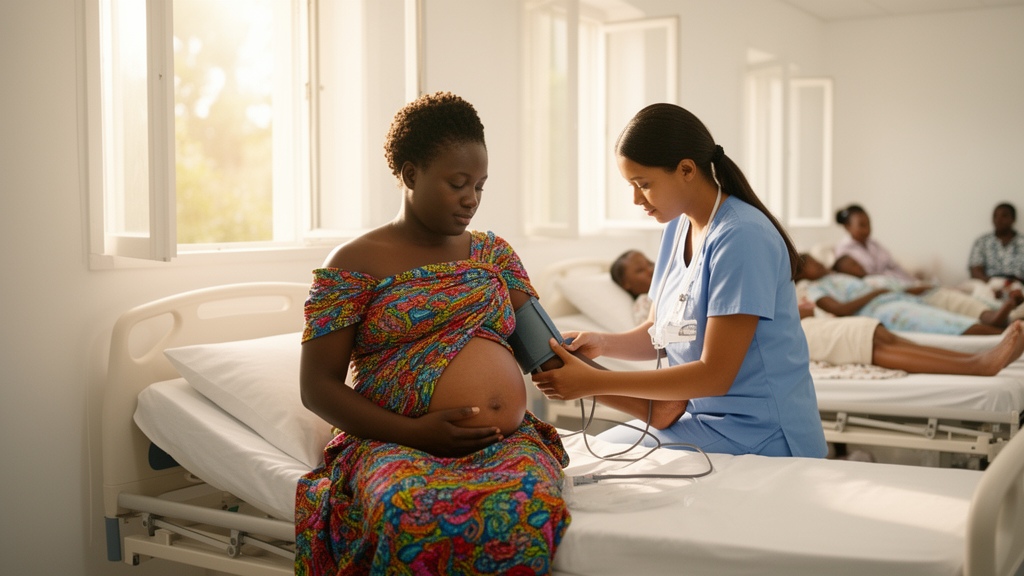
Free emergency obstetric care policies across sub-Saharan Africa were propelled onto national political agendas chiefly by persistently poor maternal and neonatal health indicators, but their implementation has remained largely partial and uneven, according to a scoping review published in Discover Health Systems. The review analysed 40 studies published between 2007 and 2024, using Kingdon’s multiple streams framework to examine how the policies gained political priority and how they fared in practice.
The evidence base was heavily concentrated in West Africa, which accounted for 27 of the 40 included studies, or 68 percent, while East Africa contributed 12 studies, or 30 percent, and only one study, or 2 percent, came from North Africa. Kenya was the most frequently represented country with 11 studies, followed by Ghana with 10, Burkina Faso with 7, Benin with 6 and Mali with 2, with single-country studies from Nigeria, Tanzania, Sudan and Senegal. Half of the studies used mixed-methods designs, 17 were qualitative and only three were exclusively quantitative. Most studies, 29 of 40, were published from 2014 onwards.
The review found that suboptimal maternal and neonatal indicators were the critical driver pushing free obstetric care onto political agendas. In Benin, rising facility-based maternal mortality reaching 387 deaths per 100,000 births, together with a neonatal mortality rate of 32 per 1,000 live births, were decisive in prompting the 2009 free emergency obstetric care policy. In Ghana, the facility-based maternal mortality rate rose from 187 per 100,000 live births in 2006 to 224 per 100,000 in 2007, influencing the adoption of the free policy in 2008. In Ghana, the proportion of births attended by skilled personnel also fell from 44.5 percent in 2006 to 35.1 percent in 2007, while in Benin the caesarean section rate stood at only 3.7 percent between 2008 and 2009.
Direct payments for care compounded these problems, exposing households to catastrophic expenditure that forced families into debt or the sale of productive assets such as livestock and crops. Fear of these payments deterred women from formal health services and pushed some towards traditional birth attendants. In Burkina Faso, the average direct cost of a caesarean section was estimated at US$137.6, equivalent to roughly one and a half months’ salary for a mid-level civil servant or 2.5 times the guaranteed minimum wage. In Benin, mothers and infants unable to pay bills were reportedly detained in facilities, sometimes left under trees or sitting on the ground.
Policy responses diverged along linguistic and regional lines. Francophone West African countries such as Benin and Burkina Faso predominantly waived user fees for maternal services, in some cases targeting free delivery or caesarean sections specifically. Burkina Faso introduced a cost-sharing arrangement among the Ministry of Health, households, health centre committees and local authorities, reducing household direct expenditure by 60 to 70 percent, with one reported distribution of costs as 34 percent families, 28 percent Ministry of Health, 27 percent local authorities and 11 percent health centres, reinforced by a national subsidy covering up to 80 percent of delivery and obstetric complication expenses. In Benin, a national agency coordinated free caesarean sections across 48 facilities, reimbursing a fixed 100,000 CFA francs per procedure.
Anglophone countries tended towards broader insurance-based coverage. In Ghana, the legal framework for national health insurance was established with Law L650 in 2003, later revised in 2012, aiming to reduce direct payments and encourage use of antenatal care, assisted deliveries, caesarean sections and postnatal care. In East Africa, Tanzania and Kenya adopted free maternal and child health services, although until 2017 many countries in the region relied on user fee exemptions rather than fully free care because of budgetary constraints and governance problems, including delayed budget allocations and duplicate payments by the Ministry of Health and the National Health Insurance Authority. Kenya replaced its 2013 free maternity policy with the Linda Mama programme in 2017, administered by the National Hospital Insurance Fund, reimbursing facilities US$44 per redeemed voucher and an average of US$225 per caesarean section. In Sudan, free care targeted women admitted for caesarean sections and children under five from 2007.
Political dynamics shaped when and why these reforms emerged. In Benin, free caesarean sections followed a presidential visit during which the President witnessed women detained in hospitals for unpaid bills and publicly pledged to cover the costs, leading to institutionalisation between 2007 and 2008. In Kenya, free healthcare featured prominently in the electoral programme of President Uhuru Muigai Kenyatta and was implemented at the start of his term. In Mali, the appointment of two female leaders, the Minister of Health and the First Lady, a midwife, created an advocacy window for maternal health, and the government adopted a free caesarean section policy in 2005 as a demonstration of sovereignty, fully financing it while later donor support targeted communication and evaluation. External pressures also mattered: policies were often introduced in response to the Millennium Development Goals, loan conditions and donor funding, with Burkina Faso’s 2006 decision linked to a World Bank requirement for accessing financing support.
Implementation, however, fell short of design across all regions. In Benin, private hospitals rarely applied the free policy, billing caesarean sections at an average of US$50, and patients in a faith-based hospital paid a median of US$53 for the procedure, with additional fees totalling €39. In Sudan, insured women often paid more than uninsured patients. Misinterpretation of policy provisions was widespread: in Kenya, newborns were not always treated as beneficiaries of Linda Mama despite explicit provisions, and in Benin some complications such as uterine rupture were excluded from reimbursement on the grounds that they did not fit a strict definition of caesarean section. Informal payments, including the sale of officially free painkillers and parallel dispensing of medicines by prescribing workers, were documented in Benin. Three years after Burkina Faso’s national policy, half of the women in one district paid more than the official rate of 900 CFA francs, with households spending on average double the expected cost.
Structural barriers further undermined the reforms. Reimbursements to facilities in Burkina Faso were often delayed by a year or more, while in Benin delays ranged from several days to three months. Stockouts of essential kits were recurrent, and in Kenya only 55 percent of surveyed facilities stocked misoprostol and 65 percent had oxygen in delivery rooms. Workloads rose without compensating staff: in Senegal, average deliveries per facility increased from 53 to 73 per month between 2004 and 2005, and in Nigeria the removal of user fees increased utilisation without expanding the workforce, contributing to a decline in quality of care. In Benin, the contents of government-supplied kits declined markedly between 2016 and 2018, covering only 17 to 38 percent of planned items, contributing to a 24 percent reduction in caesarean sections between 2015 and 2017. Geographical barriers persisted, with transport costs in Mali reaching 37,000 CFA francs where more than 100 kilometres separated referral facilities.
The authors note several limitations. The scoping review design did not allow formal appraisal of study quality or in-depth causal analysis of how political factors shaped implementation. The search was limited to two electronic databases, potentially constraining the breadth of evidence, and grey literature initially identified did not meet the predefined inclusion criteria. The concentration of studies in West and East Africa may also restrict generalisability to the entire sub-Saharan region. The review concludes that strengthening policy clarity, ensuring timely financing, supporting healthcare providers and securing essential supplies are key to achieving equitable and sustainable maternal healthcare delivery in the region.
Subject of Research: Agenda-setting and implementation of free emergency obstetric care policies in sub-Saharan Africa
Article Title: A scoping review of agenda setting and implementation of the free emergency obstetric care policy in sub Saharan Africa from 2007 to 2024
Article References: Deguenon, S. C. J., Kolié, D., Sow, A., Leno, N. N., Lainé, M. F. L., Mahoutin Gbaguidi, A. C. A., Camara, A., Beavogui, A. H., & Delamou, A. (2026). A scoping review of agenda setting and implementation of the free emergency obstetric care policy in sub Saharan Africa from 2007 to 2024. Discover Health Systems, 5(1), Article 85. https://doi.org/10.1007/s44250-026-00370-7
Image Credits: AI Generated
DOI: 10.1007/s44250-026-00370-7
Keywords: scoping review, sub-Saharan Africa, emergency obstetric care, free maternal healthcare, user fee exemption, health policy, agenda setting, Kingdon framework, health financing, maternal mortality, policy implementation, health systems
News Source: Harold Sullivan. (October 28, 2026). Poor maternal health pushed free childbirth care onto African political agendas, review finds. Scienmag.



