


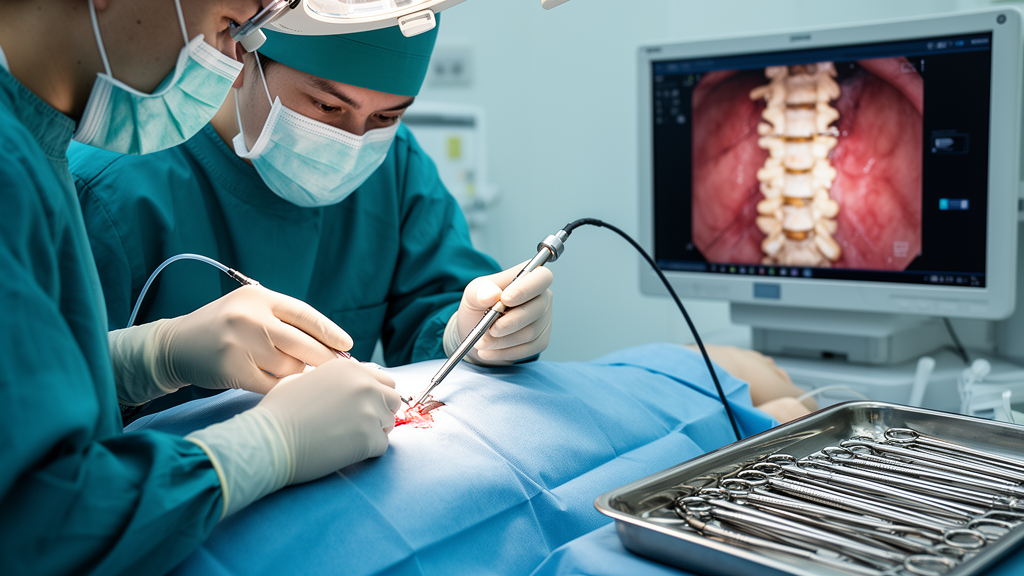
Patients with severe thoracic ossification of the ligamentum flavum, a condition in which a ligament in the spine hardens and compresses the spinal cord, may fare better with a minimally invasive endoscopic technique than with traditional open surgery, according to a retrospective cohort study published in BMC Surgery.
The research team compared unilateral biportal endoscopic (UBE) decompression with open posterior total laminectomy, the conventional approach for relieving pressure on the thoracic spinal cord. Severe cases of this ossification can cause serious thoracic spinal cord dysfunction, and open surgery is associated with substantial trauma and a high risk of complications, which motivated the comparison.
The study drew on 112 patients with severe thoracic ligament ossification and spinal canal invasion of at least 50 percent, admitted between January 2019 and December 2024. To reduce the influence of differences between patient groups, the investigators used propensity score matching, after which 42 patients were assigned to the UBE group and 42 to the open surgery group.
The primary outcomes were the modified Japanese Orthopaedic Association (mJOA) score at 12 months after surgery, the recovery rate, and the proportion of patients reaching the minimum clinically important difference (MCID), a threshold representing a change that patients perceive as meaningful.
At 12 months, the UBE group achieved a mean mJOA score of 8.2 plus or minus 0.9, compared with 6.9 plus or minus 1.1 in the open surgery group. The recovery rate was 43.2 percent in the endoscopic group versus 26.3 percent in the open group, and 88.1 percent of UBE patients reached the MCID compared with 61.9 percent of open surgery patients. All of these differences were statistically significant, with P values below 0.01.
Perioperative indicators also favored the endoscopic approach. Operative time, blood loss, and length of hospital stay were all markedly reduced in the UBE group, with P values below 0.001. Imaging assessment of decompression showed that the cross-sectional area of the dural sac, the protective membrane enclosing the spinal cord, expanded by 228.4 percent after UBE versus 184.5 percent after open surgery, a difference the authors interpret as more comprehensive imaging decompression.
Complication patterns differed as well. Dural tears, a known risk when operating near the spinal cord’s covering, occurred in 4.8 percent of the UBE group and 11.9 percent of the open surgery group. The authors note that this difference was not statistically significant, with a P value above 0.05, so the study does not establish a definitive reduction in this complication.
The study design carries important limitations. As a retrospective cohort study with propensity score matching rather than a randomized trial, it cannot rule out residual confounding, and the matched groups of 42 patients each are relatively small.
Nevertheless, the authors conclude that the UBE technique for treating severe thoracic ossification of the ligamentum flavum can significantly promote neurological function recovery, reduce surgical trauma, and achieve more comprehensive imaging decompression, making it a safe and effective minimally invasive treatment option in their analysis.
Subject of Research: Comparison of unilateral biportal endoscopic surgery with open laminectomy for severe thoracic ossification of the ligamentum flavum
Article Title: A multidimensional analysis of the clinical advantages of unilateral biportal endoscopy in the treatment of severe thoracic lateral fibrous band ossification
Article References: Xie, Y., Lian, Y., Xuan, A., Gu, H., Li, J., & Yu, H. (2026). A multidimensional analysis of the clinical advantages of unilateral biportal endoscopy in the treatment of severe thoracic lateral fibrous band ossification. BMC Surgery. https://doi.org/10.1186/s12893-026-04290-4
Image Credits: AI Generated
DOI: 10.1186/s12893-026-04290-4
Keywords: thoracic ossification of the ligamentum flavum, unilateral biportal endoscopy, UBE, laminectomy, spinal cord decompression, mJOA score, propensity score matching, dural tear, minimally invasive spine surgery, retrospective cohort study, dural sac cross-sectional area, BMC Surgery
News Source: Ophelia Keating. (October 28, 2026). Minimally Invasive Endoscopic Surgery Shows Better Outcomes for Severe Thoracic Ligament Ossification. Scienmag.



