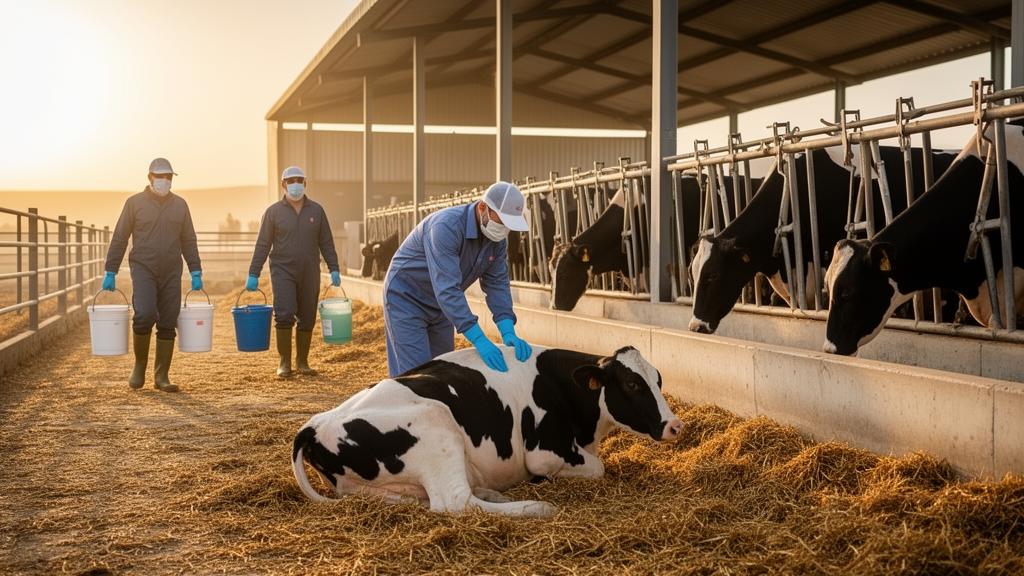
A bovine ephemeral fever outbreak that swept through a 2,100-cow commercial dairy herd near Shushtar in Khuzestan province, southwestern Iran, in the summer of 2023 has been documented in a detailed case study describing how an integrated management strategy was used to bring the event under control. Over a two-week period, 481 cows, representing 22.9 percent of the herd, developed clinical signs consistent with the disease, yet the outbreak ended with only three fatalities, a herd-level mortality rate of 0.14 percent. The report, published as a case study in the journal Dairy Science and Management, offers a rare field-level account of how a large dairy operation in an endemic region confronted an outbreak of the viral disease, which is also known as three-day sickness.
Bovine ephemeral fever is an acute, arthropod-borne viral disease of cattle and water buffalo caused by bovine ephemeral fever virus, a member of the Ephemerovirus genus within the Rhabdoviridae family. The illness is characterized by a sudden onset of fever, anorexia, lameness, muscle stiffness, recumbency, and a marked decline in milk production. Although clinical signs typically resolve within several days, complications such as prolonged debilitation, abortion, and mortality may occur, particularly in high-producing dairy cows or immunocompromised animals. The disease is endemic across Asia, Africa, Australia, and the Middle East, and outbreaks are strongly associated with climatic conditions favorable to hematophagous insect vectors, particularly Culicoides midges and Culex mosquitoes.
The economic stakes in dairy systems are considerable. Outbreaks bring abrupt reductions in milk yield, increased veterinary and labor costs, and, in severe cases, the culling of chronically affected animals. In Iran, the disease has been reported sporadically for decades, with southern provinces such as Khuzestan especially vulnerable because of their hot, humid climate, extensive irrigated agricultural areas, and high densities of insect vectors. Molecular studies have previously confirmed viral circulation in Khuzestan and documented genetic similarity between Iranian isolates and other Middle Eastern strains. Despite this history, the authors note that there has been limited field-level documentation describing how large commercial dairy farms in the region manage outbreaks under real-world conditions.
The affected farm housed approximately 2,100 Holstein-Friesian cattle managed under a semi-intensive system in which cows were kept primarily in free-stall barns without pasture access but were given daily outdoor loafing areas and walkways for controlled exercise. The herd was fed a total mixed ration year-round and managed with an emphasis on high-yield milk production. The lactating herd of roughly 1,250 cows, 59 percent of the total, was milked three times per day in a double-40 herringbone parlor, with a pre-outbreak average yield of approximately 37 to 39 kilograms per cow per day. A further 420 animals were dry cows and 430 were replacement heifers, and the median lactation number among milking cows was two, indicating a relatively young but productive herd.
Environmental conditions during the outbreak period were extreme. Daily maximum temperatures exceeded 46 degrees Celsius, with relative humidity regularly surpassing 70 percent. Combined with extensive irrigated agriculture and proximity to major water bodies, including the Dez and Karun rivers, these conditions created ideal ecological circumstances for Culicoides midges and Culex mosquitoes, both recognized vectors of the virus. Farm personnel first reported a sudden onset of illness among lactating cows in late June 2023, with affected animals showing high fever of up to 41.5 degrees Celsius, marked muscle stiffness, lameness, and recumbency. In several cases, subcutaneous emphysema and mucous nasal discharge were observed, accompanied by reduced feed intake and a pronounced decline in milk production.
The outbreak progressed rapidly before treatment began. By Day 3, 85 cows, 4.0 percent of the herd, had developed clinical signs, approximately 30 percent of which were recumbent, and the average milk yield of affected cows had fallen by roughly 11 to 12 kilograms per cow per day compared with pre-outbreak levels. No fatalities were recorded before the initiation of supportive therapy. By the end of the first week, 320 cows, or 15.2 percent of the herd, had shown clinical symptoms, and among the affected animals approximately 72 percent were cows older than three years, with a median lactation number of two. Cumulative cases reached 481 cows by Day 14. The highest incidence of new clinical cases occurred between Days 5 and 12, during which 312 cows developed symptoms.
Laboratory confirmation relied on blood samples collected from ten acutely affected cows selected to represent early-stage clinical cases. The sample size was not based on statistical power analysis, reflecting the diagnostic nature of the investigation, and samples were transported to the provincial veterinary laboratory within three hours. Reverse transcription nested polymerase chain reaction targeting the glycoprotein gene of the virus confirmed the presence of viral RNA in all submitted samples. Sequencing and phylogenetic analysis of complete glycoprotein gene sequences of 1,872 nucleotides, aligned with MAFFT v7 and reconstructed under a maximum-likelihood method in MEGA X using a GTR plus G substitution model selected by the Bayesian Information Criterion, showed that the Khuzestan strain shared 98.02 percent nucleotide identity with the closest Iranian reference sequence and 97.01 percent identity with a Turkish reference strain, indicating ongoing circulation of closely related virus lineages within the region.
The integrated control strategy combined clinical, environmental, and preventive measures. All febrile cows received intravenous flunixin meglumine at 1.1 milligrams per kilogram once daily for two to three consecutive days, administered via jugular catheterization to control fever and inflammation. Supportive therapy included 5 to 10 liters of isotonic electrolyte solution, given intravenously or by oral drench depending on severity, and B-complex vitamins to support metabolic recovery in anorectic and recumbent animals. Antibiotic therapy with ceftiofur sodium at 2.2 milligrams per kilogram intramuscularly once daily for three days was selectively restricted to cows showing clinical indications of secondary bacterial infection, such as persistent fever beyond 48 hours, mucopurulent nasal discharge, or elevated mastitis risk, an approach intended to minimize unnecessary antimicrobial use.
Vector control was intensified through twice-weekly applications of a 2.5 percent deltamethrin-based insecticide targeting barn structures, drainage channels, manure areas, and other potential breeding sites, while standing water around the barns was removed or treated with larvicide. Eight high-capacity insect-repelling fans were installed in the milking parlor to reduce vector exposure during peak evening activity periods. In addition, 300 replacement heifers under 12 months of age were vaccinated with an inactivated bovine ephemeral fever vaccine from existing farm stock. The authors emphasize that these vaccinations were not part of the acute response and were not evaluated for efficacy in this study, so no conclusions about vaccine effectiveness can be drawn from the observations. Twenty-seven staff members, including milking staff, herdspersons, and night-shift workers, also received training through two on-site workshops covering early symptom recognition, handling of recumbent animals, biosecurity protocols, and vector control, although the study did not include a formal evaluation of training effectiveness.
Following implementation of the interventions, the number of new clinical cases declined steadily, and the outbreak lasted 24 days, with no new cases recorded after Day 14. Of the 481 clinically affected cows, 456, or 94.8 percent, recovered within three to five days following supportive treatment, while the remaining animals required prolonged recovery. The average pre-outbreak milk yield of 38 kilograms per cow per day fell to 26 to 27 kilograms at the peak of the outbreak, a reduction of approximately 30 percent, and milk production in affected cows gradually returned to pre-outbreak levels within 10 to 14 days after clinical improvement. The authors report that enhanced vector control was temporally associated with the decline in new cases but caution that causality cannot be definitively established in a case study, while noting that reducing exposure to hematophagous insect vectors is biologically plausible and consistent with the established vector-borne epidemiology of the disease. They conclude that timely, coordinated clinical management, vector control, and herd-level preparedness can substantially reduce the impact of outbreaks in endemic regions, and that future efforts should focus on improving vaccine accessibility, strengthening surveillance, and enhancing cross-border collaboration given the genetic similarity of strains circulating across the Middle East.
Subject of Research: Integrated management of a bovine ephemeral fever outbreak on a large commercial dairy farm in Khuzestan, Iran
Article Title: Integrated management of a bovine ephemeral fever outbreak in a Khuzestan dairy herd: a case study on practical control strategies
Article References: Payami, M., Keyvanfard, K., Rahimi, S., & Abdous, A. (2026). Integrated management of a bovine ephemeral fever outbreak in a Khuzestan dairy herd: a case study on practical control strategies. Dairy Science and Management, 3(1), Article 1. https://doi.org/10.1186/s44363-026-00023-3
Image Credits: AI Generated
DOI: 10.1186/s44363-026-00023-3
Keywords: bovine ephemeral fever, BEFV, dairy cattle, Khuzestan, Iran, outbreak management, vector control, Culicoides midges, Culex mosquitoes, phylogenetic analysis, milk production loss, case study
News Source: Alan Morgan. (October 28, 2026). Integrated response curbed bovine ephemeral fever outbreak on Iranian dairy farm. Scienmag.