


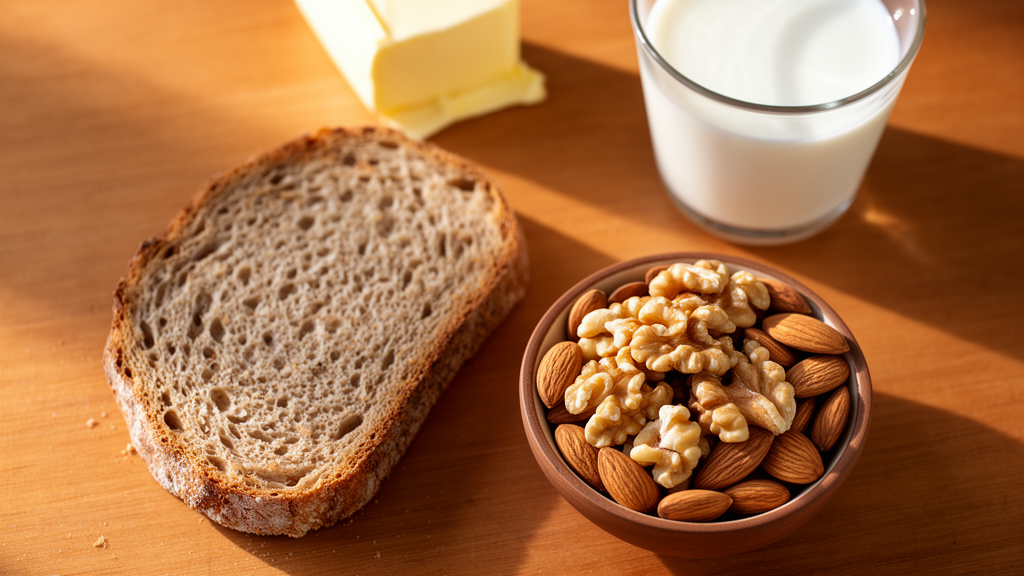
Adding peanuts or cashews to two slices of white bread blunts the bread’s glucose spike, but what happens to those nuts before they reach the plate matters more for blood fat than for blood sugar. That is the central message of an acute feeding trial from the Glycemic Index Research Unit at Temasek Polytechnic in Singapore, published in Frontiers in Nutrition. In a randomized crossover study of fifteen healthy, normal-weight adults, the same 42.5 grams of nuts delivered as whole kernels, as a ground butter, or as a blended milk produced nearly identical improvements in glycemic response, yet sharply different postprandial triglyceride curves. The more the nut’s cellular structure was disrupted before eating, the higher the fat surge that followed.
The trial was designed around a simple physical question. Nuts are rich in unsaturated fats, protein, and fiber, and epidemiological work has repeatedly linked frequent nut consumption to lower cardiovascular risk and mortality, particularly among people with diabetes. But when a nut is ground into butter or blended into milk, its fat droplets become far smaller and its cell walls are broken open, which should make the lipids more accessible to digestive enzymes. The researchers hypothesized that the liquid nut milk form would therefore produce the highest glycemic, insulinemic, and triglyceride responses, while intact whole nuts would produce the lowest. To test this, they paired a standardized carbohydrate load, two slices of white bread totaling 57 grams, with 42.5 grams of peanuts or cashews in each of the three forms.
Fifteen participants, with a mean age of 34 years and a mean body mass index of 21.4 kilograms per square meter, completed all eight test sessions without dropping out. Each person attended two control sessions with white bread alone, administered in duplicate according to the ISO 26642:2010 methodology for glycemic response testing, plus six experimental sessions in a counter-balanced crossover sequence. Sessions were held in the morning after a standardized high-carbohydrate dinner and a 10-to-14-hour overnight fast, with at least two washout days between visits. Capillary blood samples drawn by finger-prick were taken at fasting and then at intervals from 15 minutes out to 240 minutes after the meal, allowing the team to track glucose, serum insulin, and triglycerides over a full four-hour window.
The glycemic results were unambiguous. White bread alone drove a rapid rise in blood glucose that peaked within the first 45 minutes, and every nut-containing meal, regardless of nut type or form, produced a significantly lower glucose peak at that time point, with all adjusted p values below 0.05. Over the two-hour window used for standard glycemic assessment, the incremental area under the curve was lower for every nut form than for bread alone. Notably, the processing of the nut made essentially no difference to this effect. Whole peanuts, peanut butter, and peanut milk all flattened the glucose curve to a similar degree, and the same held for the cashew versions. Nut form, in other words, changed the fat response but not the sugar response.
Insulin told a subtler story. All nut meals produced slightly higher insulin areas under the curve than white bread alone, even as they lowered glucose, and insulin levels returned to fasting baseline later, at 240 minutes for the nut meals compared with 180 minutes for bread. The authors attribute this to the insulinotropic properties of the nuts’ protein and unsaturated fatty acids, which can stimulate pancreatic beta cells and trigger incretin hormones such as GLP-1 and GIP, prompting insulin secretion without a matching rise in glucose. However, none of the differences between test foods and control reached statistical significance for insulin peaks or insulin iAUC, and no significant differences emerged between nut types or forms. Glycemic response, the authors note, explains only about 23 percent of the variability in insulin response, leaving room for the meal’s fat and protein matrix to act through other pathways.
The triglyceride findings were where the food form mattered most. White bread, with just one gram of fat, left triglyceride levels essentially stable across the four hours. Every nut meal, by contrast, produced significant increases in both triglyceride peaks and iAUC compared with the control, and levels had still not returned to fasting baseline by the 240-minute mark. The processing effect was large: peanut butter and peanut milk yielded 51 percent and 41 percent higher triglyceride iAUC values, respectively, than whole peanuts, while cashew butter and cashew milk produced 53 percent and 46 percent higher values than whole cashews. Whole nuts consistently elicited the lowest lipid response, nut milk fell in between, and nut butter produced the highest of all.
That ordering contradicted the study’s own hypothesis, which had predicted the liquid milk form would top the list. The authors offer a mechanistic explanation rooted in food microstructure. Grinding nuts into butter ruptures cell walls and releases intracellular lipids, dramatically increasing lipid bioaccessibility, while the smaller fat droplets in butter and milk present a larger surface area for gastric and pancreatic lipase, accelerating digestion. Whole nuts, chewed rather than processed, retain larger fat droplets, up to four times the size of those in the processed forms, and preserve enough cellular encapsulation to slow triglyceride hydrolysis in the small intestine. The homemade nut milks in this study were blended with water but not subjected to the high-pressure and heat treatments used in commercial production, which the authors suggest may have preserved intact oil bodies and kept lipid bioaccessibility lower than expected.
Nut type produced smaller, statistically non-significant differences. Peanuts, across all forms, yielded lower two-hour glucose iAUC values than cashews, plausibly because laboratory analysis showed peanuts carry 37 percent more protein and 46 percent more dietary fiber but 64 percent fewer available carbohydrates than cashews per serving. Peanuts also produced a 15 percent higher triglyceride iAUC than cashews, which the authors link to their 1.7 grams more fat per serving. Palatability ratings, measured on a seven-point scale, ranged only from 4.2 for peanut milk to 4.8 for whole cashews and cashew butter, with no significant differences, making it unlikely that taste drove differences in chewing or eating behavior.
The authors are careful about what these acute numbers do and do not mean. A prolonged postprandial lipid excursion is a normal physiological response to eating fat, and the elevated triglyceride readings after nut butter and nut milk partly reflect slower digestion of emulsified lipids rather than an adverse outcome in themselves. At the same time, they note that repeated and sustained postprandial hypertriglyceridemia has been associated with cardiovascular risk through prolonged exposure to triglyceride-rich lipoprotein remnants, while long-term studies consistently associate habitual nut consumption, regardless of form, with improved lipid profiles and lower cardiovascular mortality. Their practical suggestion is that for people managing postprandial glucose and lipid levels, choosing whole nuts over more highly processed forms such as nut butter may be a beneficial dietary strategy within a high-carbohydrate meal.
Several limitations frame the conclusions. The study was acute and involved only fifteen normal-weight healthy adults, so the findings cannot be generalized to people with overweight, obesity, or diabetes, and no long-term outcomes were measured. Particle size was not directly measured, incretin hormones were not assayed, and hunger and satiety were not assessed. The test meals were deliberately not energy matched: adding 42.5 grams of nuts to bread raised total energy, fat, and protein substantially compared with bread alone, so the observed effects reflect realistic nut-containing meals rather than isolated per-gram effects of nut form. Habitual bread and nut consumption were not recorded. The authors call for future work directly measuring lipid bioaccessibility across nut forms, including commercially processed nut milks, and for longer studies to determine whether the transient triglyceride differences seen here translate into meaningful metabolic consequences over time.
Subject of Research: Acute postprandial glycemic, insulinemic, and triglyceride responses to white bread eaten with peanuts or cashews as whole nuts, nut butter, or nut milk
Article Title: Acute study of the glycemic, insulinemic and triglyceride responses on white bread with peanuts and cashews in different forms (whole nut, nut butter and nut milk)
Article References: Mohamed Salleh, S., Bte Syed Abdullah, S. F., & Bhaskaran, K. (2026). Acute study of the glycemic, insulinemic and triglyceride responses on white bread with peanuts and cashews in different forms (whole nut, nut butter and nut milk). Frontiers in Nutrition, 13, Article 1838715. https://doi.org/10.3389/fnut.2026.1838715
Image Credits: AI Generated
DOI: 10.3389/fnut.2026.1838715
Keywords: postprandial metabolism, glycemic response, triglycerides, peanuts, cashews, nut butter, nut milk, lipid bioaccessibility, randomized crossover trial, white bread, insulin response, food processing
News Source: Ophelia Keating. (October 28, 2026). Whole nuts beat butter and milk at blunting bread’s triglyceride spike. Scienmag.



