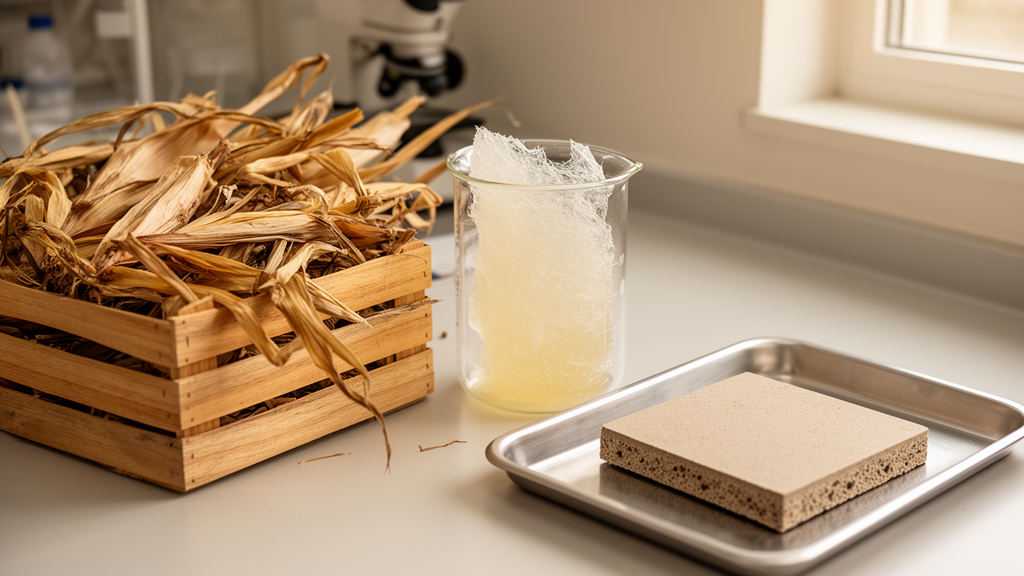
Every corn harvest leaves behind mountains of stalks, leaves, and husks known as corn stover, a residue rich in cellulose, hemicellulose, and lignin that farmers rarely convert into anything of value. A new study published in Biotechnology for Sustainable Materials reports that this agricultural leftover can be turned into three entirely additive-free biocomposites whose lifespans can be tuned by simply choosing the polymer matrix that binds the fibers together. Even more striking, when the materials reach the end of their useful life, their degradation products can feed bacteria that spin out bacterial nanocellulose, a high-value biomaterial, closing what the researchers describe as a multicircular loop from field waste to functional product and back to new material.
The research team, led by Marijana Ponjavic and colleagues working in Serbia, named the new material family SferiCorn. They combined ground corn stover in the form of short, randomly oriented fibers with three chemically distinct biopolymer matrices: corn starch, sodium alginate, and the commercial polyhydroxyalkanoate poly(hydroxybutyrate-co-hydroxyhexanoate), abbreviated PHBH. The starch-based version, called Sferi R, contained 12.5 percent starch and was made by gelatinizing a starch solution and casting it with the fibers. The alginate-based Sferi S used a 2 percent alginate solution crosslinked with calcium chloride. The thermoplastic Sferi BioTP blended 100 grams of corn stover with just 15 grams of PHBH and was processed by single-screw extrusion at 170 to 180 degrees Celsius, within the polymer’s normal processing window, without any compatibilizers or synthetic additives.
Thermal analysis revealed how strongly the matrix choice shapes material behavior. Differential scanning calorimetry showed that adding corn stover disrupted the crystallization of the PHBH matrix, lowering its melting temperature from 166.6 degrees Celsius for the neat polymer to 142 degrees Celsius in the composite. The authors note that this melting-point depression actually broadens the thermal processing window, allowing lower extrusion and molding temperatures and reducing the risk of thermal degradation during manufacturing. Thermogravimetric analysis showed that the PHBH composite degraded in a single sharp step with its maximum degradation rate at 272 degrees Celsius, slightly below the 282.3 degrees Celsius observed for neat PHBH, while the starch and alginate composites decomposed in two overlapping steps between roughly 311 and 358 degrees Celsius.
Water behavior separated the three materials even more dramatically. The starch-based Sferi R disintegrated almost immediately upon immersion in water, though it did not dissolve. The alginate-based Sferi S swelled considerably, a consequence of the hydrophilic alginate matrix whose hydroxyl groups act as water absorption channels. In sharp contrast, the PHBH-based Sferi BioTP reached its water-absorption plateau within 24 hours and showed no significant swelling, thanks to the hydrophobic polymer that densifies the composite structure through interfacial bonding with the embedded fibers.
Mechanical testing confirmed that only the PHBH composite could carry real structural loads. Sferi BioTP achieved a tensile strength of 4.495 megapascals, nearly ten times the 0.234 megapascals measured for the alginate composite, along with a Young’s modulus of 851.2 megapascals indicating relatively high stiffness. Both materials showed low ductility, with elongation at break values of 0.706 and 0.683 percent respectively. The starch composite could not be tested meaningfully at all because it physically fell apart during handling. Scanning electron microscopy of the PHBH composite revealed a compact, dense appearance with corn stover fibers well integrated into the matrix, demonstrating effective wetting of the hydrophilic fibers by the hydrophobic polymer without any compatibilizer.
Degradation experiments then mapped out the end-of-life options for each formulation. In model compost at 37 degrees Celsius, the starch composite lost more than 70 percent of its weight after 10 days and more than 90 percent after 17 days, fragmenting almost completely. The alginate composite lost about 40 percent at 10 days and also exceeded 90 percent by 17 days. The PHBH composite remained essentially intact at 10 days and lost less than 15 percent of its mass even after 17 days, which the researchers attribute to the hydrophobicity and high crystallinity of the PHBH matrix restricting water penetration and microbial access to the ester linkages.
Aqueous degradation tests told a parallel story. In a mildly acidic buffer and in buffer supplemented with cellulase from Trichoderma reesei, the starch composite lost 55 percent of its weight after two weeks and 65 percent after four weeks, while the alginate composite lost roughly 30 and 40 percent respectively. The PHBH composite lost close to 1 percent under both conditions. Enzymatic treatment consistently accelerated breakdown compared with buffer alone, and the dinitrosalicylic acid assay quantified the difference: hydrolysates from the enzymatically degraded starch and alginate composites contained 3.98 and 4.38 milligrams per milliliter of reducing sugars, versus 0.18 and 1.80 milligrams per milliliter in buffer-only samples. The PHBH composite released only about 0.4 milligrams per milliliter under either condition, consistent with its resistance to both hydrolytic and enzymatic attack.
The most innovative step came when the researchers collected these hydrolysates and fed them to the bacterium Komagataeibacter medellinensis as the sole carbon source for producing bacterial nanocellulose. Hydrolysates from the degraded starch composite yielded approximately 1.3 grams of nanocellulose per liter, significantly higher than the 0.3 grams per liter obtained from the standard Hestrin-Schramm glucose medium, and the yield remained high even without glucose supplementation. Hydrolysates from the alginate composite produced 0.9 grams per liter with added glucose and 0.7 grams per liter without it. No nanocellulose grew from the PHBH hydrolysates, which matched their negligible degradation. The authors suggest the superior performance of the hydrolysates may reflect a synergistic effect, since the degraded composites release not only fermentable sugars but also trace nutrients, minerals, and organic co-products that stimulate bacterial metabolism more effectively than a chemically defined medium.
Because of its favorable mechanical properties and melt processability, the PHBH composite was selected for a proof-of-concept product: a coat hanger. The researchers argue that coat hangers are an ideal demonstrator for sustainable materials because billions are manufactured annually, mostly from polystyrene, polypropylene, or mixed plastic-metal assemblies, and most are discarded after brief use, with their small dimensions and mixed construction making them economically unattractive for recycling. The extruded Sferi BioTP prototype, produced with an existing CNC-machined aluminum die, measured 40 centimeters wide with a body thickness of 1 to 1.2 centimeters and a 2-centimeter hook diameter suited to standard closet rods. Because it is a single material with no additives, the hanger can be recycled or biologically degraded as one piece, unlike conventional composite hangers.
The study, published on 3 September 2026 as an open-access article, demonstrates a complete life-cycle approach to composite design, from formulation and characterization through degradation testing to upcycling. The authors position the starch and alginate composites as candidates for short-lived applications such as compostable packaging or agricultural mulch, while the durable PHBH composite suits longer-lasting consumer products. By converting spent biocomposites into bacterial nanocellulose rather than sending them to landfill or incineration, the work illustrates how agricultural residues could feed a circular bioeconomy in which waste streams become feedstocks for progressively higher-value materials, all while avoiding the synthetic additives that typically push biocomposites toward incineration or disposal at end of life.
Subject of Research: Development and end-of-life evaluation of corn stover biocomposites made with starch, alginate, and PHBH matrices, including a coat-hanger prototype and upcycling into bacterial nanocellulose.
Article Title: Valorization of corn stover into biodegradable biocomposites: characterization, prototype design, and upcycling into bacterial nanocellulose
Article References: Ponjavic, M., Djuraskovic, N., Milovanovic, J., Jankovic, V., Nikodinovic-Runic, J., Cosovic, V. R., Tica, N., & Zivkovic, I. (2026). Valorization of corn stover into biodegradable biocomposites: characterization, prototype design, and upcycling into bacterial nanocellulose. Biotechnology for Sustainable Materials, 3(1), Article 13. https://doi.org/10.1186/s44316-026-00064-3
Image Credits: AI Generated
DOI: 10.1186/s44316-026-00064-3
Keywords: corn stover, biocomposites, biodegradable plastics, PHBH, bacterial nanocellulose, composting, agro-waste valorization, circular bioeconomy, starch, alginate, coat hanger prototype, enzymatic degradation
News Source: Alan Morgan. (October 28, 2026). Corn Stover Transformed Into Biodegradable Composites and Bacterial Nanocellulose. Scienmag.