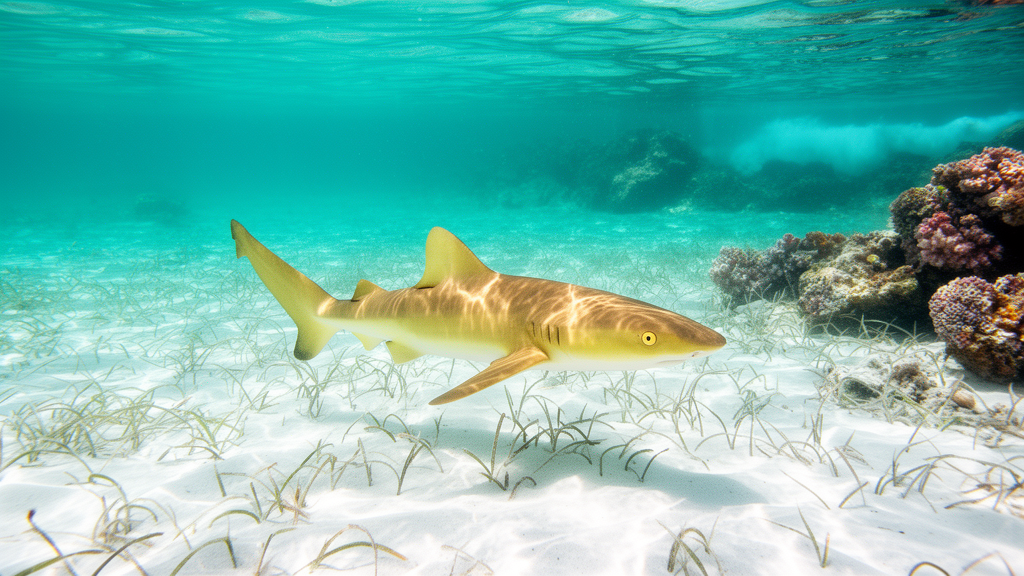
The shallow nearshore waters around Dongsha (Pratas) Island in the South China Sea support a persistent nursery for the sicklefin lemon shark (Negaprion acutidens), according to a new open-access study published in Animal Biotelemetry on 1 October 2026.
Across standardized surveys conducted from 2020 to 2022, the research team recorded 740 sharks, of which roughly 90 percent were juveniles. Using mark–recapture records spanning 2015 to 2022 and an open-population model, the authors estimated a mean annual juvenile abundance of about 277 individuals.
Between 2016 and 2023, an array of 14 receiver stations collected more than 360,000 detections of tagged sharks.
Within that core subset, juvenile sharks were concentrated at receivers along the eastern coast and at the lagoon mouth, while small sharks and subadults showed a broader distribution across the array. This pattern suggests that different size classes use the island’s shallow habitats in distinct ways, with the youngest animals clustering in particular zones.
To examine the possible influence of coastal construction, the researchers restricted their noise-related analyses to eligible 2022 deployment blocks in which telemetry and passive acoustic monitoring ran concurrently. During construction-active intervals within this limited overlap subset, detections at the lagoon-mouth station declined while detections increased at eastern or southwestern stations.
The authors urge caution in interpreting this construction-associated pattern. The overlap subset was small, and acoustic detectability itself can vary, so the observed shifts in receiver detections cannot be attributed to construction sound with confidence. The study describes a coincidence in timing rather than a demonstrated causal effect of underwater noise on shark movement.
Shallow nearshore habitats can serve as nursery areas for coastal elasmobranchs, but they are increasingly exposed to coastal development. The study’s conclusion that Dongsha’s monitored habitats support a persistent juvenile nursery system underscores the conservation value of these waters for a species whose young depend on them.
Because the article was released as an accepted manuscript under Springer Nature’s in-review sharing process, it is citable and carries a permanent DOI, with the final version of record to follow.
Subject of Research: Juvenile sicklefin lemon shark nursery use and construction-associated acoustic detection patterns at Dongsha Island
Article Title: Nursery use and construction-associated receiver detection patterns of the sicklefin lemon shark (Negaprion acutidens) at Dongsha (Pratas) Island
Article References: Chen, Y.-Y., Chiu, K., & Chiang, W.-C. (2026). Nursery use and construction-associated receiver detection patterns of the sicklefin lemon shark (Negaprion acutidens) at Dongsha (Pratas) Island. Animal Biotelemetry. https://doi.org/10.1186/s40317-026-00503-y
Image Credits: AI Generated
DOI: 10.1186/s40317-026-00503-y
Keywords: sicklefin lemon shark, Negaprion acutidens, nursery habitat, acoustic telemetry, Dongsha Island, juvenile abundance, mark-recapture, coastal development, underwater noise, elasmobranchs, Nursery, construction-associated
News Source: Drew Townsend. (October 28, 2026). Shallow waters around Dongsha Island sustain a juvenile lemon shark nursery. Scienmag.