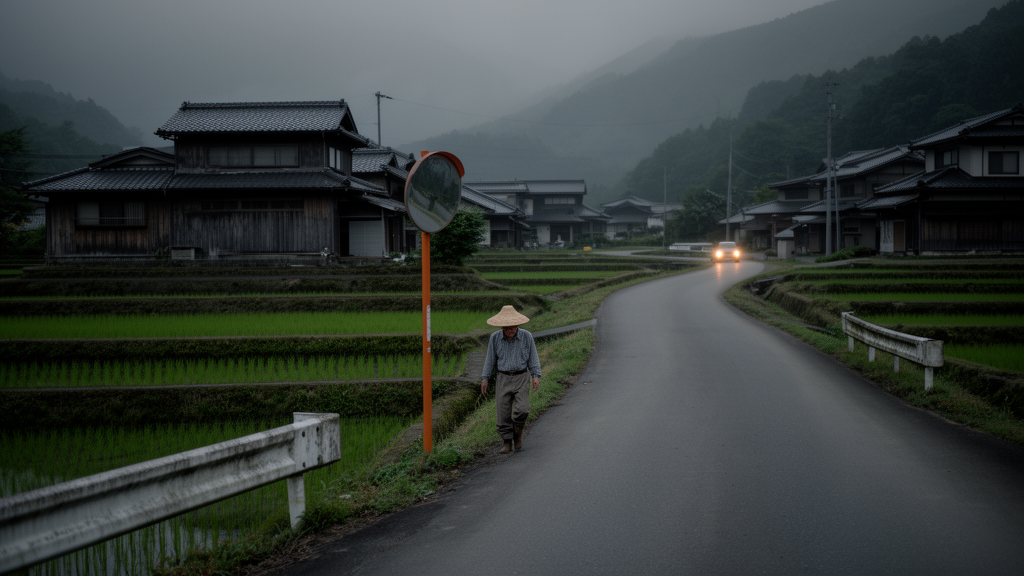
A nationwide analysis of all 1,890 Japanese municipalities has mapped how cause-specific mortality varied across the country's rural and urban communities before and during the COVID-19 pandemic, revealing that rural excesses in deaths from traffic accidents, unintentional injuries and suicide persisted throughout the pandemic years even as overall relative mortality remained remarkably stable. The study, published as an open-access research paper in BMC Public Health, compared the pre-pandemic period of 2017 to 2019 with the pandemic period of 2020 to 2022. The methodological design was deliberately conservative.
Expected deaths were calculated by applying common pre-pandemic national age-, sex- and cause-specific mortality rates to municipal populations, which were estimated by interpolation to mid-2018 and extrapolation to mid-2021 from the 2015 and 2020 censuses. This approach means that changes in the age structure of local populations were accounted for using a single, consistent baseline, allowing the researchers to isolate shifts in relative mortality rather than raw death counts. At the heart of the analysis were Empirical Bayes-smoothed standardised mortality ratios, or EB-SMRs.
The team then fitted period-specific Besag–York–Mollié 2 spatial models for 34 individual causes of death as well as all-cause mortality, both with and without adjustment for area deprivation. To test whether the relationship between rurality and mortality changed with the pandemic, the researchers fitted pooled models containing period-specific spatial fields and examined period-by-rurality interactions. The headline numbers tell a story of stability at the surface and change underneath.
Observed deaths across Japan rose by 7.3 percent between the two periods, yet the median municipal all-cause EB-SMR barely moved, shifting from 100.1 to 99.5. In other words, once age, sex and population changes were held constant, the typical community's relative mortality position was essentially unchanged, even though more people died during the pandemic years. Beneath that stable aggregate, individual causes moved sharply in both directions.
The largest declines in median EB-SMR were recorded for asthma, which fell by 38.2 points, pneumonia by 28.5, traffic accidents by 24.4 and tuberculosis by 21.8. On the rising side, senility increased by 21.2 points, pancreatic cancer by 4.7 and suicide by 4.6, with the suicide increase reaching 13.5 points among women. Smaller increases appeared for liver disease, leukaemia and renal failure.
The rural-urban patterning proved to be the study's most policy-relevant finding. In deprivation-adjusted models for the pandemic period, the rate ratio for rurality was 1.103 for traffic accidents, meaning rural municipalities carried roughly ten percent higher mortality than expected, with a 95 percent credible interval of 1.062 to 1.146. Unintentional injuries showed a rate ratio of 1.029 and suicide 1.026, and all three associations survived the multiplicity adjustment, marking them as statistically robust rather than chance findings.
Senility also showed a positive adjusted association of 1.027, but this did not survive correction for multiple testing, so the authors treat it with appropriate caution. Crucially, no period-by-rurality interaction reached detectability for any cause. The rural excesses in external causes of death were therefore not a pandemic phenomenon that emerged or vanished between 2017 and 2022; they were a persistent structural feature of Japanese mortality geography.
The researchers are explicit about the limits of their design: the two-period comparison does not isolate pandemic effects from underlying secular trends, and as an ecological study it identifies area-level patterns, not individual-level risks. The authors argue that municipal-level monitoring of this kind can inform geographically targeted planning for transport safety, emergency care, long-term care and suicide prevention.
Subject of Research: Rural-urban patterning of cause-specific mortality across Japanese municipalities before and during the COVID-19 pandemic
Article Title: Cause-specific mortality and its rural–urban patterning across 1,890 Japanese municipalities before (2017–2019) and during (2020–2022) the COVID-19 pandemic: a nationwide small-area ecological study of rurality and deprivation
Article References: Koda, M., Nomura, S., Osaka, K., & Harada, N. (2026). Cause-specific mortality and its rural–urban patterning across 1,890 Japanese municipalities before (2017–2019) and during (2020–2022) the COVID-19 pandemic: a nationwide small-area ecological study of rurality and deprivation. BMC Public Health. https://doi.org/10.1186/s12889-026-29694-y
Image Credits: AI Generated
DOI: 10.1186/s12889-026-29694-y
Keywords: mortality, Japan, COVID-19, rural health, health inequality, standardised mortality ratio, suicide, traffic accidents, ecological study, spatial epidemiology, area deprivation, municipalities
News Source: Kristina Jarvis. (October 28, 2026). Rural Japan’s excess deaths from crashes, injuries and suicide persisted through the pandemic. Scienmag.