A wild relative of the husk tomato, harvested for its sweet orange fruits in Mexico, has passed its first formal test as a candidate crop. A new study in Botanical Reports-style research published in the journal Botanical Studies reports that Physalis gracilis, a perennial herb known locally as “costomate” or “costomatillo,” is completely self-incompatible, meaning it cannot fertilize its own flowers and depends entirely on cross-pollination to set fruit. Despite that dependence, the plants showed no sign of pollen limitation in the field, survived open-field cultivation at a rate of 93.8 percent, and produced a potential average yield of 8.178 tonnes per hectare with fruit sweetness reaching 11.29 degrees Brix on average.
The findings come from a team at the University of Guadalajara and collaborating Mexican institutions, who combined greenhouse pollination experiments with a full open-field growing cycle at the university’s experimental fields in Zapopan, Jalisco. Their goal was twofold: to determine, for the first time, the reproductive system of P. gracilis, and to measure how the species performs under standard agricultural management. Both questions matter for any effort to turn a wild plant into a reliable crop, because the mating system dictates how breeders must manage pollination, seed production, and genetic uniformity.
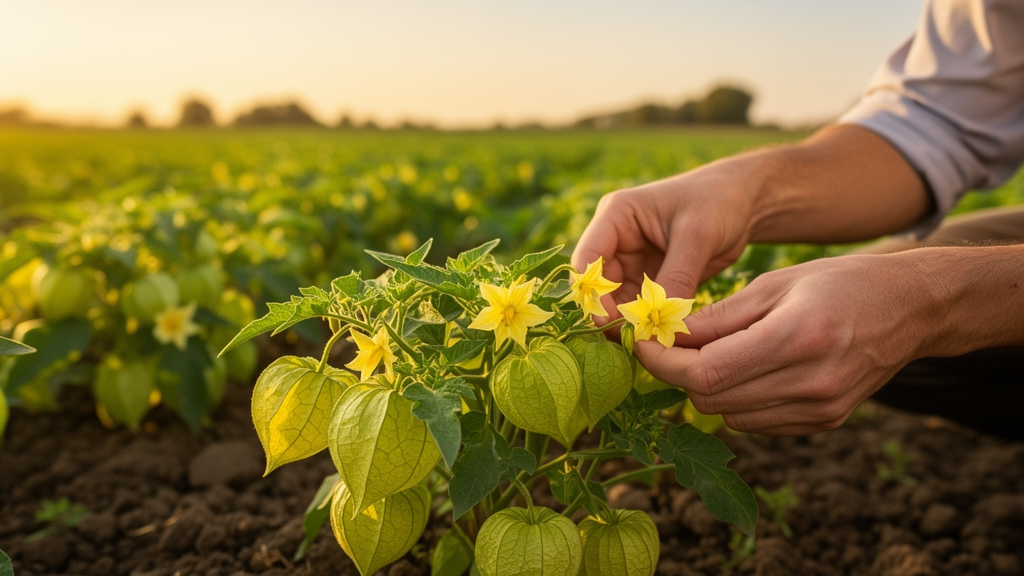
Physalis gracilis is distributed from Nayarit and San Luis Potosí in Mexico through Central America to Panama, at elevations between 1,400 and 2,250 meters. It grows as a slightly erect to prostrate perennial herb, profusely branched at the stem base, with branches reaching up to 90 centimeters and occasionally 1.5 meters in length. Its yellow corollas bear five distinct dark spots, and the orange berries measure 8 to 15 millimeters in diameter. The species inhabits open areas within pine-oak and cloud forests and turns up as a weed in agricultural fields associated with those ecosystems. Its sweet fruits are valued for household consumption and, on a very small scale, for sale in local markets.
To characterize the reproductive system, the researchers germinated seeds from three accessions, two collected in San Luis Potosí and one in Querétaro, and established fifteen plants in a greenhouse and fifteen in the open field. They applied seven artificial crossing treatments, including agamospermy tests with emasculated flowers, autonomous self-pollination with untouched flowers, hand-mediated self-pollination, cross-pollination with a single pollen donor, cross-pollination with three donors, pollen supplementation under open-field conditions, and natural pollination left entirely to visiting insects. Each treatment was replicated on 30 flowers.
The result was unambiguous. The self-incompatibility index came out at zero, the classification for a completely self-incompatible species. Neither agamospermy, autonomous self-pollination, nor hand-mediated self-pollination produced a single fruit. In contrast, the treatments favoring cross-pollination, namely single-donor crosses, three-donor crosses, pollen supplementation, and natural pollination, brought 84 percent of the set fruits to maturity. Because the Solanaceae family, to which Physalis belongs, carries an RNA-ase gametophytic self-incompatibility system that uses RNases to recognize and reject self-pollen, the authors suggest P. gracilis likely shares this mechanism, though they note that future work is needed to confirm it directly.
Floral biology reinforced the picture. Monitoring flower buds from emergence to senescence revealed eight developmental stages, from immature bud through full anther dehiscence to floral senescence. Flower longevity differed sharply between environments: in the greenhouse, the opening-to-senescence stages lasted an average of four days, while in the open field they lasted only about 2.5 days. Flowers opened between 9:00 and 10:00 in the morning and closed around 5:00 in the afternoon, and stigma receptivity coincided with the onset of anther dehiscence. The authors interpret the extended greenhouse anthesis as a strategy that keeps flowers available longer when pollinators are absent, consistent with the general expectation that self-incompatible plants prolong flowering to maximize cross-pollination opportunities.
Pollen limitation, a common worry for outcrossing species that depend on pollinators, was absent. The pollen limitation index came out negative at minus 0.17, and the pre-dispersal fitness index was similarly negative at minus 0.43, both indicating no limitation. In fact, fruit and seed production were higher under natural pollination than under pollen supplementation. Natural pollination achieved a fruit set of 96.6 percent, and natural pollination also produced the highest seed numbers of any treatment. The authors attribute this to highly efficient plant-pollinator interactions; although floral visitors were not systematically quantified, field observations recorded frequent visits by the honeybee Apis mellifera, and the small experimental plot was surrounded by diverse crops that may have attracted pollinators. Interestingly, pollen supplementation with extra hand-applied pollen reduced seed output relative to natural pollination, a pattern the researchers suggest may reflect stigma saturation, in which excessive pollen grains cause competition among growing pollen tubes so that only a fraction successfully fertilize ovules.
On the agronomic side, the team transplanted 80 seedlings of each accession into open fields with mulch, drip irrigation, and rows spaced 150 centimeters apart, at a planting density of 13,778 plants per hectare, with worm humus incorporated before planting and weekly fertilization thereafter. Of the 162 plants established, 93.8 percent survived. Data were collected from 48 plants per accession across six descriptors: number of fruits per plant, average fruit weight, equatorial diameter, firmness, total soluble solids, and pH. Most descriptors differed significantly among the three accessions, except fruit number and soluble solids. Average fruit weight ranged from 1.99 to 2.48 grams, equatorial diameter from 15.7 to 16.9 millimeters, and total soluble solids fluctuated only narrowly between 11.17 and 11.36 degrees Brix. Fruit pH ranged from 3.91 in the most acidic accession to 4.43 in the least. Estimated yields per hectare differed among accessions, with the highest at 9.07 tonnes per hectare and the lowest at 6.99.
Those fruit traits are what make the species stand out. Fruit weight and equatorial diameter exceeded values previously reported for three other wild Physalis species and even surpassed cultivated P. angulata, while sweetness was superior to those wild relatives and comparable to cape gooseberry, P. peruviana, a commercially important South American fruit whose sweetness ranges from 10.86 to 15.5 degrees Brix. The San Luis Potosí accessions emerged as the most promising: accession 512 produced the largest and heaviest fruits, while accession 513 combined the highest fruit number per plant with the best Brix value and the highest yield. Accession 432 from Querétaro produced smaller fruits with high sweetness, and the authors note an apparent negative correlation between fruit size and sweetness across accessions, a trend also seen in wild tomatoes that complicates breeding programs.
The authors are careful about limits. The reproductive-system assessment relied on a small sample size, and they call for expanded sampling across more populations and individuals. Complete self-incompatibility also poses a practical challenge, since it prevents self-pollinated lines and makes phenotypic uniformity harder to achieve in monoculture; only a minority of self-incompatible crops are completely so, and artificial selection often drives transitions toward self-compatibility, as documented in other Physalis species where breakdowns of the system have occurred. Yields of 7 to 9 tonnes per hectare fall within the range reported for P. pubescens and P. acutifolia but remain below those of P. chenopodiifolia and the widely cultivated husk tomato P. philadelphica, and ground-level cultivation generally yields less than staked systems, suggesting that staking or trellising could improve productivity of the prostrate perennial. Still, the combination of reliable pollinator-mediated fruit set, positive response to agricultural management, and fruit quality comparable to an established export crop leads the researchers to conclude that P. gracilis is a credible candidate for development as a new open-field crop, one whose sweet, carotenoid-rich orange fruits could eventually serve local communities fresh, juiced, as jam, or dried.
Subject of Research: Reproductive system and open-field agronomic performance of the wild husk tomatillo Physalis gracilis in Mexico
Article Title: Reproductive system and agronomic performance of the wild husk tomatillo Physalis gracilis
Article References: Enríquez-Antonio, O., Zamora-Tavares, M. D. P., Solís-Montero, L., Rodríguez-Zaragoza, F. A., Sánchez-Hernández, C. V., Alcalá-Gómez, G., Sánchez-Nuño, J. A., & Vargas-Ponce, O. (2026). Reproductive system and agronomic performance of the wild husk tomatillo Physalis gracilis. Botanical Studies, 67(1), Article 12. https://doi.org/10.1186/s40529-026-00500-7
Image Credits: AI Generated
DOI: 10.1186/s40529-026-00500-7
Keywords: Physalis gracilis, self-incompatibility, pollen limitation, open-field cultivation, crop domestication, husk tomato, Solanaceae, fruit quality, pollination, Mexico, agronomic yield, wild crop relatives
News Source: Alan Morgan. (October 28, 2026). Wild Mexican tomatillo proves fully self-incompatible yet thrives in open-field trials. Scienmag.