Acute Oak Decline, one of the most serious forest health problems facing European oaks, has been formally recorded for the first time in Croatia’s continental pedunculate oak forests. A two-year survey covering the species’ entire range in the country found the disease syndrome established at 22 sites, with tree-level incidence reaching 58 percent at the worst-affected location and individual trees bearing as many as 19 stem bleeds. The findings, published in Annals of Forest Science, give Croatia its first baseline for a disease that had previously been documented in the country only on Mediterranean holm oak.
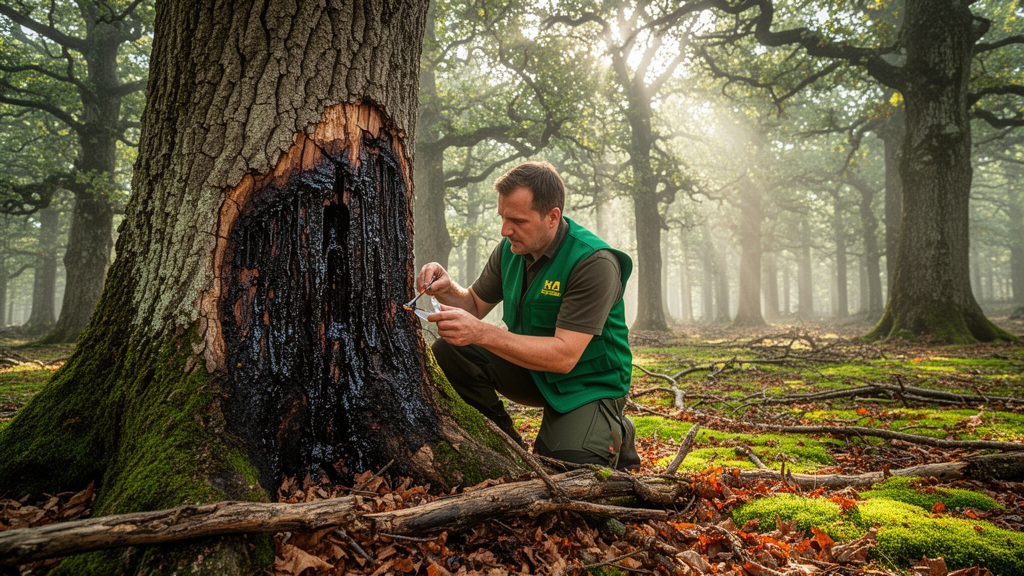
The survey was carried out during 2024 and 2025 across 72 locations spanning the full distribution of pedunculate oak in Croatia, covering roughly 630 hectares of forest, or about 3 percent of the country’s approximately 210,000 hectares of this forest type. The work began with trained foresters, who surveyed their own management units for the characteristic weeping stem lesions of the disease and reported occurrences photographically. Only symptomatic trees were then swab-sampled for laboratory confirmation, and sites where bacterial testing came back positive were revisited for detailed assessment of how many trees were affected and how severely.
Laboratory analysis at the University of the West of England and Forest Research in the United Kingdom combined bacteriological isolation with a multiplex real-time PCR assay targeting the four bacteria most consistently associated with Acute Oak Decline. Brenneria goodwinii was detected at all 22 confirmed sites, making it the most frequently encountered pathogen in the survey. Gibbsiella quercinecans was found at 11 sites and, notably, always appeared together with B. goodwinii. The other two bacteria in the classical consortium, Lonsdalea britannica and Rahnella victoriana, were not detected in any sample, a narrower bacterial community than reported in some earlier studies elsewhere in Europe.
The split between the two survey years revealed a marked geographic pattern. In 2024, sampling concentrated on the eastern part of the pedunculate oak range yielded 14 positive samples out of 32. In 2025, work in the western part of the range produced 8 positives from 40 samples. Overall, 22 of the 72 sampled sites tested positive for the AOD-associated bacteria, and the highest incidence and symptom severity were recorded in eastern Croatia, with the Vinkovci locality standing out: there, 58.33 percent of the 120 trees examined showed at least one stem bleed, and often several more per tree.
Across all confirmed sites, 2,580 trees were assessed for bleeding symptoms, with between 60 and 120 trees examined per location along north-south and east-west transects. In total, 542 trees, or 21 percent of those surveyed, were positive for at least one of the target bacterial species, and the average incidence across localities was 21.21 percent. Yet the variation among sites was striking: incidence ranged from 0.83 percent to 58.33 percent, and the number of bleeding lesions per affected tree also varied widely, with a maximum of 19 bleeds recorded on a single tree counted up to a height of three metres. The authors characterise the disease as widespread but strongly heterogeneous in both incidence and severity.
Because no previous study had categorised the intensity of these symptoms, the researchers proposed a five-level classification based on the percentage of affected trees out of 120 sampled per site: negligible from 0 to 10 percent, mild from 11 to 20 percent, moderate from 21 to 30 percent, severe from 31 to 40 percent, and very severe above 41 percent. They stress that future surveys should always sample 120 trees per site so that results remain comparable with this baseline.
The survey also examined whether tree size, used as a proxy for age through diameter at breast height, could explain how many bleeds a tree carried. The answer was largely no. In the pooled dataset, Spearman’s rank correlation showed only a weak negative association between DBH and the number of bleeds (rho = -0.148), and a Poisson model gave an incidence-rate ratio of 0.840 per 10-centimetre increase in DBH, meaning larger trees carried slightly fewer bleeds on average. But once locality was included as a fixed effect, the direction reversed, with an incidence-rate ratio of 1.058, and locality-specific models showed larger trees with significantly more bleeds at some sites, significantly fewer at others, and no significant relationship at most. Tree size alone therefore cannot account for the spatial differences in symptom severity, pointing instead to local hydrology, soil conditions, stand structure, management history and climatic stress as likely determinants.
Another unexpected feature was the scarcity of exit holes from Agrilus jewel beetles, which are often considered a prominent component of the disease complex in the United Kingdom. Across all surveyed trees, exit holes were visible on only 1.74 percent, with the highest incidence at Lipovac at 10 percent of trees, followed by Vinkovci and Otok at 5 percent each, and no holes at all at nine localities. The authors caution that this does not rule out an insect role: exit holes only record completed adult emergence and may miss current larval colonisation, and the survey recorded only presence or absence of holes, so the relationship between beetle abundance, bacterial infection and severity could not be tested directly.
The Croatian findings add to a growing list of European reports of AOD-associated bacteria and bleeding cankers, following the original characterisation of the syndrome in the UK and subsequent reports from Slovakia, Poland, Italy, France and Serbia. The authors are careful about what this pattern means: the increasing number of reports does not necessarily demonstrate rapid recent expansion, since it may reflect genuine spread, greater disease expression under changing environmental conditions, improved recognition and targeted sampling, or a combination of these. Bleeding bark lesions on oaks are not a new phenomenon, having been described decades ago and historically attributed to Agrilus damage, and Croatian foresters had occasionally observed stem bleeding long before the syndrome was formally investigated. The bacteria may therefore have been present and undetected for some time.
Because this was a cross-sectional survey, it cannot determine whether the affected range or disease severity is increasing, and the authors call for repeated standardised surveillance to detect changes at high-incidence sites and guide risk-based management. They also note limitations: fungal pathogens and Phytophthora species were not systematically investigated, detailed hydrological and soil data were not available for every locality, and Agrilus activity was assessed only through visible exit holes. Eastern Croatia, where incidence was highest, also experienced a severe storm in 2023 that caused extensive windthrow in the Spačva Basin, and while the spatial correspondence does not establish causation, storm damage, drought, altered hydrology and chronic feeding by the invasive oak lace bug, present in Croatia since 2013, may all contribute to reduced tree vitality. The study establishes the first confirmed assessment of Acute Oak Decline on pedunculate oak in Croatia and a baseline against which future changes in its distribution and severity can be measured.
Subject of Research: First national assessment of Acute Oak Decline occurrence and severity in Croatian pedunculate oak forests
Article Title: Acute Oak Decline in pedunculate oak forests in Croatia: first record and assessment of disease occurrence and severity
Article References: Pernek, M., Kovač, M., Kajamuhan, A., Crampton, B., Brady, C., & Denman, S. (2026). Acute Oak Decline in pedunculate oak forests in Croatia: first record and assessment of disease occurrence and severity. Annals of Forest Science, 83(1), Article 53. https://doi.org/10.1186/s13595-026-01370-6
Image Credits: AI Generated
DOI: 10.1186/s13595-026-01370-6
Keywords: Acute Oak Decline, pedunculate oak, Quercus robur, Brenneria goodwinii, Gibbsiella quercinecans, Croatia, forest pathology, Agrilus, stem bleeding, disease surveillance, plant microbiology, forest health
News Source: Kristina Jarvis. (October 27, 2026). Acute Oak Decline confirmed across Croatian pedunculate oak forests for the first time. Scienmag.