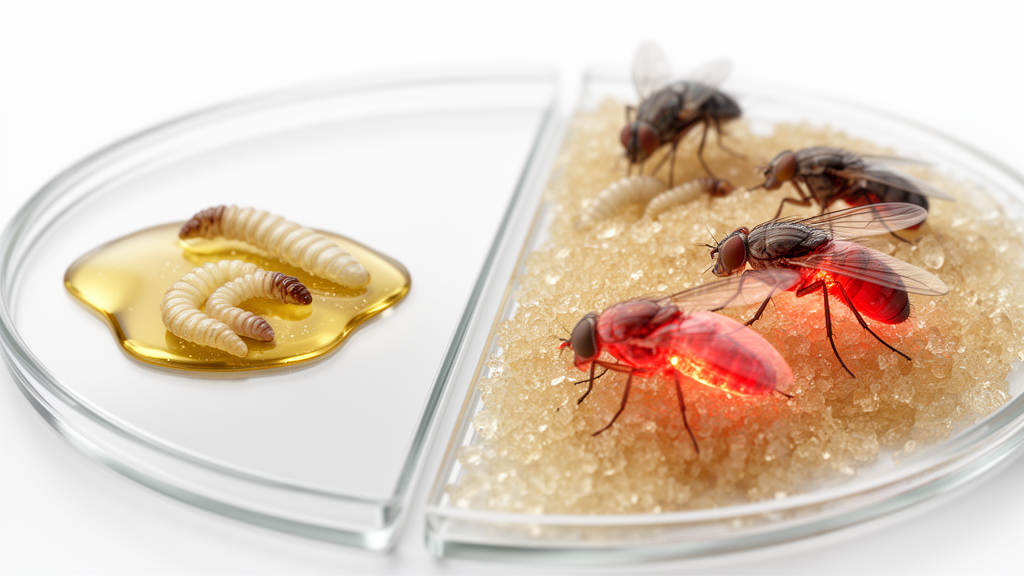
D-galactose, a sugar found in milk, honey, beets and dairy products, has long served as a laboratory tool for accelerating ageing in animal models. When given in excess, it generates reactive oxygen species, damages mitochondria and drives inflammation, which is why researchers have used it for decades to study how organisms age. But a new open-access study in Discover Developmental Biology suggests the story is more complicated than simple toxicity. In fruit flies, the same sugar appears to act like a classic hormetic agent: a low dose improved development and boosted antioxidant defenses, while higher doses impaired development and pushed the insects into oxidative and nitrosative stress.
The research team, led by Oluwasegun Davis Olatomide of Redeemer’s University in Nigeria, set out to answer a question that previous work had largely ignored. Most D-galactose studies have exposed adult animals continuously and focused on lifespan shortening and cognitive decline. Almost nothing was known about what happens when exposure is confined strictly to development, from egg to eclosion, and then withdrawn. The researchers wanted to know whether dose-dependent effects exist during early life, whether a beneficial low dose could be identified, and whether any changes would persist into early adulthood once the sugar was gone from the diet.
They worked with the Oregon R strain of Drosophila melanogaster, a species that has anchored biomedical research for more than a century thanks to its short life cycle and rich genetic toolkit. Before the main experiment, a preliminary survival assay established that doses of 10, 20 and 25 milligrams per gram of food were sub-lethal over a 21-day adult observation period; survival curves showed no significant decline compared with controls. The 10 mg/g dose was chosen as the low dose because it produced no detectable harm, the 20 mg/g dose served as an intermediate, and the 25 mg/g dose was selected as the high dose based on earlier reports of lifespan-shortening effects at that concentration.
The exposure design was deliberately developmental. Newly eclosed males and females were allowed to mate on untreated food, and then D-galactose dissolved in distilled water was applied uniformly to the surface of embryo-laden solidified food at 100 microliters per vial. Eggs therefore developed entirely on treated food, while control vials received an equal volume of vehicle alone. The moment flies eclosed, treatment stopped: all emerging adults were transferred to untreated standard cornmeal food for five days. This drug-free interval was the crux of the design, because any biochemical or behavioural differences seen in five-day-old adults could not be attributed to ongoing exposure.
The results revealed a clear biphasic pattern. At the low dose of 10 mg/g, pupation percentage rose significantly compared with controls and with the higher-dose groups, an effect strong enough to reach p < 0.001. Eclosion percentage was also significantly higher in the low-dose group than in the high-dose group. Larval behaviour told the same story: mouth hook contractions, a proxy for feeding rate, and the number of lines crossed in a crawling assay both increased significantly in low-dose larvae. Body wall contractions showed a significant overall difference among groups by ANOVA, but Tukey’s post-hoc test found no significant pairwise differences, so that particular measure remained statistically unresolved.
Biochemical assays on five-day-old adults, performed on whole-body homogenates of 100 flies per replicate without sex sorting, extended the pattern into early adulthood. Flies that had received the low dose during development showed significantly elevated total thiol and non-protein thiol levels, markers of enhanced antioxidant capacity, alongside significantly reduced hydrogen peroxide, a reactive oxygen species. The authors interpret this combination as consistent with a hormetic response: mild stress during development apparently upregulated protective mechanisms that persisted after the sugar was withdrawn. Because the adults lived on untreated food for five days, the researchers argue these redox shifts suggest lasting developmental programming rather than a direct pharmacological effect.
The high dose of 25 mg/g produced the opposite signature. It impaired pupation, elevated hydrogen peroxide and nitrite/nitrate levels, and reduced thiol concentrations, indicating oxidative and nitrosative stress detectable in early adulthood even though exposure had ended at eclosion. The authors connect this to the established molecular account of D-galactose toxicity: at high concentrations, metabolism through the Leloir pathway becomes overloaded, galactose-1-phosphate accumulates, and excessive reactive oxygen species are generated through polyol pathway activation, mitochondrial dysfunction, glutathione depletion and NADPH oxidase activity. Elevated nitric oxide can also react with superoxide to form peroxynitrite, a potent cellular oxidant. Notably, the medium dose of 20 mg/g also reduced thiol levels compared with controls, placing it closer to the harmful end of the dose-response curve than to the beneficial one.
Perhaps the most striking finding is what did not change. Adult climbing activity, measured with a rapid iterative negative geotaxis assay at day five, showed a significant overall ANOVA difference among groups but no significant pairwise differences after post-hoc testing, and the performance index did not differ between groups either. Monoamine oxidase-B activity, an enzyme linked to neurotransmitter metabolism and motor regulation, was likewise unchanged across all treatment groups. The authors highlight this as a biochemical-functional dissociation: clear redox alterations in both directions, yet no corresponding enhancement or impairment in adult behaviour. They caution that the behavioural assessment relied on a single assay at a single time point, and that learning, memory and coordination were not measured, so subtle functional consequences cannot be ruled out.
The study has other limitations the authors acknowledge directly. Effects were assessed only at five days post-eclosion, so whether they persist into later adulthood or influence lifespan remains unknown. Specific antioxidant enzymes such as superoxide dismutase, catalase and glutathione peroxidase were not measured, nor were stress-responsive transcription factors like Nrf2 and FOXO, so the proposed mechanism stays at the level of hypothesis. Whole-body homogenates from mixed-sex populations precluded detection of sex-specific effects, despite known sex differences in oxidative stress responses. The authors also speculate that improved larval feeding and crawling might reflect neuromodulatory effects of mild oxidative stress, but they explicitly label this interpretation speculative, noting that neurotransmitter levels, receptor expression and synaptic function were not assayed and that alternative explanations such as altered energy metabolism remain possible.
The translational question is unavoidable, since D-galactose is a natural component of breast milk and infant diets, but the authors are careful to draw a firm boundary: the doses and the developmental exposure paradigm used in flies should not be directly extrapolated to human dietary exposure, and the relevance of these findings to human nutrition remains to be established. What the study does establish is narrower but notable. Within a carefully controlled insect model, a single dietary sugar produced dose-dependent, biphasic effects that spanned development and persisted into early adulthood after withdrawal, and favourable biochemical changes did not automatically translate into better functional outcomes. For a compound so widely used to model accelerated ageing, the demonstration that a low dose can be beneficial, at least in developing flies, adds an unexpected twist to a familiar experimental system.
Subject of Research: Dose-dependent effects of developmental D-galactose exposure on life history traits, behaviour and redox homeostasis in Drosophila melanogaster
Article Title: D-galactose dose-dependently exerts differential effects on life history traits and redox modulation in early adulthood in Drosophila melanogaster
Article References: Olatomide, O. D., Omotoso, D. R., Tawose, O., Akin-Adekeye, U. T., Alake, T. G., Emmanuel, C. T., Idowu, O. D., Arogundade, T. T., Bello, Z. M., & Abdulazeez, R. (2026). D-galactose dose-dependently exerts differential effects on life history traits and redox modulation in early adulthood in Drosophila melanogaster. Discover Developmental Biology, 236(1), Article 7. https://doi.org/10.1007/s00427-026-00733-3
Image Credits: AI Generated
DOI: 10.1007/s00427-026-00733-3
Keywords: D-galactose, Drosophila melanogaster, hormesis, oxidative stress, developmental biology, redox homeostasis, antioxidant thiols, pupation, eclosion, negative geotaxis, nitrosative stress, life history traits
News Source: Drew Townsend. (October 27, 2026). Low-Dose Sugar Helps Fly Development While High Dose Triggers Oxidative Stress. Scienmag.