


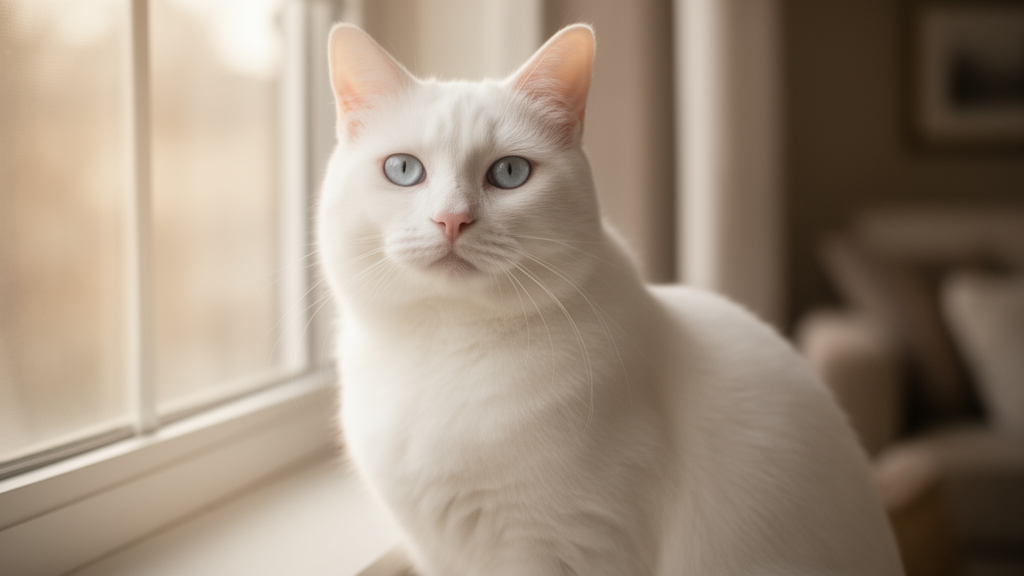
Blue eyes have long been one of the most coveted features in the domestic cat, but a new review warns that the genetics behind the trait can carry serious health consequences, including deafness and, in one variant, high kitten mortality. The analysis, published in the journal Companion Animal Health and Genetics, brings together what is known about the genes that produce blue irises in Felis catus and argues that breeding for appearance without genetic testing can put animal welfare at risk.
The review, authored by Olga Shatokhina, Eleanor Curtis and Victoria S. Foster, focuses on a phenomenon known as dominant blue eyes, or DBE. Unlike the familiar blue eyes of Siamese or Ragdoll cats, which come paired with colorpoint coats or white fur, DBE produces vivid blue irises on a fully colored coat. The trait arises from mutations in the PAX3 gene, and as of 2025 four independent DBE alleles have been described: DBECEL, DBERE, DBEALT and the newly reported DBEAGO. Each differs in how reliably it produces blue eyes, how much white spotting it causes, and how much risk it carries for sensorineural hearing loss.
To understand why eye color and hearing are linked at all, the authors turn to developmental biology. Melanocytes, the pigment-producing cells that color fur and irises, are also essential to the inner ear. During embryonic development, neural crest-derived melanoblasts migrate into the cochlea and become the intermediate-cell population of the stria vascularis, a structure required for maintaining endolymph homeostasis and generating the endocochlear potential that drives hair-cell transduction. When melanocyte migration, survival or differentiation is disrupted, the stria fails and cochlear degeneration can follow, resulting in hearing loss. This is why white cats, especially those with blue eyes, are at elevated risk of deafness, and why breeders are urged to use the brainstem auditory evoked response, or BAER, test to check hearing and avoid breeding deaf animals.
The review places the PAX3 variants in the context of two older genetic routes to blue eyes. The first involves the KIT proto-oncogene. A dominant W allele at the White locus interferes with the migration, proliferation and survival of melanoblasts during embryonic development, producing a completely white coat and a very high likelihood of blue eyes. Work by David and colleagues found that all deaf cats in their analysis carried at least one copy of the W allele, and all W/W cats showed some degree of sensorineural hearing loss. The second route runs through the tyrosinase gene, TYR. A homozygous recessive cs allele produces a thermolabile form of tyrosinase that works best at lower temperatures, darkening the cooler extremities of colorpoint cats such as Siamese while leaving the warmer iris stroma devoid of pigment. Blue color there comes purely from the Tyndall effect, the scattering of short-wave light on colloidal structures of the stroma. Unlike the W allele, cs is not associated with deafness, and neither is the rare blue-eyed albino allele ca., which produces a white coat with pale translucent blue irises.
The PAX3 variants are a different story. DBEALT, the Altai Dominant Blue Eye variant, is driven by an RD-114 long terminal repeat insertion in intron 4 of PAX3. It was the first selectively bred DBE variant, isolated from a founding lineage of Fyodor, a full-colored blue-eyed cat found in the Altai Mountains of Kazakhstan, and later spread through selection programs in Russia and Ukraine. A similar mutation recognized in New Mexico in 1984 led to the Ojos Azules breed, but those breeding programs were discontinued because of a high incidence of skeletal deformities in affected cats. According to cohorts reported by Abitbol and colleagues, heterozygous DBEALT cats did not show BAER-confirmed deafness, though homozygous cats are viable but may exhibit deafness.
DBECEL, the Celestial variant, also stems from an endogenous retroviral LTR inserted into intron 4 of PAX3. Derived from a founder named Roxy, it produces bright blue eyes with minimal or variable white spotting, and SNHL is not present in heterozygotes. However, likely because of altered embryonic melanocyte migration, hearing loss may occur in homozygotes. The picture is far darker for DBERE, the Rociri Elvis variant, identified in a Dutch line of Maine Coons through a c.937 C>T mutation. In the original family, one copy of the mutation caused blue eyes and deafness in a high proportion of affected cats, and the line suffered high kitten mortality. Rudd Garces and colleagues predicted that two copies would likely result in prenatal mortality. The Center for Animal Genetics advises against breeding cats carrying DBERE, and the review states that continuing to breed with this gene cannot be considered ethical under German law. More recent BAER data do show some DBERE heterozygotes with normal hearing, along with latent carriers without blue irides, indicating variable penetrance and a likely influence of genetic background.
The newest entry, DBEAGO, corresponds to a PAX3 c.160del frameshift in exon 2 reported in a Maine Coon lineage known as the Agostino line. All DBE cats genotyped from this line were heterozygous for the deletion, while related non-DBE and control cats were wild-type, consistent with autosomal dominant inheritance and a strong genotype-phenotype correlation. No BAER-confirmed deafness was reported in the available Agostino cases, but the authors stress that BAER data remain limited and further testing is needed to establish prevalence. No latent cats were identified in the Agostino line in the current dataset. Incomplete penetrance more broadly means some kittens never develop blue eyes at all, instead showing a reddish eye reflection in infancy; such latent DBE carriers have been documented in DBECEL, DBEALT and, more recently, DBERE lines.
The review draws comparisons across species to frame the puzzle. In humans, blue eyes are driven by melanocyte biology but trace to the OCA2-HERC2 locus of chromosome 15, and lighter eye color influences susceptibility to noise-induced hearing loss without being linked to sensorineural loss alone. Waardenburg syndrome, an auditory-pigmentary disorder, is PAX3-associated, and around half of patients with the PAX3 mutation have hearing loss, likely due to abnormalities in inner ear morphogenesis. Mouse studies have confirmed the importance of PAX3 for melanocyte development and survival in the inner ear, yet one Waardenburg mouse mutant showed no hearing loss and no impacts on cochlear development, suggesting other regions of the gene may rescue inner ear structure. In Border Collies, white hair, blue iris and sensorineural hearing loss are associated, though genetic linkage has not been established. The authors ask how pigment can be absent without deafness, speculating about rescue mutations, survival factors or hypomorphic alleles, while acknowledging that it is not yet known whether such mechanisms exist for PAX3 in melanocyte migration.
The welfare stakes are framed against the broader costs of inbreeding. As inbreeding decreases genetic diversity, it brings detrimental effects ranging from decreased litter size and conception complications to compromised immunity and breed-specific disorders, including familial AA amyloidosis, progressive retinal atrophy and a predisposition to mediastinal lymphoma in Oriental Shorthair and related Siamese lineages, lysosomal storage disease in Siamese cats, TBXT-associated spinal abnormalities in Manx cats, and TRPV4-associated osteochondrodysplasia in Scottish Folds. Demand for the DBE trait is growing: recent reports from the Fédération Internationale Féline highlight its rising popularity on colored coats, particularly in Maine Coons, which account for 25 percent of FIFé-issued pedigrees, and in British cats, where the trait is described as quite in trend.
Legal and regulatory landscapes vary. In Germany and Austria, breeding is prohibited if offspring are foreseeable to suffer from hereditary conditions including deafness, under Article 11b of the German Animal Welfare Act and 5(2) of the Austrian Animal Welfare Act. In the United Kingdom and the United States, cats fall under the Pet Animals Act 1951 and the Animal Welfare Act, neither of which stipulates the importance of genetic health in cat breeding. FIFé, which aims to improve feline health and welfare, states that two white cats cannot be bred due to health risks, and the review argues that DBERE’s ability to cause SNHL even in heterozygous states makes its continuation in the breeding pool incompatible with both German law and FIFé guidelines. The authors point to models such as RUS4Osh, a FIFé-approved project outcrossing Oriental Shorthairs with Russian Blues, as examples of widening gene pools under strictly controlled measures. Their conclusion is a call for caution: genetic testing for PAX3 variants, BAER hearing assessment and responsible breeding decisions are essential, and it remains unknown whether a blue-eyed phenotype on a colored coat can ever be established without some degree of hearing risk.
Subject of Research: Genetics of dominant blue eyes in domestic cats and associated hearing loss risks
Article Title: Blue eyes in Felis catus: genetics and health impacts
Article References: Shatokhina, O., Curtis, E., & Foster, V. S. (2026). Blue eyes in Felis catus: genetics and health impacts. Companion Animal Health and Genetics, 13(1), Article 10. https://doi.org/10.1186/s40575-026-00159-0
Image Credits: AI Generated
DOI: 10.1186/s40575-026-00159-0
Keywords: dominant blue eyes, PAX3, Felis catus, sensorineural hearing loss, DBE variants, cat genetics, melanocytes, inbreeding, Maine Coon, responsible breeding, BAER test, Waardenburg syndrome
News Source: Juliet Wilcox. (October 27, 2026). Blue-Eyed Cats: PAX3 Mutations Carry Hidden Hearing Risks. Scienmag.



