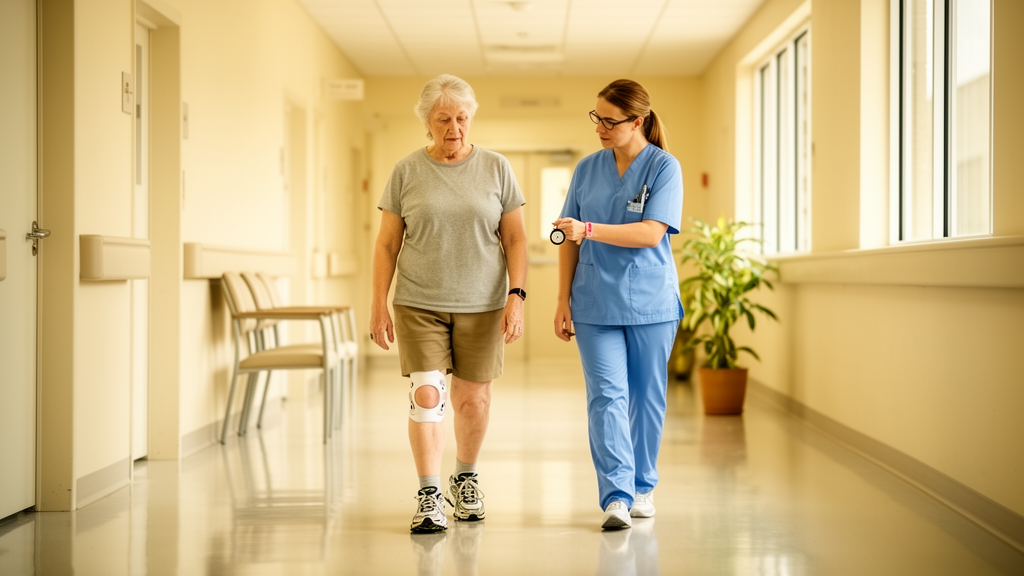
Patients recovering from total knee arthroplasty now have a new candidate for a quick bedside measure of walking ability. A study published in Archives of Orthopaedic and Trauma Surgery reports that the 30-Second Fast-Paced Walk Test, a short timed walking assessment requiring nothing more than a stopwatch, a tape measure and a corridor, shows excellent test-retest reliability in people who underwent knee replacement surgery at least six months earlier. The finding matters because walking speed is one of the most informative and easily obtained indicators of functional recovery after this very common operation.
The research team, led by Bayram Unver and colleagues, enrolled 38 consecutive patients who had undergone unilateral primary total knee arthroplasty at least six months before testing. The participants were predominantly women, with 34 females and four males, and their mean age was 70.11 years with a standard deviation of 10.19 years. All operations were performed by the same surgeon using a medial parapatellar approach, and patients with a body mass index of 40 or higher, prior surgery on the same limb, revision arthroplasty, or orthopedic, neurological or systemic conditions affecting walking were excluded. No participant used walking aids or had major comorbidities.
The study was conducted between January 2022 and December 2022 in the outpatient orthopedic clinic of a regional hospital. It was designed as a repeated-measures study carried out by a single assessor, a physical therapist with seven years of experience who tested every patient in the same clinical setting. Before any walking assessment, the same therapist administered the Hospital for Special Surgery knee score and the Short Form-12 quality of life questionnaire. Pain levels were recorded before and after the walking trials using a numeric rating scale from zero to ten.
The 30-Second Fast-Paced Walk Test itself is straightforward. Participants removed their shoes and, on a command counted down from three, walked as far as they could for 30 seconds at a quick but safe pace along a straight tiled path with no turning points. The distance was measured from the starting line to the front of the foot in contact with the ground when the examiner called stop. After one practice trial at a moderate pace, two scored trials at a fast pace were performed with a five-minute rest between them, and the greater distance of the two was recorded as the result. In this study the test was administered twice on the same day, with an hour-long seated rest between sessions to mitigate fatigue, following procedures used in earlier reliability research.
The results were striking in one dimension. The intraclass correlation coefficient, calculated as ICC (2,1) with a random-effects model and absolute agreement, reached 0.98, which the authors classify as excellent on the interpretation scale they used. The standard error of measurement was 1.05 meters and the minimal detectable change at the 95 percent confidence level was 2.91 meters. In practical terms, a patient would need to improve by more than 2.91 meters on the test before an observed difference could be confidently attributed to real change rather than measurement error, assuming similar testing conditions. The authors are careful to stress that this threshold reflects statistical reliability, not clinical importance, because the minimal clinically important difference was not investigated.
On the validity side, the picture was more moderate. The distance walked in 30 seconds correlated with the physical component score of the SF-12 at a Pearson coefficient of 0.45, with a p value of 0.005, which the authors describe as a moderate association under the classification guidelines they applied. There was no correlation between the walking distance and the mental component of the SF-12. The authors note that this correlation is weaker than those reported in comparable studies of other short walking tests, and they suggest that differences in SF-12 calculation methods and in the patient-reported outcome measures used across studies may explain the disparity.
During testing, the patients walked a mean of 33.63 meters with a standard deviation of 7.46 meters, and their mean Hospital for Special Surgery knee score was 83.53 points out of 100. For context, the authors point to the original development study of the test in people with knee osteoarthritis, in which patients with a mean age of 58.30 years walked a mean of 44.4 meters, while asymptomatic controls of similar age walked 58.1 meters. The authors interpret their patients’ performance as reflecting very good knee function despite both advanced age and the experience of major surgery. Importantly, no statistically significant difference in pain levels was found between measurements taken before and after the walking trials, and no injury or adverse event occurred during testing, with all collected data included in the analyses.
The rationale for developing and validating a short, fixed-time walking test rests on some well-documented problems with existing options. Long walking tests can impose substantial physical load on the lower-extremity joints of knee replacement patients and consume considerable clinician time. Very short fixed-distance tests, such as the 8-foot, 8-meter and 10-meter walk tests, capture only a few steps and may not represent a person’s overall walking ability, and because the walking time is so brief, stopwatch timing errors can inflate measurement error. The Osteoarthritis Research Society International has called for the development and validation of a time-based short-distance walking performance test for people with knee osteoarthritis, and the 30-second test was created in response to that gap, having previously shown reliability and validity in that population.
The study’s authors are transparent about its boundaries. The sample was small and heavily skewed toward female participants, which may limit generalizability to the broader knee replacement population. Testing took place at a single center with one experienced assessor, so the findings speak only to within-rater reliability and say nothing about how well the test performs across different raters or centers. Both sessions occurred on the same day, and although an hour of rest was provided, potential learning, familiarization or residual fatigue effects cannot be excluded, and the short retest interval means the reliability estimates apply only to repeated measurements under similar and relatively stable conditions. The study also lacked longitudinal follow-up, so responsiveness and clinically meaningful change remain undetermined. In addition, the test indicates walking speed but not gait pattern, movement quality or smoothness, and the clinical and radiographic status of the contralateral knee was not assessed, meaning that osteoarthritis or pain in the other knee could have influenced the walking scores.
Within those constraints, the message for clinicians is measured. The 30-Second Fast-Paced Walk Test appears to be a reliable, low-cost and quick way to quantify short-distance walking performance in patients at least six months after total knee arthroplasty, and its simplicity makes it feasible for standard clinical examination in almost any setting. Its benefits include speed, the absence of specialized equipment and minimal personnel requirements. However, the authors emphasize that further studies are needed to establish the test’s responsiveness and its clinically important change in this population, ideally with larger and more balanced samples, multiple assessors and centers, longer retest intervals and longitudinal designs that track patients whose clinical status actually changes over time.
Subject of Research: Reliability and validity of the 30-Second Fast-Paced Walk Test in patients with total knee arthroplasty
Article Title: The reliability and validity of the 30-Second Fast-Paced Walk Test in patients with total knee arthroplasty
Article References: Unver, B., Ozcan, D., Sevik Kacmaz, K., & Karatosun, V. (2026). The reliability and validity of the 30-Second Fast-Paced Walk Test in patients with total knee arthroplasty. Archives of Orthopaedic and Trauma Surgery, 146(1), Article 379. https://doi.org/10.1007/s00402-026-06507-w
Image Credits: AI Generated
DOI: 10.1007/s00402-026-06507-w
Keywords: total knee arthroplasty, walking speed, reliability, validity, 30-Second Fast-Paced Walk Test, minimal detectable change, standard error of measurement, SF-12, functional recovery, gait assessment, knee osteoarthritis, rehabilitation
News Source: Ophelia Keating. (October 27, 2026). Simple 30-Second Walk Test Shows Strong Reliability After Knee Replacement. Scienmag.