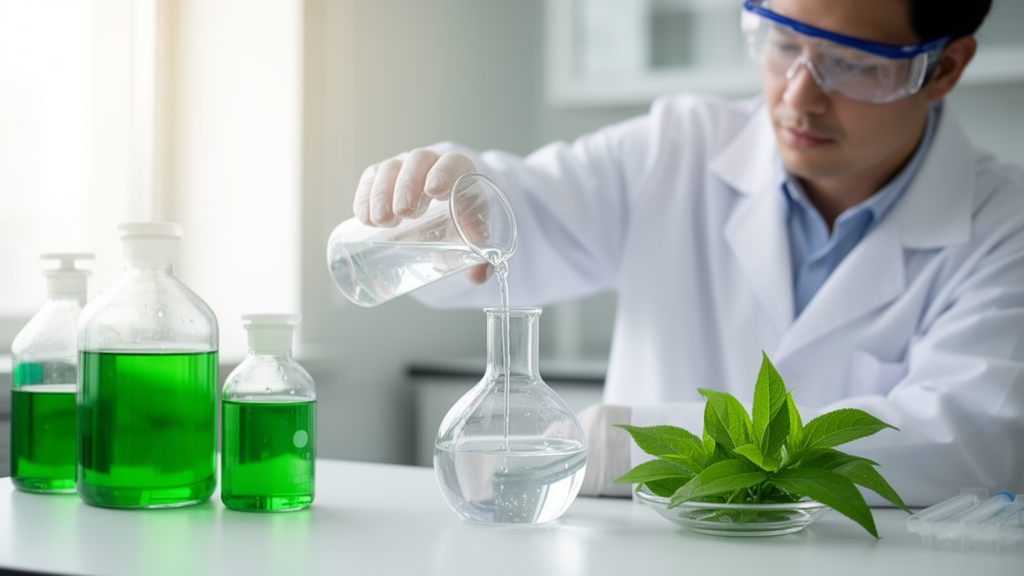
Solvents are the quiet workhorses of pharmaceutical and chemical manufacturing, and they are also its largest waste stream. A new review published in the Future Journal of Pharmaceutical Sciences argues that many of the organic solvents at the heart of industrial synthesis are toxic, volatile and environmentally persistent, and that proven greener substitutes already exist for many of the reactions that depend on them. The authors, led by Sumbul Fatma Khan, compile case studies in which hazardous solvents such as pyridine, toluene, tetrahydrofuran, nitromethane, dimethylformamide, carbon tetrachloride and chloroform were swapped for ionic liquids, bio-derived solvents and safer conventional solvents, often without sacrificing, and sometimes while improving, reaction efficiency.
The scale of the problem is considerable. According to the review, solvents account for roughly 80 to 90 percent of the total mass consumed in a typical chemical reaction and around 80 to 85 percent of the waste produced. Common solvents carry risks including flammability, explosivity, stratospheric ozone depletion and global warming. Regulatory pressure is also mounting: the polar aprotic solvents dimethylformamide (DMF), N-methylpyrrolidone (NMP) and dimethylacetamide (DMA) have been designated substances of very high concern under the European REACH regulation administered by ECHA, creating supply risks for any manufacturer that continues to rely on them. The review frames replacement of these solvents as both an environmental priority and a practical industrial necessity.
Among the alternatives highlighted, ionic liquids receive particular attention. These salts, composed of bulky organic cations and weakly coordinating anions, cannot pack efficiently into a crystal lattice, so they melt at or below room temperature and remain liquid under ambient conditions. Because they are essentially non-volatile, with negligible vapor pressure, they do not evaporate into the air, and because they do not evaporate during distillation, products can be separated by distilling off the product while the ionic liquid remains behind for reuse. Their dual character, containing both polar ionic regions and non-polar organic regions, allows them to dissolve a wide range of organic, inorganic and organometallic compounds. The review also notes their limits: synthesis is often expensive, and the choice of anion strongly influences stability, viscosity, solubility and overall performance, with some anions costly or environmentally unfriendly to produce.
Pyridine illustrates the substitution pattern in detail. Widely used as a solvent, reagent and catalyst in reactions such as Knoevenagel condensations, eliminations and esterifications, pyridine causes nose and throat irritation, dizziness and headache on inhalation, and long-term exposure is associated with tiredness, mood changes, weakness and sleeplessness. In acetylation of alcohols, the review reports that pyridine gave an 89 percent yield in 20 hours, while a nicotine-derived ionic liquid delivered 86 percent in just 10 hours, and an amino-functionalized imidazolium ionic liquid, [Boc-NH-EMIM]OAc, completed the reaction within 5 minutes with a 98 percent yield. In the Huisgen cycloaddition of dimethyl acetylenedicarboxylate with dipolarophiles, a nicotine-based task-specific ionic liquid increased product yields in shorter times, an effect the authors attribute to electrostatic stabilization of a reactive zwitterionic intermediate by the ionic environment, something free pyridine, lacking a counter-anion, cannot provide.
The same nicotine-based chemistry extends to reductive amination and the Morita–Baylis–Hillman reaction. Pyridine-borane, a reagent that selectively converts imine groups to amines, is highly heat-sensitive and can explode, because the weak bond between neutral pyridine and boron shifts toward free BH3 at elevated temperature, generating flammable diborane and hydrogen in the headspace. A nicotine-borane ionic liquid, in which positively charged nicotine binds negatively charged BH3 more strongly, was reported to be thermally robust, free of toxic substances, and more efficient than other reagents in one-pot reductive amination, with better yields in every case tested. In the Morita–Baylis–Hillman reaction, a nicotine-based ionic liquid outperformed DABCO despite DABCO’s more nucleophilic nitrogen, again because the ionic surroundings stabilize the charged intermediate that controls the reaction pathway, and the catalyst could be recovered and reused repeatedly with no loss of activity.
For toluene, a narcotic and neurotoxic solvent linked to memory loss, confusion, loss of appetite and hearing loss on inhalation, the review points to bio-derived and redesigned alternatives. Limonene and p-cymene, obtained from abundant citrus residues, serve as low-polarity substitutes in Fischer esterification, where their hydrophobicity and structural resemblance to toluene allow azeotropic removal of water while avoiding toluene’s hazards. A more engineered option is 2,2,5,5-tetramethyloxolane (TMO), an ether lacking alpha-protons, which eliminates the possibility of dangerous peroxide formation and prevents unwanted chain-transfer reactions during radical polymerization. TMO enabled the production of high molecular weight polymers above 500,000 grams per mole, important for pressure-sensitive adhesives, and was successfully used by Byrne and colleagues in radical-initiated polymerizations of butyl acrylate and acrylic acid in place of toluene.
Tetrahydrofuran, which causes central nervous system toxicity including headache, nausea, fatigue and loss of smell, is another target. In the Suzuki–Miyaura coupling of amides, Peng Lei and colleagues screened 14 solvent systems and 10 palladium N-heterocyclic carbene catalysts and selected isopropyl acetate as the ideal THF replacement, citing its comparable solvent properties, compatibility with palladium catalysts and greener profile. For the acid-catalyzed conversion of C6 sugars such as glucose, maltose and beta-cyclodextrin into levulinic acid, Xun Hu and colleagues found that plain water outperformed THF, dissolving sugars into a homogeneous mixture and, with its high dielectric constant of 78 at 25 degrees Celsius, stabilizing charged intermediates while cushioning the reactive intermediate 5-hydroxymethylfurfural to prevent humin polymerization. For Grignard reactions, which normally require THF, base-stable 2-arylated and 2-alkylated imidazolium salts and phosphonium ionic liquids bearing alkyl ether side arms have been developed, since conventional imidazolium salts lose their C2 hydrogen to form carbenes that destroy the Grignard reagent.
Dimethylformamide, linked to hepatotoxicity, liver fibrosis, cirrhosis and cancer, appears in several substitution studies. In amide coupling reactions using the COMU coupling reagent, Allan J. B. Watson’s team found ethyl acetate, dimethyl carbonate and 2-methyltetrahydrofuran gave reactivity comparable to DMF, with the added advantages of lower boiling points for easier separation and chemical inertness that reduces side reactions. Cyclic carbonates, ethylene carbonate and propylene carbonate, promoted high productivity in the Heck reaction, their biodegradability, low vapor pressure and low toxicity making them safer, and their combustion produces no NOx or SOx pollution. In the Sonogashira reaction, where 41 percent of reported reactions use DMF, the bio-based solvent Cyrene delivered yields of 81 to 100 percent, reaching 100 percent with 0.5 M triethylamine at 20 degrees Celsius for 5 hours. For solid-phase peptide synthesis, N-butylpyrrolidone emerged from a screen of 34 alternatives as the only suitable DMF replacement for large-scale production of octreotide and other peptides, and gamma-valerolactone, derived from lignocellulosic biomass with a dielectric constant near 36 matching DMF’s 36.7, gave good to excellent yields of 74 to 94 percent in the Hiyama coupling.
Carbon tetrachloride and chloroform round out the list. CCl4, a hepatotoxic, nephrotoxic and neurotoxic solvent, was replaced in free-radical bromination by ethyl acetate-water systems achieving roughly 99 percent conversion of toluene, xylenes and substituted toluenes, by methyl acetate in benzylic bromination of halogenated arenes, by a biphasic diethyl ether and aqueous sodium hydroxide system in the Hunsdiecker reaction with yields of 63 to 95 percent, and by cyclohexane in RuO4-catalyzed oxidative cleavage, where yields of 58 to 97 percent matched or exceeded the 58 to 90 percent obtained in CCl4. Chloroform, discontinued as an anesthetic and associated with liver necrosis and carcinogenicity, was replaced by dimethoxyethane in the Schmidt reaction and by biomass-derived dimethyl ether, whose low boiling point of 24 degrees Celsius allows easy recovery. Nitromethane, neurotoxic and explosive, was replaced by nitro-functionalized imidazolium salts that raised silylation yields from 94 to 99 percent and ring-opening reaction yields from 63 to 95 percent.
The review’s authors caution that a green label alone is not enough. Metrics such as the E-factor, the mass of waste per unit mass of product, and process mass intensity, the total mass of materials per unit mass of product, are process-dependent rather than intrinsic solvent properties, and lower toxicity or volatility does not necessarily mean a lower overall environmental burden once manufacture, purification, transport, recovery and disposal are counted. Many green solvent systems have been demonstrated only at laboratory scale, and industrial adoption requires attention to mixing, heat transfer, corrosion, solvent recovery and cost. The authors argue that future solvent selection should combine hazard assessment with process-level metrics, life-cycle assessment and techno-economic analysis, moving beyond simple one-to-one substitution toward whole-process design in which chemical performance, safety, recyclability and economics are judged together.
Subject of Research: Green solvent alternatives to hazardous organic solvents in pharmaceutical and chemical synthesis
Article Title: Toward a sustainable future: green replacements for hazardous solvents in chemistry
Article References: Khan, S. F., Sargar, S., Rathod, P., Agala, V. S. B., & Hiradeve, S. (2026). Toward a sustainable future: green replacements for hazardous solvents in chemistry. Future Journal of Pharmaceutical Sciences, 12(1), Article 97. https://doi.org/10.1186/s43094-026-01027-1
Image Credits: AI Generated
DOI: 10.1186/s43094-026-01027-1
Keywords: green chemistry, ionic liquids, organic solvents, pharmaceutical manufacturing, sustainable chemistry, dimethylformamide, pyridine, tetrahydrofuran, carbon tetrachloride, bio-derived solvents, process mass intensity, solvent replacement
News Source: Bethany Barker. (October 27, 2026). Green Solvents Offer Safer Replacements for Chemistry’s Most Hazardous Liquids. Scienmag.