When a terrorist attack unfolds, the first people on the scene are rarely paramedics or emergency physicians. They are bystanders, and in the vocabulary of modern trauma care, those bystanders are increasingly being redefined as “immediate responders” capable of performing life-saving interventions before professional help arrives. A new study from Francisco de Vitoria University in Spain reports that an advanced clinical simulation exercise, built around a simulated terrorist attack, significantly improved how prepared fifth-year medical students felt to act in a mass casualty incident, and sharply increased the proportion who knew the correct first action to take.
The study, published in the journal Advances in Simulation, set out to describe an educational activity focused on medical care in mass casualty incidents, delivered through an advanced clinical simulation scenario. The work was grounded in the Hartford Consensus, a set of recommended actions for intentional mass casualty events and active shooter scenarios. Those recommendations are summarized in the acronym THREAT: Threat suppression, Hemorrhage control, Rapid Extrication to safety, Assessment by medical providers, and Transport to definitive care. One of the central goals of the consensus is to train civilians to provide emergency assistance, because bystanders present at the scene can often perform initial hemorrhage control. The authors argue that these immediate responders should not be seen as passive observers but as people capable of frontline interventions that eliminate preventable prehospital death from external bleeding.
Despite that emphasis, the teaching of this kind of emergency care in medical schools is often limited to emergency medicine curricula, which are not universally implemented. The researchers note that several publications support the use of clinical simulation in this type of incident training, including within nursing practice. At Francisco de Vitoria University, the clinical simulation curriculum spans all academic years, and in the fifth year of the medical degree a subject incorporates emergency medicine content, using simulation as an instructional tool to meet specific course objectives. Among those objectives was for students to become familiar with the Hartford Consensus and the THREAT protocol.
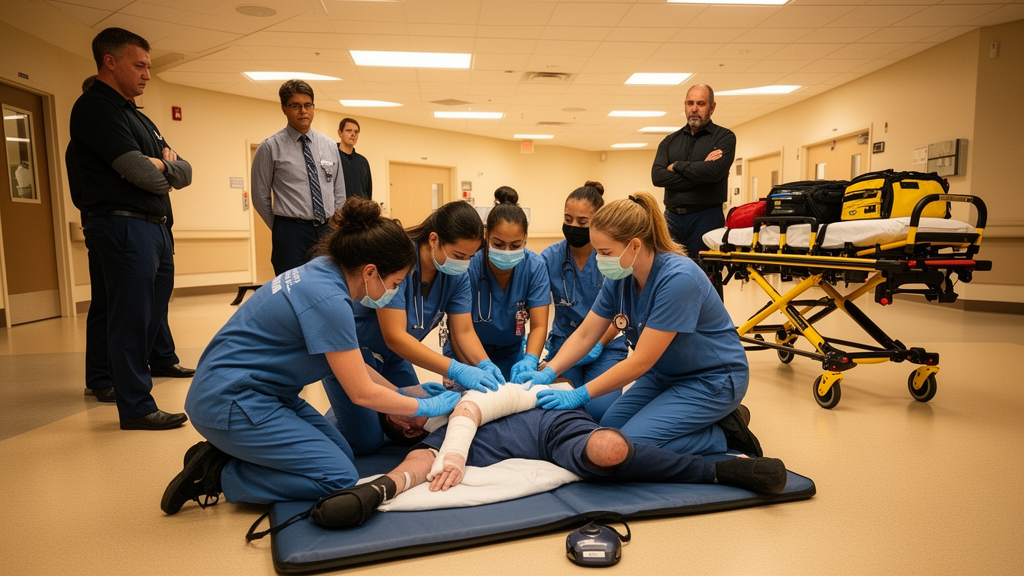
The simulation itself was deliberately immersive. Students gathered in an enclosed area with no possibility of escape. In the first part of the exercise, instructors explained the basic principles of action during a terrorist attack. The scenario then unfolded: a simulated terrorist group entered the building and began attacking the students, whose objective was to follow the established procedure. Minutes later, instructors dressed as terrorists fired simulated weapons, using foam projectiles, at students acting as victims. The students had to choose to escape, hide, or fight, in that order, as recommended by the protocol, and additionally had to assist the injured. When the simulation team determined that someone had been shot, they handed that person a paper detailing the injury; anyone attempting to help had to read the paper and proceed with immediate care. The wounded were then transported to a meeting point, where a descriptive debriefing took place as a third phase of the session, followed by a final group meeting.
Learning outcomes were assessed with a questionnaire containing technical questions on specific care concepts, as well as subjective questions about perceived preparedness for such incidents. The questionnaire was administered at the beginning and end of the activity and completed online via Google Forms by 112 fifth-year medical students. The authors are transparent about an important limitation: the questionnaire is not validated. It was developed by the course teaching team. Statistical analysis used the Chi-square test to compare the frequencies of each response category before and after the activity.
The response numbers themselves reveal an asymmetry worth noting. A total of 71 questionnaires were completed before the activity and 41 afterward, so the pre- and post-activity comparison rests on different subsets of respondents. Even so, the headline shifts were large and statistically significant. Before the workshop, most participants reported not feeling prepared, with 66.2 percent answering that they did not feel prepared to know how to act in a multi-victim incident, and only 1.4 percent considering themselves prepared. After the intervention, the distribution changed substantially: the proportion who felt prepared rose to 26.8 percent, those who reported feeling only a little prepared rose to 63.4 percent, and negative responses fell to 4.9 percent. These differences were statistically significant at p < 0.001.
Knowledge items moved in parallel. Correct responses to the question of the first thing to do in an attack increased from 19.4 percent to 92.7 percent, a difference the authors report as statistically significant. Understanding of the concept of improvised means rose from 85.9 percent to 100 percent, reaching significance at p = 0.042. Not every item showed the same pattern, however. No statistically significant differences were observed for more technical questions, such as those covering hemorrhage control or cardiac arrest. Question 7, for example, showed an increase in correct responses after the workshop, including greater recognition of appropriate management strategies such as wound packing, but the improvement was not statistically significant at p = 0.125. Question 8 revealed a ceiling effect: nearly all participants already answered correctly before the workshop, at 97.2 percent, rising slightly to 100 percent afterward, with no significant difference at p = 0.278. Question 9 showed no significant change at p = 0.683, and Question 10, despite a notable rise in correct responses from 74.6 percent to 95.1 percent, approached but did not reach statistical significance at p = 0.058.
The authors interpret the overall pattern as evidence that the workshop had a positive effect on participants’ knowledge, particularly in the more practical and operational aspects of responding to attacks and mass casualty incidents. The most consistent improvements appeared in self-perceived preparedness, the initial response to an attack, the concept of improvised means, and the management of certain traumatic injuries. They also acknowledge that some items showed a high baseline level of knowledge or limited room for improvement, which they attribute either to the participants’ initial level or to the wording of certain questions. In general terms, they conclude that the results support the usefulness of the training intervention and suggest that its content helps strengthen key competencies in the health response to critical situations.
Broader context matters here. The authors argue that the threat of intentional mass casualty incidents remains high due to ongoing terrorist activity affecting the majority of countries, and that the ability to manage such events has been identified as a priority for healthcare services, with recent events revealing opportunities for improvement in the response to these incidents. Because such events are fortunately rare, they write, training must necessarily occur in simulated environments, making repeated practice desirable. Replicating the conditions of real-life situations allows students to appreciate the inherent challenges of providing care in such contexts. Teaching through simulated environments, they contend, yields undeniable learning benefits, although integrating these objectives into the curricula of different medical faculties is still ongoing, hampered by the high cost of simulation equipment and the need for a large number of personnel trained specifically in this methodology. In emergency and critical care training, simulation has long been a valuable tool for reinforcing and acquiring knowledge, and while the literature includes examples of mass casualty training using virtual reality, the authors note that the effectiveness of these and other tools remains to be fully demonstrated.
The study’s conclusion is direct: using a simulated environment at the undergraduate level to train students as first responders in mass casualty incidents is an effective educational strategy. The evidence behind that claim comes from a single institution, a single cohort of fifth-year medical students, an unvalidated questionnaire, and unequal pre- and post-activity response counts, with several knowledge items showing no statistically significant change. What the data do robustly support is a large, significant shift in perceived preparedness and in the correct first action during an attack, alongside descriptive improvements elsewhere. For educators weighing whether mass casualty response belongs in undergraduate medical training, the study offers a cost-effective template, and a reminder that the skills it teaches are aimed at the minutes when the nearest trained responder is a student in the room.
Subject of Research: Simulation-based training of medical students in mass casualty incident response using the Hartford Consensus THREAT protocol
Article Title: Teaching medical care in mass casualty incidents through advanced clinical simulation
Article References: Rodríguez, A. M., Barba, E. C., Bastante, E. M., Villegas, T. V., Neria Serrano, F., & Arranz, S. D. (2026). Teaching medical care in mass casualty incidents through advanced clinical simulation. Advances in Simulation, 11(1), Article 80. https://doi.org/10.1186/s41077-026-00459-2
Image Credits: AI Generated
DOI: 10.1186/s41077-026-00459-2
Keywords: mass casualty incidents, clinical simulation, Hartford Consensus, THREAT protocol, medical education, hemorrhage control, immediate responders, emergency medicine, undergraduate training, preparedness, debriefing, terrorist attack response
News Source: Courtney Benton. (October 27, 2026). Simulated Terror Attack Training Boosts Medical Students’ Emergency Preparedness. Scienmag.