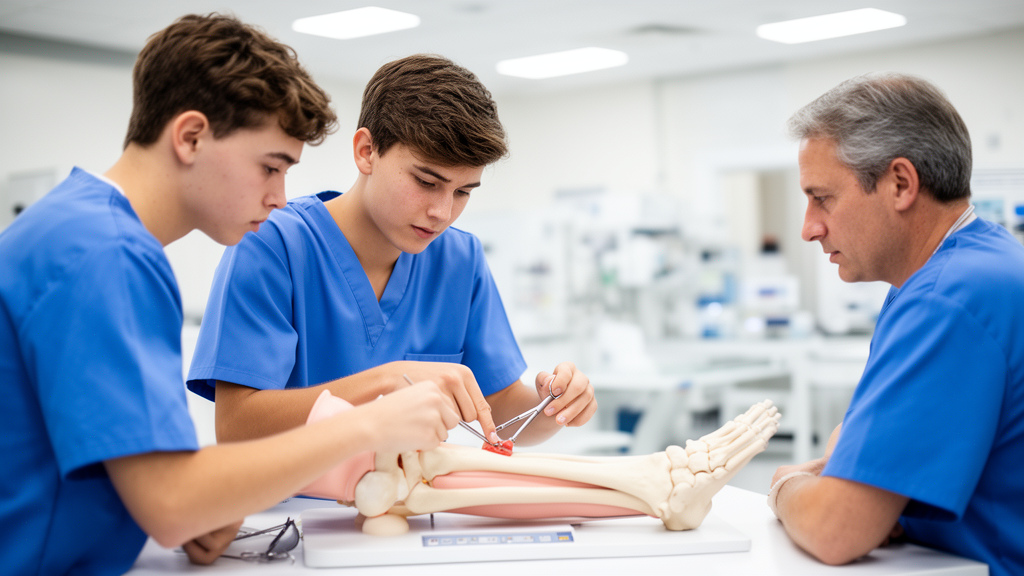
Medical students rotating through orthopedics often face a stubborn gap between what they learn in lectures and what they can actually do at the bedside. A randomized study published in BMC Medical Education reports that combining problem-based learning with hands-on skeletal simulation-based surgical training narrowed that gap for orthopedic interns, producing significantly higher teaching evaluation and comprehensive assessment scores than problem-based learning alone. Before the intervention began, the researchers compared baseline characteristics including age, gender, and grade point average between the two groups and found no statistically significant differences, establishing that the cohorts were balanced and comparable at the outset.
The aim was to recreate the operational context of orthopedic practice that traditional classroom-based problem-based learning cannot easily provide. The combined group scored significantly higher on both the teaching evaluation score and the comprehensive teaching assessment score. The statistical differences were substantial.
For the teaching evaluation score, the comparison yielded t = 3.3162 and P = 0.0020, while the comprehensive teaching assessment score yielded t = 4.0990 and P = 0.0002. In both cases the combined teaching group outperformed the problem-based learning group, and the authors report the differences as statistically significant. According to the study team, the hybrid model effectively compensates for the practical deficiencies of traditional problem-based learning, improving interns' learning satisfaction, theoretical knowledge mastery, clinical thinking, and practical operation abilities.
They describe the approach as an efficient and feasible teaching mode worthy of popularization in orthopedic internship teaching. Orthopedics, described by the authors as a highly practical clinical discipline, is particularly dependent on spatial understanding of the skeleton and on manual skills that lectures alone struggle to convey. Several caveats deserve attention.
The evaluation instruments were self-designed by the study team rather than externally validated tools, and the trial was retrospectively registered on August 7, 2026, in the China National Medical Research Registration and Filing System under filing number MR3226054559 and in the Chinese Clinical Trial Registry under number ChiCTR2600129632. The published version is also an early-access article that remains subject to further editorial edits before the final Version of Record appears. Even so, the trial offers a concrete template for programs weighing how to modernize clinical rotations: keep the case-driven reasoning of problem-based learning, but anchor it in simulated anatomy demonstration areas, operating stations, and image reading exercises.
For orthopedic educators, the results suggest that the combination, not the replacement, of theory-focused and simulation-focused methods may be the most practical route to closing the classroom-to-clinic divide.
Subject of Research: Effect of problem-based learning combined with skeletal simulation-based surgical training on orthopedic interns' clinical competencies
Article Title: Application effect of PBL combined with skeletal simulation-based surgical training teaching mode in orthopedic teaching
Article References: Yin, Z., Zhang, H., Hu, Q., Wang, C., Ma, Q., & Yin, J. (2026). Application effect of PBL combined with skeletal simulation-based surgical training teaching mode in orthopedic teaching. BMC Medical Education. https://doi.org/10.1186/s12909-026-10404-6
Image Credits: AI Generated
DOI: 10.1186/s12909-026-10404-6
Keywords: orthopedics, medical education, problem-based learning, surgical simulation, clinical rotation, randomized trial, teaching evaluation, intern training, BMC Medical Education, simulation-based training, Application, effect
News Source: Ophelia Keating. (October 27, 2026). Simulation-Based Surgery Training Boosts Orthopedic Learning in Randomized Teaching Trial. Scienmag.